
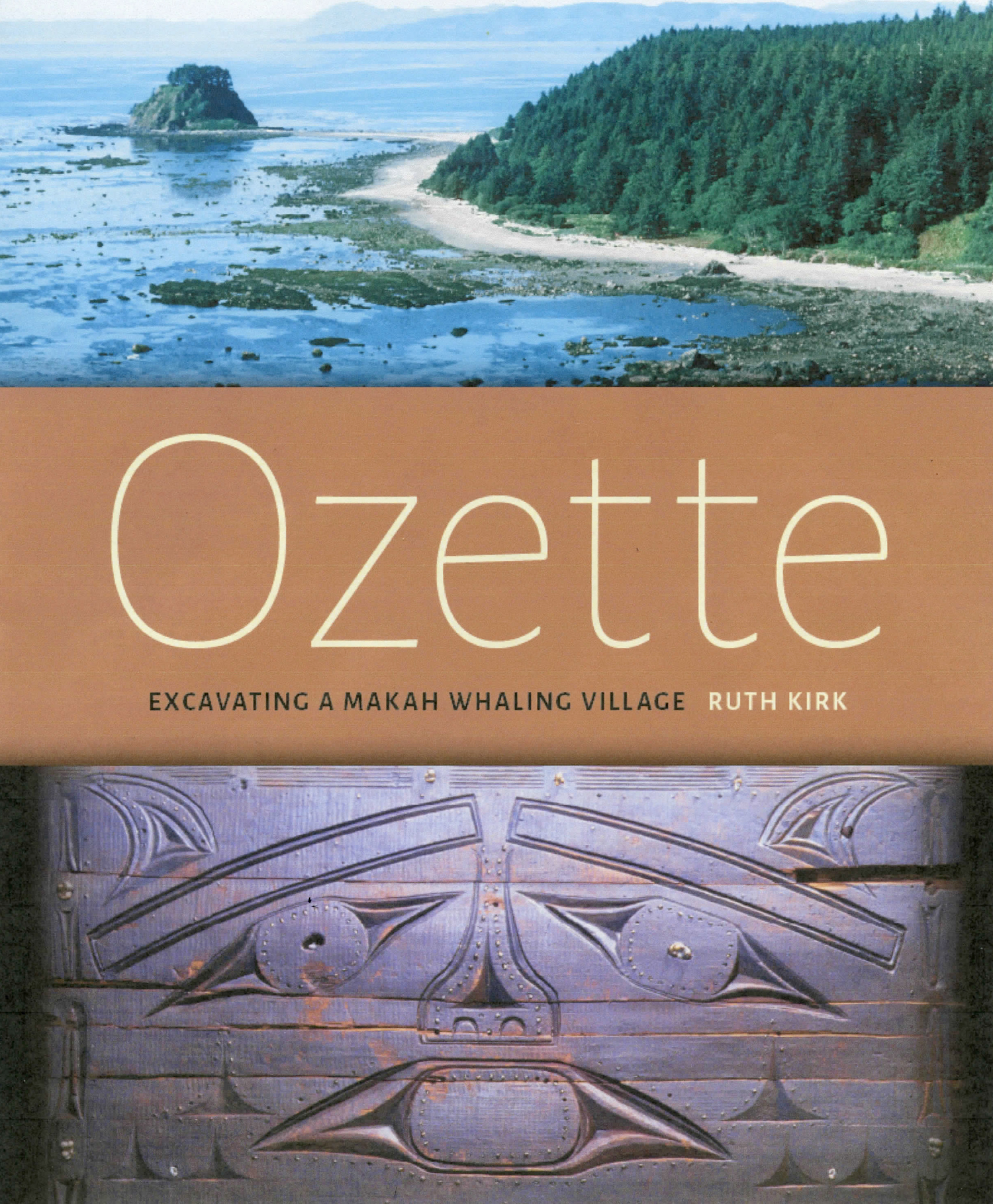
NEAH BAY — The Ozette story borders on hyperbole, writes Ruth Kirk, a woman who saw it all unfold.
Kirk is the teller of this true tale: How a Makah village on the coast south of Neah Bay became an unparalleled place of discovery.
In Ozette: Excavating a Makah Whaling Village, Kirk has published the full account, complete with her photographs and interviews with the people of the Makah tribe.
Kirk, 90, will give a reading from Ozette at the Makah Marina on Bayview Avenue at 12:30 p.m. today (Tuesday).
The public is invited to the free event, which will be a casual one with refreshments.
Copies of the 102-page softcover will be on hand for purchase and signing; they’re also available at the Makah Museum, 1880 Bayview Ave., and at other North Olympic Peninsula bookstores and through the University of Washington Press.
“This is the book we’ve all been waiting for,” said Meredith Parker, general manager of the Makah tribe and contributor of the book’s foreword.
“There is no one better suited or better trusted by the tribe,” she said of Kirk.
The writer was no detached observer as, throughout the 1970s, archeologist Richard Daugherty led the excavation of the centuries-old village.
The archeological dig eventually yielded more than 55,000 objects, culminating in the creation of Neah Bay’s Makah Cultural and Research Center.
“She came into our village and formed friendships with the older women of our tribe,” said Parker, also a writer and photographer.
“I would see her, the way she walked on the Earth, among nature and among people, and that was very inspiring to me. Her images reflect that.”
“It is rare indeed for an archeologist to be able to talk with the direct descendents of the people who made and used the material he/she is investigating within the ground,” Kirk wrote in an email to the Peninsula Daily News.
“But with Ozette, much of Makah culture remains intact.
“During the 1970s when the main excavation was underway, there even were elders in Neah Bay who remembered living at Ozette as children.
“They willingly shared memories and knowledge; they could describe how various objects were made and used [and] why certain raw materials were preferred over others,” Kirk added.
“Ozette is just a great story — and with the splendid museum in Neah Bay, it’s a story available for all.”
Ozette was the most southern of five Makah villages that existed before contact with non-Native Americans in 1790. Neah Bay is the only one left now.
Radiocarbon dates demonstrated that a mudslide some 500 years ago had buried six longhouses and their contents, locking the pre-contact wooden and wood-based artifacts in a shroud of earth.
Some of these were uncovered during a series of storms in the 1970s. The site has been termed “the American Pompeii.”
Makahs had abandoned Ozette, a whaling village that had been occupied since about 400 BC, in 1917 to send their children to school as ordered by the government.
Makah elders told Kirk stories about Ozette. Their pictures are in her new book, as are their words.
“My grandma lived at Ozette . . . and one time she said they were short of men to go whaling,” Isabell Ides said in a 1978 interview.
“Well, they asked Grandma to go along, so she went. And they did catch a whale at that time. My, she said, she was so afraid when the whale came up beside them.”
Elder Ada Markishtum likewise remembered her girlhood: “Everybody was all the time going places in canoes then. They were big . . . They could carry three families at once.
“We used to go to Victoria after the last of the halibut was dried — six or seven canoes of us,” traveling across the sea for eight hours.
Ozette comes after many other books Kirk has authored, including From Sunrise to Paradise: The Story of Mount Rainier National Park and Exploring Washington’s Past: A Road Guide to History.
She grew up in Southern California, “on a grassy hilltop,” she recalled, “where there were still oak trees to climb, wildflowers to pick, horned toads to play with.
“In other words, a fairly intact natural environment to puzzle over and rejoice in.”
With her books, Kirk hopes to give people deeper insight into nature and the way humans coexisted with it generations ago.
“For this, Ozette proved extraordinary,” Kirk said.
She and Daugherty were friends for 40 years; in 2007, they married in Neah Bay. Kirk was working on Ozette when he died at age 91 in February of last year. She has dedicated the book to him.
________
Features Editor Diane Urbani de la Paz can be reached at 360-452-2345, ext. 5062, or at diane.urbani@peninsuladailynews.com.
