
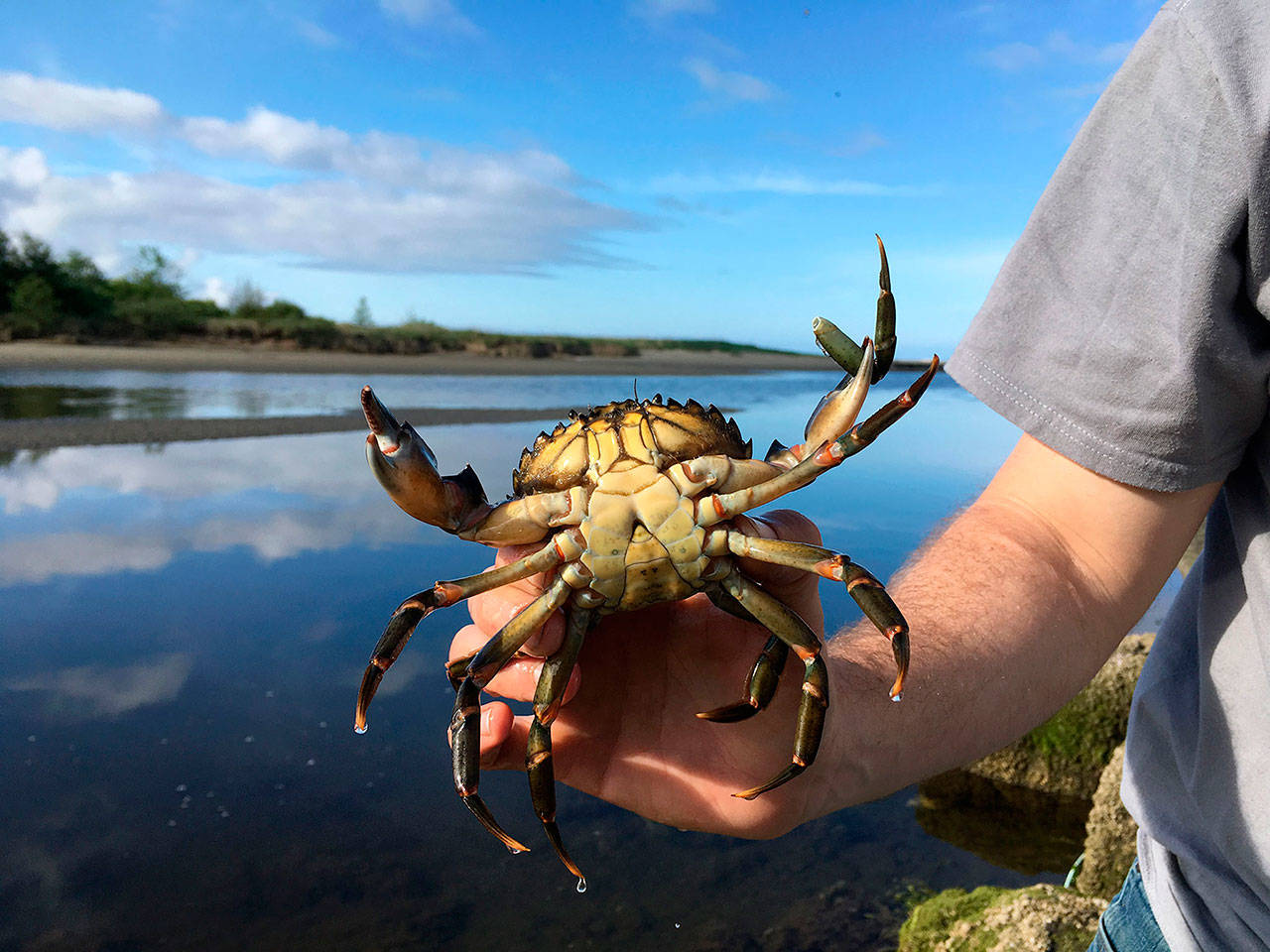
NEAH BAY — As resource managers continue to catch European green crab in the Sequim area, the invasive species seems to have its pinchers clamped down tight in Neah Bay.
Adrianne Akmajian, marine ecologist with Makah Fisheries Management in Neah Bay, reported that she, fellow staffers and volunteers have caught 392 green crab as of Tuesday.
In less than two months of trapping, Akmajian said they’ve set out up to 100 traps a week in the Wa’atch River, Tsoo-Yess River and nearshore of Neah Bay with the two river spots recording the most catches in their lower areas and none in the nearshore.
The numbers are significantly higher than the Sequim area’s with resource managers catching 96 green crabs on the Dungeness Spit and one in Sequim Bay through October last year.
Lorenz Sollmann, deputy project leader at the state Maritime National Wildlife Refuge, said 42 green crab have been trapped this season in Dungeness as of Tuesday.
Allen Pleus, Aquatic Invasive Species coordinator for the state Department of Fish and Wildlife, reported three of the crabs were larger than 80 millimeters, which “is fairly large for this species.”
Akmajian said the Neah Bay crab range from 17½ millimeters to 84 millimeters and could pose a threat to native species.
“They have habitat overlapping with some juvenile Dungeness crab,” she said.
“It has potential to predate on clams, but we’re not for sure if they are.”
In Neah Bay, Akmajian said “there’s preferred habitat here with soft muddy areas like estuaries of a mixture of fresh and saltwater.”
“They also like steep banks that they can bury into,” she said.
Call to catch
Intense trapping efforts began after someone correctly identified and notified Washington Sea Grant about seeing a European green crab in Neah Bay, Akmajian said.
A Sea Grant representative contacted her, leading teams to place 80 traps last October and catch 34 green crabs. From there, the Makah Tribe and Sea Grant worked with them using aerial photos of local waterways to spot the best places to trap, Akmajian said.
Pleus said his department loaned traps to the tribe, coordinated management strategies and support their efforts for securing grants.
Akmajian said the tribe recently purchased traps from grants through the North Pacific Coast Marine Resources Committee.
Trapping will continue every two weeks through the end of September, she said.
Akmajian sent out a call for volunteers two weeks ago, and depending on their numbers, Akmajian said she’s either sent out two teams of four or teams of three to set up traps.
“It got to the point where it was unmanageable because we were catching so many in one day,” she said.
Paid staff have been helping with the effort, but it’s added to their workload, which may include studying marine mammals, and/or managing the tribe’s hatchery and ocean fisheries, Akmajian said.
To volunteer with the Makah Tribe’s green crabbing effort, email marine.ecologist@makah.com.
More crabs
In the Sequim area, green crabs were first reported in April 2017 on the Dungeness Spit’s Graveyard Spit.
Resource managers performed monthly early detection monitoring since 2001 in Dungeness as one of 50-plus early detection sites for green crabs, Pleus previously said, and Sea Grant staff members’ advice to move traps to a new location led to the discovery of green crabs there.
Scientists worldwide attribute the European green crab, identifiable by its five spines on each side of its eyes, as one of the worst invasive species on Earth. Industry leaders in shellfish harvests and seagrass beds blame the crab for damaging their markets in the northeast, too.
Lorenz Sollmann, deputy project leader at the state Maritime National Wildlife Refuge, said volunteers and staff began trapping on the Spit in April with 45 traps.
Green crabs from last year were tested from Dungeness and revealed the crabs likely came from a coastal population in Canada, Washington, Oregon or even California.
Emily Grason, Crab Team project coordinator through Washington Sea Grant, reported that one female green crab can release up to 500,000 larvae at a time at least once a year.
If you spot a European green crab, you can snap a picture and send it to the Washington Sea Grant Crab Team at crabteam@uw.edu or bring a photo into the office of the Wildlife Refuge. Resource managers ask the crabs be left alone.
For more resources on the green crab, visit https://wsg.washington.edu/crabteam.
________
Matthew Nash is a reporter with the Olympic Peninsula News Group, which is composed of Sound Publishing newspapers Peninsula Daily News, Sequim Gazette and Forks Forum. Reach him at mnash@sequimgazette.com.
