
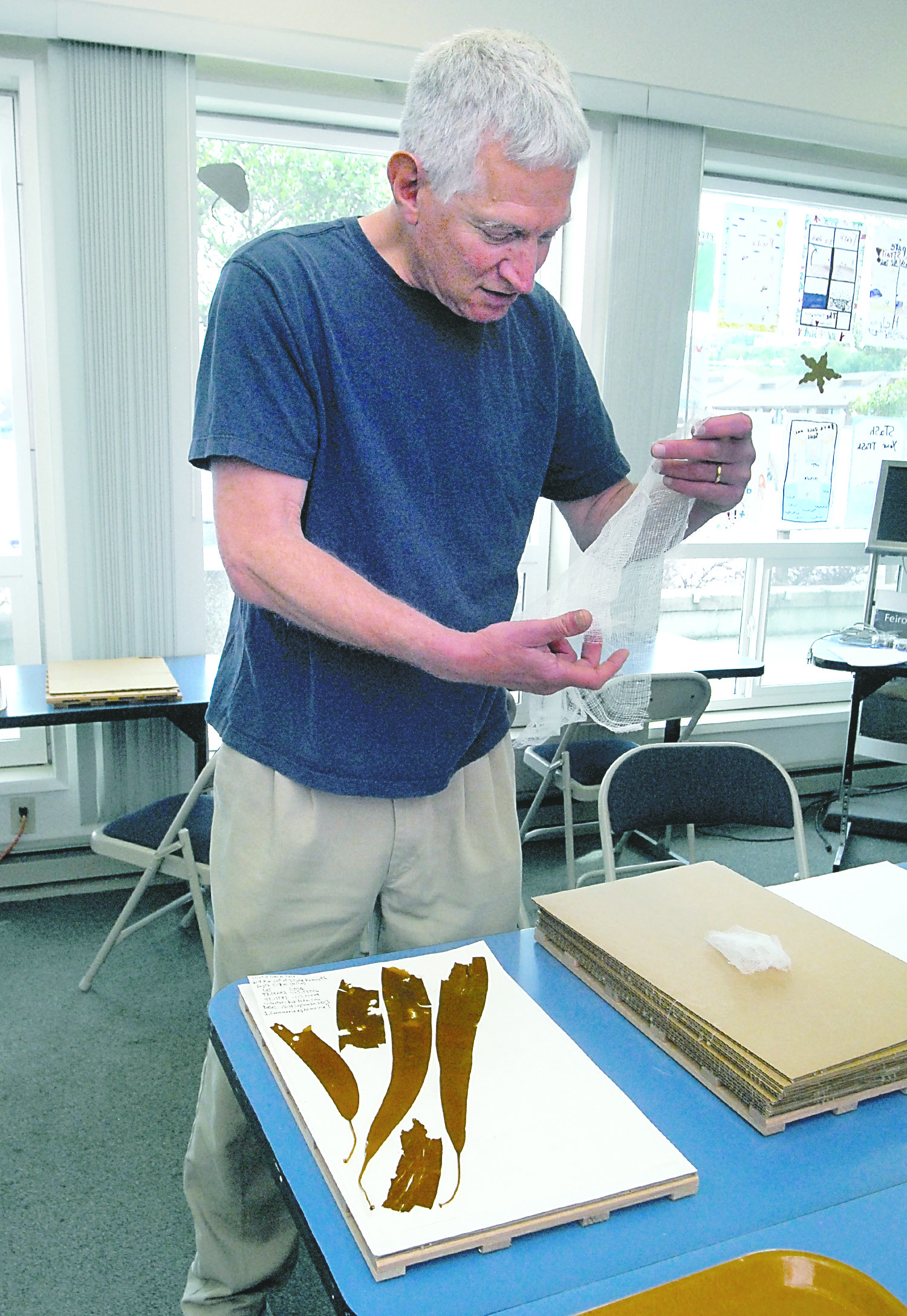
PORT ANGELES — An uncommon species of kelp was found last week off the Elwha River mouth — possibly a species that has not been seen there before.
A team of scientists found the kelp, thought to be Laminaria ephemera or Laminaria yezoensis, during a survey of the Strait of Juan de Fuca near the Elwha River mouth and brought it to the Feiro Marine Life Center on City Pier for temporary safekeeping.
“There is something strange going here, something different,” said Steve Rubin, a fishery biologist for the U.S. Geological Survey.
The multi-agency team has been studying the Elwha offshore sea floor between July and September since 2008 to document the changes in ecology as the removal of dams on the river results in millions of cubic yards of sediment being deposited in the Strait.
In July, there was little seaweed to be found, even in places that once were lush.
In August, a large number of young kelp began emerging from the kelp beds, Rubin said.
Rubin asked the team to collect samples during the September survey and found the new mature kelp was not what they were expecting.
When Rob Peterson, a researcher with the federal Environmental Protection Agency, came up with the sample of the mystery kelp, the find puzzled the scientists, Rubin said.
Photos of the plants were sent to Tom Mumford, a retired state Department of Natural Resources kelp specialist in Olympia.
Based on the photos, the kelp could be one of two seaweed species, one more likely than the other, Mumford told the research team.
Laminaria ephemera, an unusual but known species native to the Strait, was the far more likely identification, he said, but there is also a possibility that the mystery kelp is Laminaria yezoensis, a species that exclusively lives north of Vancouver Island — even less likely a find for the area.
Mumford asked for actual samples of the kelp, in particular the stem, which could reveal the species when examined under a microscope.
That brought the mystery to the Feiro center and the education center’s natural seawater tanks.
The marine center works with the science survey team and offered to place the samples in the Feiro tanks to keep the kelp alive and healthy until it could be prepared for shipment, said Bob Campbell, Feiro facility coordinator.
On Wednesday, Rubin retrieved the plants from the Feiro tank, pressed whole plants for preservation, then clipped samples and shipped them to Mumford.
Mumford said he expects to have an answer Monday to which species the samples belong.
Laminaria ephemera was first identified in California in the late 1890s. It was first recorded in 1905 in a Vancouver Island bay.
According to the Journal of the California Native Plant Society, “Laminaria ephemera is not only ephemeral, but also elusive, appearing in large numbers at only a few widely separated sites.”
Its known range is limited to areas around Port Renfrew, Vancouver Island, B.C., Neah Bay, Puget Sound and Carmel Bay, Calif.
If it proves to be ephemera, the kelp is growing in the wrong season and in a place where it has not been documented in the past, Rubin said.
He said it is possible the newly found kelp normally has a very early spring growth cycle and is gone by the survey’s first July visits — and therefore not seen before by the survey group.
Sediment has been released during the teardown of the Elwha River and Glines Canyon dams begun in September 2011 as part of the $325 million Elwha River restoration project, and the mouth of the Elwha River has undergone changes.
Elwha Dam was removed in March 2012, restoring some sediment flow, and Glines Canyon Dam has been reduced to 60 feet and has released much of the stored sediment.
Much of that sediment already has moved downstream, beginning the restoration of miles of fish habitat in the river itself but also clouding the water and covering some sea life that had moved to the mouth after the fine sediments ceased flowing from the river 100 years ago, leaving behind a rocky and unnatural river mouth landscape.
The silt carried to the river mouth could have delayed the development of the short-lived seasonal kelp by blocking light, and when the water cleared during the summer, the kelp began its cycle late in the year, Rubin said.
Or it could be entirely new to the area, he said.
Laminaria yezoensis is a perennial kelp found on rock in the extreme low intertidal to subtidal zones in British Columbia, Alaska and the Aleutian Islands.
If the kelp found off the Elwha River mouth is yezoensis, then Rubin will go back to the drawing board to figure out why it is in the Strait, he said.
________
Reporter Arwyn Rice can be reached at 360-452-2345, ext. 5070, or at arwyn.rice@peninsuladailynews.com.
