
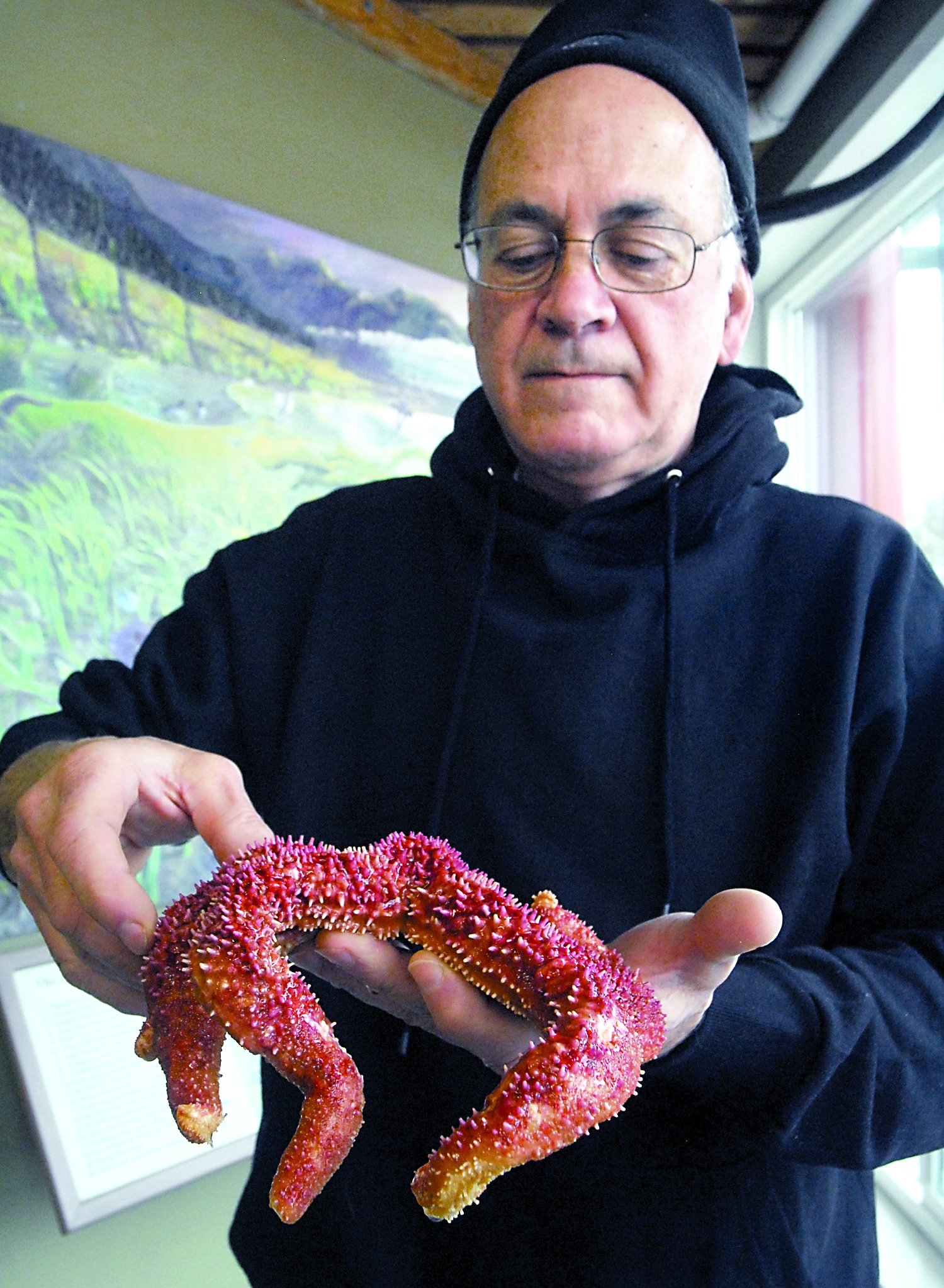
Something mysterious is eating its way through sea stars along the coast of Olympic National Park.
It so far has proved invisible to scientists and researchers who are studying the cause.
The effects of the affliction are all too clear.
Pale white lesions first appear on the bodies and arms of the normally brightly colored sea stars, marring the royal purple or brick red skin of the creatures.
Then it gets worse.
“Many of the sea stars were actually shedding limbs,” said Steve Fradkin, a coastal ecologist with the park.
“The arms on them were falling off,” he said.
“It really looked like kind of like a horror show.”
Fradkin said he and his research team first began seeing stars afflicted with this disease, dubbed sea star wasting syndrome, in June in the relatively shallow intertidal reaches of an area called Starfish Point, not far from the Kalaloch region of the park.
“This was the first observance of this wasting disease along the entire West Coast,” Fradkin said.
Since then, researchers have documented confirmed cases of the disease in sea star communities as far north as Alaska and as far south as islands off the coast of San Diego, according to a map produced by a multi-agency group studying the disease.
Reports have come in from the San Juan Islands and Puget Sound.
Fradkin said scattered reports have also come in from the East Coast, though few have been confirmed.
The affliction has found its way into Port Angeles’ Feiro Marine Life Center.
White lesions were found on a rainbow sea star seen earlier this month. It was placed in quarantine, Fradkin said.
“The symptoms are consistent with the disease we’re seeing on the outer coast,” said Fradkin, who also serves on the marine life center’s board of directors.
Fradkin’s observations have been mostly of ochre sea stars, a five-armed species that comes in purple, orange and red and is most often seen clinging to rocky outcroppings in the shallow coastal waters of the North Olympic Peninsula.
In June at Star Fish Point, Fradkin said the disease was seen in roughly 25 percent of the local ochre star population, though more recent trips to the same area showed the affected portion had reduced to 8 percent.
Fradkin said he could not estimate the mortality rate of the disease, as it’s impossible to check up on individual sea stars because of their normal movement.
“Some of these observations suggest that not all these animals die,” Fradkin said, adding that he had seen many sea stars starting to regrow limbs lost to the disease.
Observations up and down the West Coast show the disease is not limited to one species.
“It’s happening with five or six other sea star [species], including a lot of other sub tidal sea stars,” Fradkin explained, referring to regions that one would need scuba gear to see.
The disease has sparked research projects at universities on both coasts of the U.S., all trying to get a handle on one question: what’s causing it?
“Right now, we don’t know what the actual causal agency is or [what] the mode of transference is,” Fradkin said.
For example, biologists specializing in marine infectious diseases at Cornell University in New York are analyzing samples of afflicted sea stars to pinpoint something common in them that could be the culprit.
“While we don’t know currently whether it’s a bacterium or a virus, we really hope to know what the smoking gun there is, sometime within the next two to three months,” Fradkin said.
A biologist at Western Washington University in Bellingham is collecting sick and healthy sea stars to track mortality, Fradkin said.
“There’s a lot of work going into it right now,” he said.
So little is known at this point, Fradkin said, that researchers can not even be sure the disease has not been seen before in much smaller numbers.
Other things can cause lesions on sea stars, Fradkin explained, though previous instances might not have been reported as wasting syndrome since researchers were not looking for it.
“We may have seen it before [on] one individual that has a lesion, but it’s never sort of blown up into a population phenomenon,” Fradkin said.
“Something of this great effect has not been seen before.”
Liam Antrim, a resource protection specialist with the Olympic Coast National Marine Sanctuary, said sanctuary scientists also are paying attention to research and observation efforts, since ochre and other types of a sea stars play a vital role in the 2,400 square miles of coastal marine ecosystem the sanctuary comprises.
“That will be some work we’re going to be involved in and track through [other researchers] . . . the changes in the [ecological] community that occur when you severely reduce or remove an influential organism like the ochre sea star,” Antrim said.
“It’s certainly a phenomenon that we’ve had a lot of interest in.”
Fradkin described the ochre sea star as a “keystone” predator, meaning its presence has an immense effect on the surrounding ecological community.
Their predation on mussels, for example, acts a check against mussel populations exploding.
“You don’t need a whole lot of [ochre sea stars] to really change a structure of a community,” Fradkin said.
“If we didn’t have those sea stars on our shorelines, our shorelines would look very different.”
________
Reporter Jeremy Schwartz can be reached at 360-452-2345, ext. 5074, or at jschwartz@peninsuladailynews.com.
