
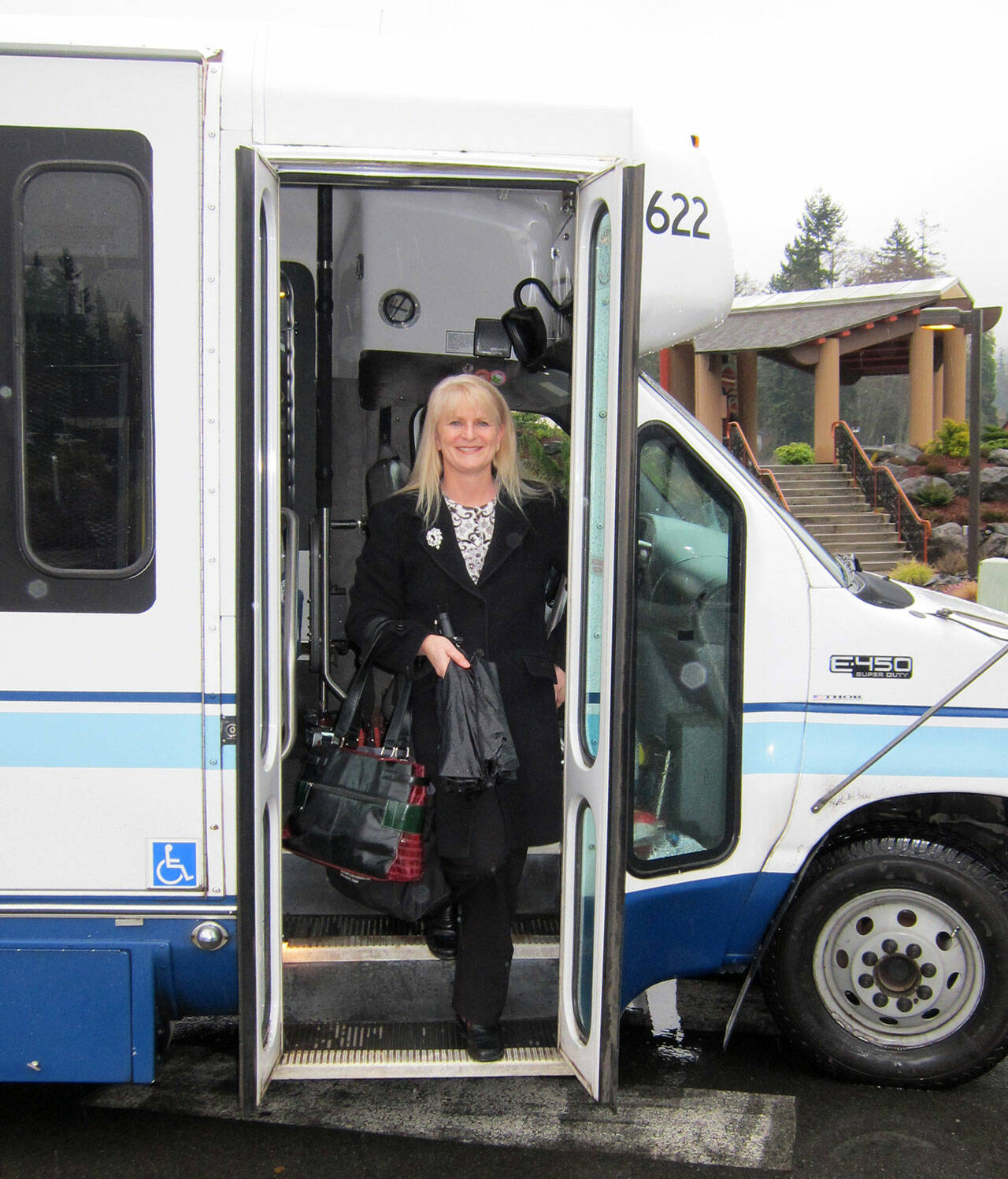
BLYN — For someone who saw much of her career involved with the myriad details surrounding transportation, Annette Nesse spent her professional life close to home.
Now, after three decades in various roles with the Jamestown S’Klallam Tribe, she’s set to retire — sort of.
Technically, Nesse stepped down from her official role with the tribe in September 2018 and is contracting to do work — “for however long they’ll have me,” she said with a laugh — and training her replacement while she considers her 3½-year journey into retirement.
“I was able to gradually let go of things, so it’s actually worked out really well for me to retire this way,” Nesse said in early December.
“The problem solving is what I’ll miss the most,” said Nesse, who most recently held the part-time position of transportation program manager after 20 years as chief operations officer.
“The Jamestown S’Klallam Tribe loves to be first at things; that often involves solving problems,” she said. “I like that; it’s challenging and rewarding. Never a dull moment.”
Nesse began her tenure with the tribe in March 1990 as an administrative assistant for the Economic Development Department, under John Robben. Then she served as executive assistant to tribal head Ron Allen, then called the executive director of the tribe, followed by a stint writing grants under Joan Vance.
Nesse, she recalled, was employee No. 26. Now the tribe employs about 800 staffers at campuses in Blyn, Sequim and Clallam County, and is regarded as the second-largest employer on the Olympic Peninsula behind Olympic Medical Center.
Still, some people don’t really know the size and reach of a tribe that celebrated its 40th year of federal recognition in February 2021.
“A lot of people (still) think the tribe is the casino,” Nesse said. “They’ll ask, ‘Oh, what do you do at the casino?’”
Nesse’s family moved from the Kirkland area to Sequim in about 1969 or 1970, attracted by the abundance of dairy farms and small-town life. The town boasted a single stoplight then.
“It seemed like a nice rural area to raise a family,” she recalled.
Nesse graduated from Sequim High School in 1975 before heading east to earn a bachelor’s degree in animal science at Washington State University in Pullman.
Her interest in animals didn’t yield a job immediately so she took a job with the tribe. She recalled knowing about the tribe and attending classes with tribal members, but it took some time to learn the depth of the tribe’s cultural identity.
“I did have to learn more about the culture and how the tribe as a sovereign entity, a nation, fits into its relationship with other jurisdictions, especially (with) the federal government,” Nesse said.
“Tribal law — I would have loved to have a course (on that). Now, they do a great job in orientation for new employees; they are more aware of culture and traditions. But I had lot of great teachers along the way.”
Thirty years later, through all the changes, Nesse still calls it her work home.
“The tribe is an amazing governmental entity; it was an honor to work with the tribe that long,” she said.
Tribal leaders moved from a downtown Sequim headquarters to an administration building on Sequim Bay, where the tribe has built up its main campus — and where Nesse took her first role. When Tom Elliott retired as office manager in 1995, she was offered the position of director of administration.
The tribe’s administrative department began to evolve significantly then, she said. It included accounting, planning, human resources, information technology, housing and facilities. A year later, Jamestown Excavating was added to the department.
In 1998, Nesse earned her master’s degree in public administration from City University, what she called a “very early form of online learning.”
Said Nesse, “I was rewarded with some promotions as a result.”
Over time, Jamestown S’Klallam Tribe’s administration spun off into multiple departments such as planning, human resources, information systems and housing, which is now under the tribe’s Social and Community Services Department.
About a decade ago, Allen — whose title had been executive director — sought more business-oriented job titles for tribe executives. His title was changed to chief executive officer; Nesse’s title was changed to chief operations officer.
“Annette has been an amazing part of our Jamestown team; her steady leadership and her clear understanding of our Jamestown vision for self-governance and self-reliance has made a huge difference,” Allen said.
“She always understood that we wanted our governing structure and foundation to be one that made our future generations proud. Our executive team always deeply appreciated her fun-loving participation in countless events. We will miss her laughter and spirit, but her contribution to our journey is deeply appreciated.”
Nesse said she always felt supported by Allen and other coworkers.
“Ron always called tribal staff tribal family; it was a great place to work (with) a lot of opportunities if (people) chose to pursue them,” she said. “I hope that I was able to offer a lot back to the tribe in advancing the many different programs and businesses.”
What didn’t change was Nesse’s involvement in transportation planning. Starting in 1994, Nesse represented the tribe in the then-newly formed Bureau of Indian Affairs Indian Reservation Roads Inventory, which was the beginning of her involvement with transportation.
The work, partially funded by Tribal Transportation Program funds, covered planning, maintenance and construction on multi-modal facilities such as roads, trails and the like that access tribal lands.
The transportation program grew from basically nothing in 1994 to include several roads owned by different jurisdictions (county, city, state) through to present day, as Jamestown has added three tribal-owned transportation facilities: sections of Olympic Discovery Trail, Zaccardo Road and, most recently, the Loop Road running behind 7 Cedars Casino between Sophus and Correia roads.
“I was able to grow into the program as the program grew,” Nesse noted.
Nesse served on three transportation committees: the Peninsula Regional Transportation Planning Organization, the Tribal Transportation Planning Organization and the Washington Indian Transportation Policy Advisory Committee. In addition, Nesse served as tribal representative to the Dungeness River Center Board and as chair of its executive committee. She eventually had to resign the position as the tribe’s official representative but then re-upped on the board as a private citizen.
Nesse said the project she’s most proud of is likely the tunnel project that allows pedestrians and bicyclists a safe path to travel north or south under U.S. Highway 101 at the tribe’s Blyn campus.
“We had to cut through Highway 101 to make that happen,” Nesse said, recalling the numerous entities that collaborated.
It’s that and her work on the various points of the Olympic Discovery Trail that she’ll look back upon with pride.
“That trail really serves our entire Olympic Peninsula population, plus any visitors,” she said.
Nesse was also able to closely work with immediate family members along the way: her mother Barabara Kertis worked for Northwest Native Expressions as a sales associate while her brother, John Kertis, was the division manager for Jamestown Excavating for many years. And her husband Pete worked as site supervisor for the Dungeness River Audubon Center expansion project until October of 2021.
