
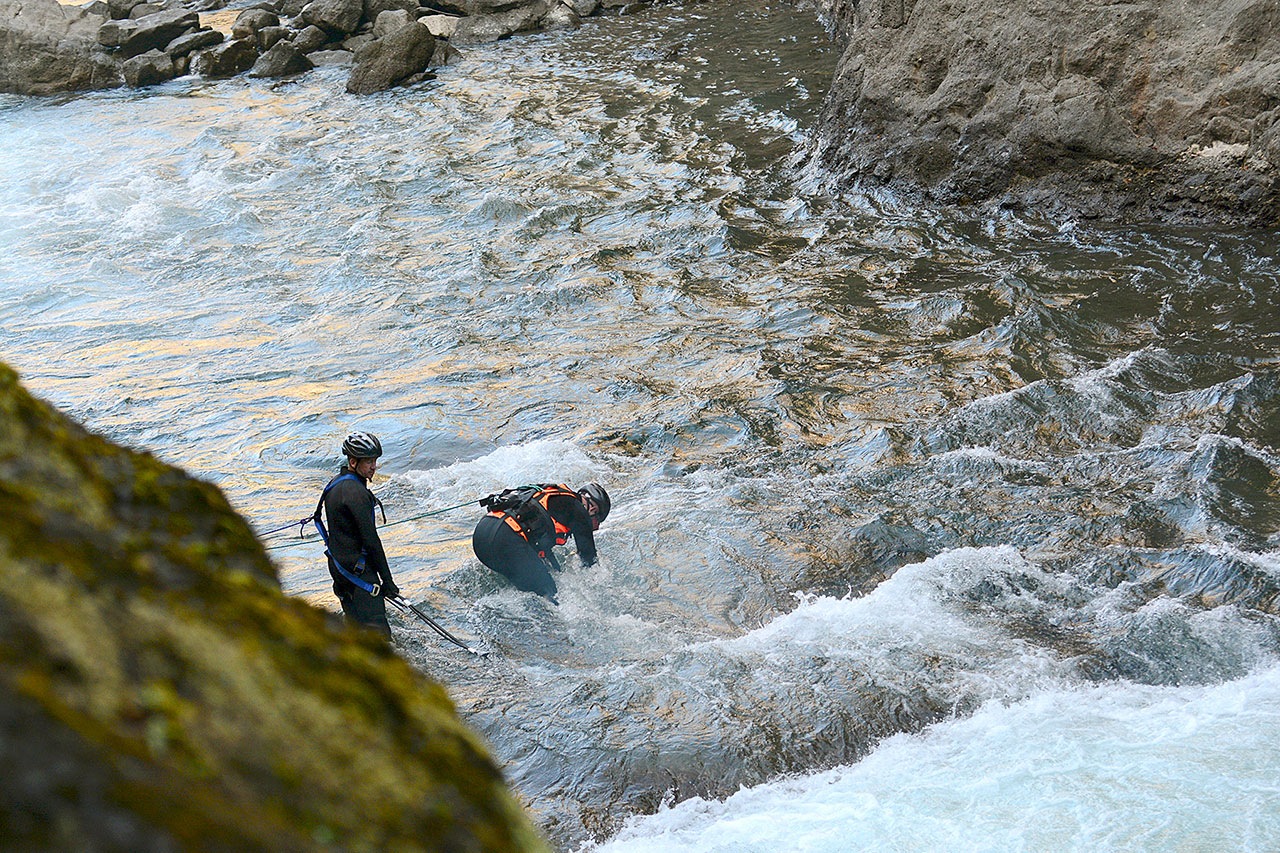
PORT ANGELES — Crews are removing metal bars sticking out from the former Elwha Dam’s foundation and blasting boulders near the site of the former dam and at the former Glines Canyon Dam site upstream.
Olympic National Park officials say the boulders could become barriers to fish reaching the upper Elwha River, while the rebar presents a hazard to boaters.
Crews with the U.S. Army Corps of Engineers this week are using an underwater torch to cut about 25 pieces of metal, ranging from one foot long to three feet long, from the dam’s foundation and are blasting apart boulders at both dam sites to facilitate fish passage, said Barb Maynes, spokeswoman for the park.
The National Park Service led a $325 million effort to restore the Elwha River to its natural state with the removal of the Elwha and Glines Canyon dams. The fish-blocking dams were gone by 2014.
Last fall, the park demolished 14 of the largest boulders that remained at the Glines Canyon Dam site and the winter’s high river flows moved sediment that had built up behind the rocks down the river.
Crews have returned this week to demolish six more boulders — four at Glines Canyon and two at the lower Elwha Dam site — after monitoring the sites, Maynes said.
No sediment has built up behind the remaining boulders, but biologists fear it could — and present an obstacle to fish moving upstream, Maynes said.
Work could continue into next week, she added.
Those boulders fell some time after the Glines Canyon Dam was built in the 1920s, though it isn’t clear when or how it happened.
The park believes the fall was likely triggered by work when the dam was built, which Maynes said may have destabilized parts of the canyon.
Engineers are now using controlled blasting to remove several large boulders that could limit fish passage through the former dam sites.
Fish have been successfully moving through both dam sites and are recolonizing the upper river, but biologists and river geologists remain concerned about passage impediments created by the boulders and the possibility of sediment accumulating behind them, Maynes said.
The work last year, coupled with recent flooding, the removal of the dams and the river returning to its natural state has helped salmon reach the upper river, she added.
For the first time in more than 100 years, biologists in August found summer steelhead and sockeye salmon above the former Glines Canyon Dam. Chinook were seen in September 2014.
Maynes said there isn’t a way yet to know exactly how many fish made the journey, but said biologists were pleased to see two pairs of sockeyes in the upper river.
“Five years ago (Saturday) the river was impounded by two dams and there were no salmon,” she said, referring to the fifth anniversary of when dam removal first began. “Now we have salmon as high up as 30 miles from the mouth of the river.”
Chinook, sockeye, bull trout and summer steelhead have all migrated through both dams to reach the upper river, while adult pink, coho and chum salmon, and Pacific lamprey have passed upstream of the former Elwha Dam site.
“The dams are gone and the natural processes are reasserting themselves,” she said. “What we’re seeing is a wild and dynamic river.”
Maynes said there have been significant improvements since the work was done last year, but that biologists were still concerned the boulders could limit fish passage.
“If there is a need for more work, we’ll move forward with planning for that,” she said. “but first we’ll monitor.”
At the lower dam site, a crew of Army Corps of Engineers divers from Vicksburg, Miss., are cutting away at twisted rebar sticking out from the foundation of the former Elwha Dam.
Since the dam was removed, the river has been eating away at the foundation, exposing the twisted metal. That metal posed such a great risk to boaters that in May, the park asked boaters to exit the river at that point and walk around the dam site.
That is expected to change after work is done to remove it.
Maynes said the park didn’t know the river would erode the foundation and expose the hazardous rebar.
“The drawings and plans were from the early 1900s and they didn’t show us everything,” she said. “There were aspects that were unknown because of the quality of the drawings.”
While some had gone through the area and noticed the risk, Maynes said no injuries or property damage has been reported.
Mayne said the contracting business that demolished the dam met all its responsibilities and removed the dam down to the elevation that was required.
“But what has happened since then was the river continued eroding in the channel and it eroded more than expected,” she said.
“When it did that, it exposed the remnants of the old foundation of the dam.”
Divers will survey the remaining concrete dam foundation and develop a plan for removing it during late summer of 2017.
“That should be the end,” she said. “There won’t be any further remnants.”
________
Reporter Jesse Major can be reached at 360-452-2345, ext. 56250, or at jmajor@peninsuladailynews.com.
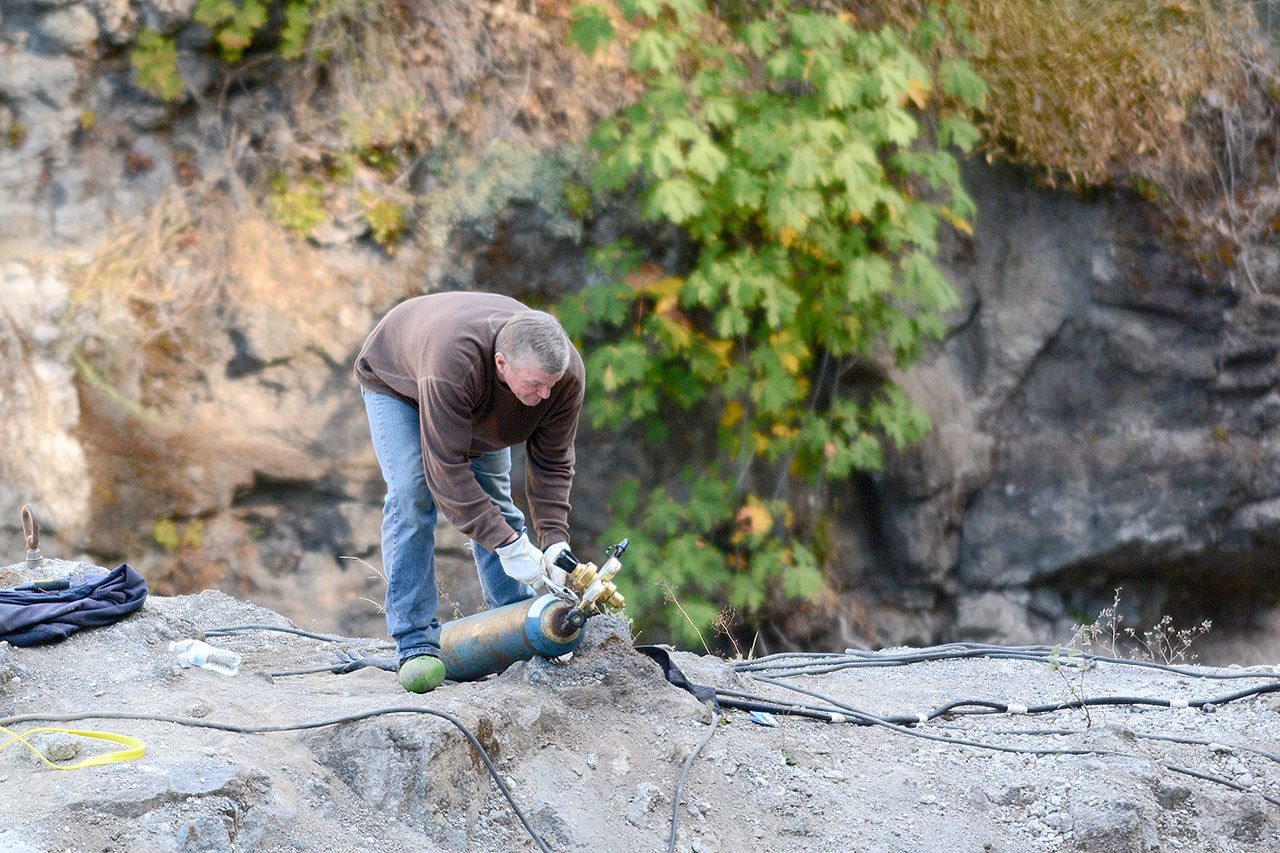
Dan Carney with the U.S. Army Corps of Engineers prepares welding-grade oxygen tanks as divers work to remove rebar from the Elwha River on Thursday. (Jesse Major/Peninsula Daily News)
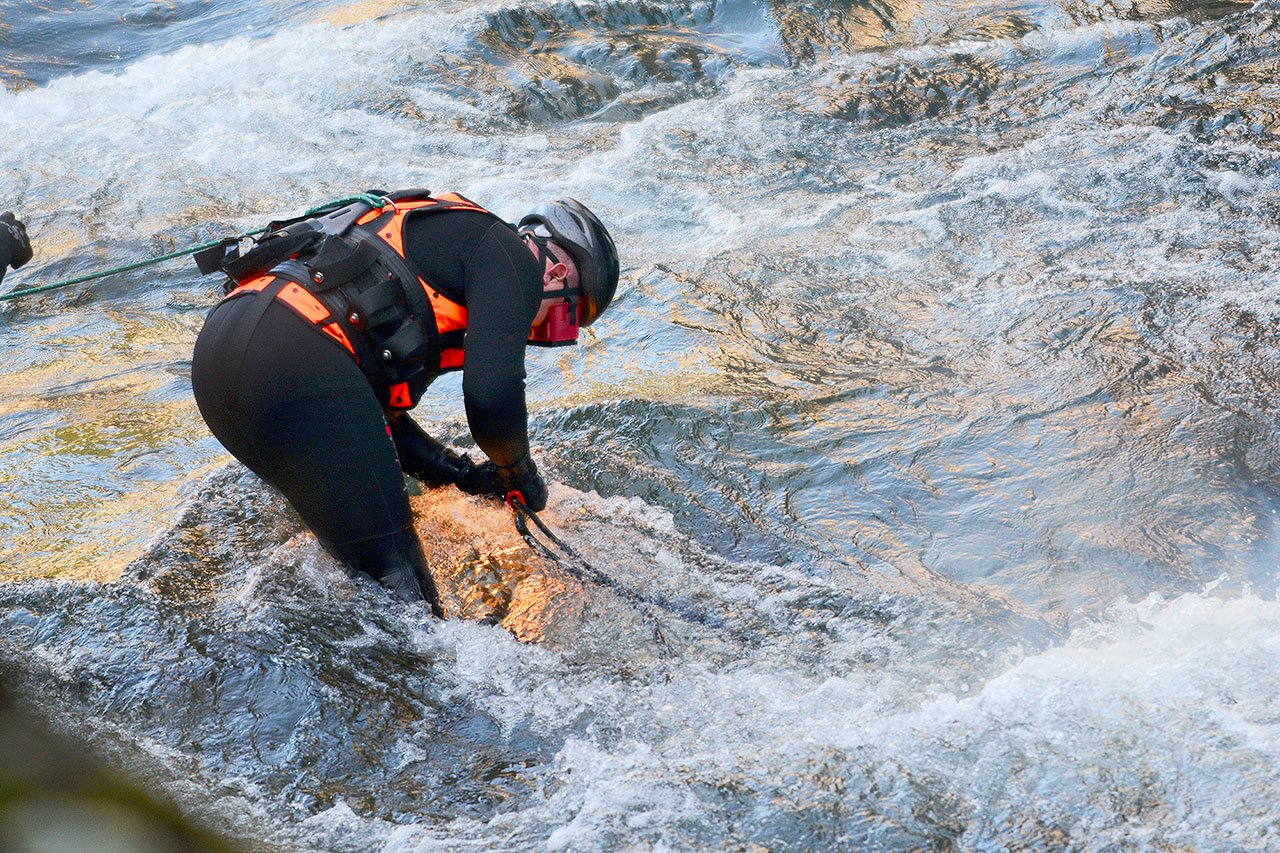
U.S. Army Corps of Engineers diver Lance Gullett used a welding torch to cut through rebar at the former Elwha Dam site Thursday. (Jesse Major/Peninsula Daily News)
