
By Seth Borenstein
The Associated Press
WASHINGTON —
Astronomers call it the monster.
It was the biggest and brightest cosmic explosion ever witnessed.
Had it been closer, Earth would have been toast.
Orbiting telescopes got the fireworks show of a lifetime last spring when they spotted what is known as a gamma ray burst in a far-off galaxy.
The only bigger display astronomers know of was the Big Bang — and no one, of course, was around to witness that.
“This burst was a once-in-a-century cosmic event,” NASA astrophysics chief Paul Hertz said at a news conference Thursday.
But because this blast was 3.7 billion light-years away, mankind was spared. In fact, no one on Earth could even see it with the naked eye.
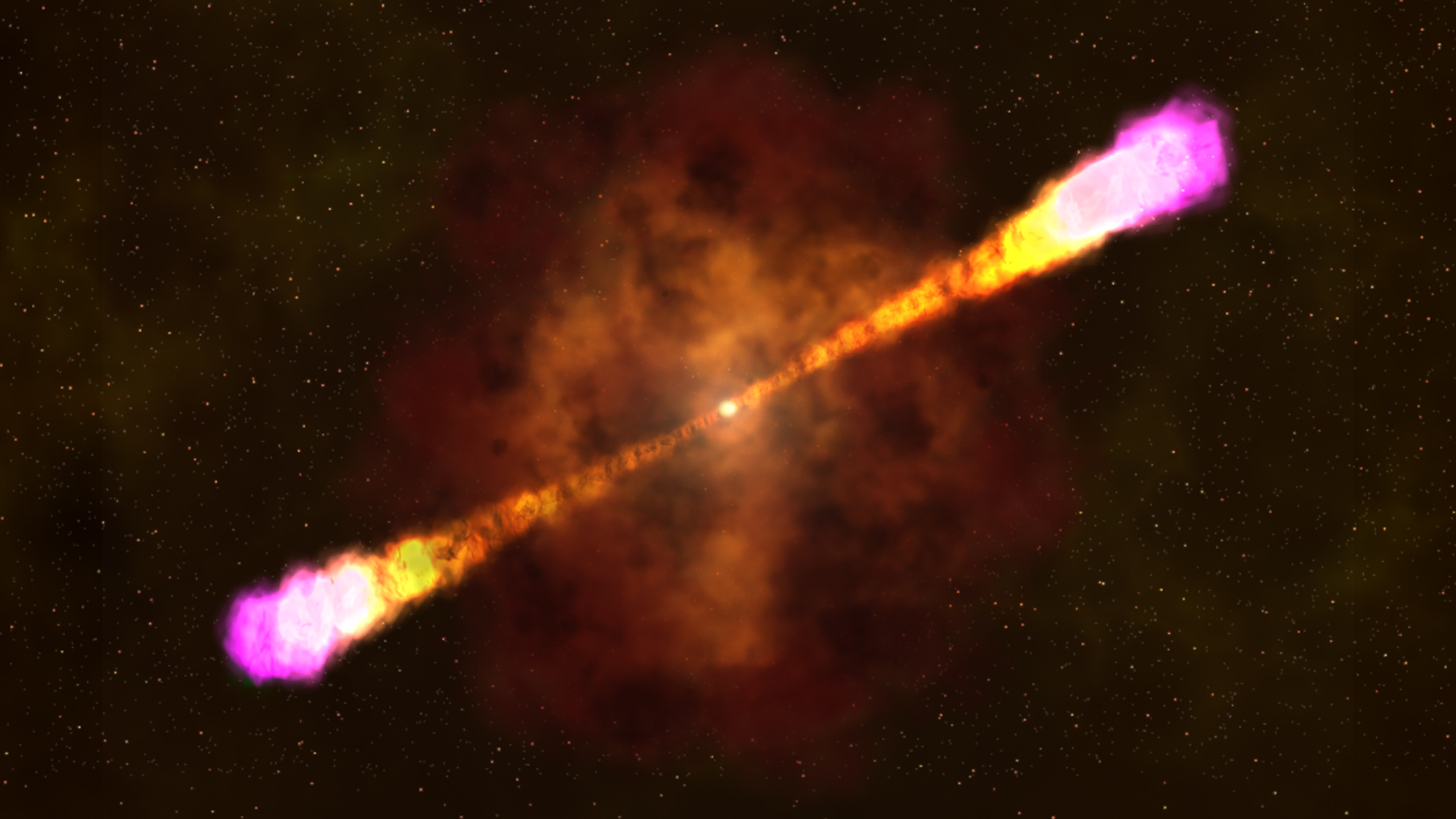
A gamma ray burst happens when a massive star dies, collapses into a brand-new black hole, explodes in what’s called a supernova and ejects energetic radiation.
The radiation is as bright as can be as it travels across the universe at the speed of light.
A planet caught in one of these bursts would lose its atmosphere instantly and would be left a burnt cinder, astronomers say.
Scientists might be able to detect warning signs of an impending gamma ray burst.
But if a burst were headed for Earth — and the chances of that happening are close to zero, astronomers say — there wouldn’t be anything anybody could do about it.
NASA telescopes in orbit have been seeing bursts for more than two decades, spotting one every couple of days.
But this one, witnessed on April 27, set records, according to four studies published Thursday in the journal Science.
It flooded NASA instruments with five times the energy of its nearest competitor, a 1999 blast, said University of Alabama at Huntsville astrophysicist Rob Preece, author of one of the studies.
It started with a star that had 20 to 30 times the mass of our sun but was only a couple of times wider, so it was incredibly dense. It exploded in a certain violent way.
In general, gamma ray bursts are “the most titanic explosions in the universe,” and this one was so big that some of the telescope instruments hit their peak, Preece said.
It was far stronger and lasted longer than previous ones.
“I call it the monster,” Preece said. In fact, one of the other studies, not written by Preece, used the word “monster” in its title, unusual language for a scientific report.
One of the main reasons this was so bright was that relative to the thousands of other gamma ray bursts astronomers have seen, the monster was pretty close by cosmic standards. A light-year is almost 6 trillion miles.
Most of the bursts NASA telescopes have seen have been twice as distant as this one.
Other explosions could be this big, but they are so much farther away, they don’t seem so bright when they reach Earth, the studies’ authors say.
Astronomers say it is incredibly unlikely that a gamma ray burst — especially a big one like this— could go off in our galaxy, near us.
Harvard’s Avi Loeb, who wasn’t part of the studies, put the chances at less than 1 in 10 million.
Our galaxy doesn’t have many of the type of star that lends itself to gamma ray bursts, said Charles Dermer, a co-author of the studies and an astrophysicist at the U.S. Naval Research Laboratory.
“The chance of anything happening and being dangerous is virtually nil,” Dermer said.
Also, because a burst is concentrated like a focused searchlight or a death beam, it has to be pointing at you to be seen and to be dangerous.
“Either it’s pointed at us or it’s not,” Preece said. “If it’s not, yay! Civilization survives and we see maybe a supernova. If it were pointed at us, then it matters very much how far away it is in our galaxy. If it’s in our local arm, well, we had a good run.”
Some theorize that a mass extinction on Earth 450 million years ago was caused by a gamma ray burst in a nearby part of our galaxy, but Dermer said that’s unlikely.
We don’t see gamma ray bursts from the surface of Earth because the atmosphere obscures them and because most of their light is the type we cannot see with our eyes. That’s why NASA has satellites that look for them.
This burst was so bright telescopes on Earth saw a brief flash in the constellation Leo.
For scientists, this was a wow moment.
“These are really neat explosions,” said Peter Michelson, a Stanford physicist who is the chief scientist for one of the instruments on a NASA gamma ray burst-spotting telescope.
“If you like fireworks, you can’t beat these. Other than the Big Bang itself, these are the biggest there are.”
The burst “is part of the cycle of birth and life and death in the universe,” Michelson said. “You and I are made of the stuff that came from a supernova.”
___
Online:
Journal Science: http://www.sciencemag.org
NASA: http://1.usa.gov/1dlvvy3
