
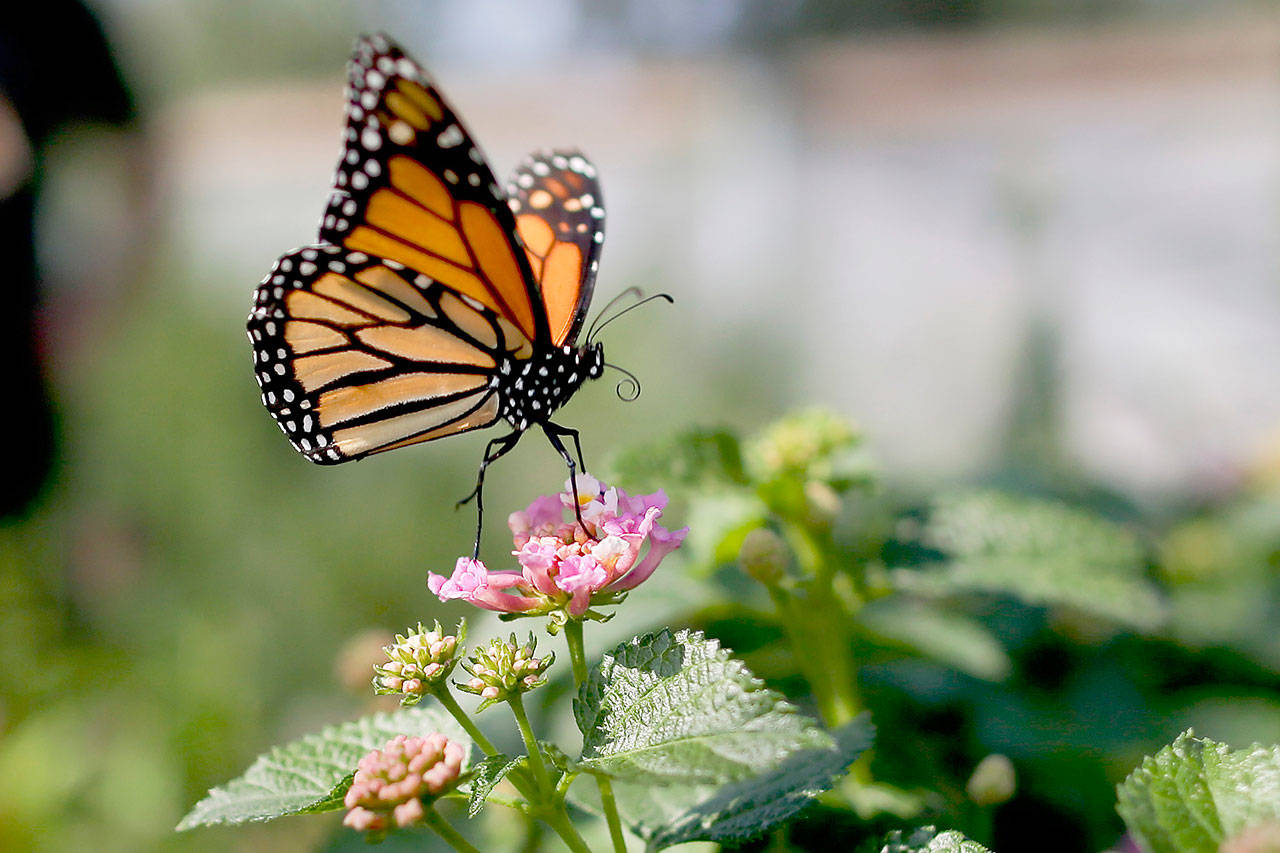
This photo from Aug. 19, 2015, shows a monarch butterfly in Vista, Calif. The number of western monarch butterflies wintering along the California coast has plummeted to a new record low, putting the orange-and-black insects closer to extinction, researchers announced Tuesday. A recent count by the Xerces Society recorded fewer than 2,000 butterflies, a massive decline from the millions of monarchs that in 1980s clustered in trees from Marin County to San Diego County. (AP Photo/Gregory Bull)

This photo from Aug. 19, 2015, shows a monarch butterfly in Vista, Calif. The number of western monarch butterflies wintering along the California coast has plummeted to a new record low, putting the orange-and-black insects closer to extinction, researchers announced Tuesday. A recent count by the Xerces Society recorded fewer than 2,000 butterflies, a massive decline from the millions of monarchs that in 1980s clustered in trees from Marin County to San Diego County. (AP Photo/Gregory Bull)

Monarch butterfly population moves closer to extinction

  • By Olga R. Rodriguez The Associated Press
  • Wednesday, January 20, 2021 1:30am
  • NewsRegional News

SAN FRANCISCO — The number of western monarch butterflies wintering along the California coast has plummeted precipitously to a record low, putting the orange-and-black insects closer to extinction, researchers announced Tuesday.

An annual winter count by the Xerces Society recorded fewer than 2,000 butterflies, a massive decline from the tens of thousands tallied in recent years and the millions that clustered in trees from Northern California’s Marin County to San Diego County in the south in the 1980s.

Western monarch butterflies head south from the Pacific Northwest to California each winter, returning to the same places and even the same trees, where they cluster to keep warm.

The monarchs generally arrive in California at the beginning of November and spread across the country once warmer weather arrives in March.

On the eastern side of the Rocky Mountains, another monarch population travels from southern Canada and the northeastern United States across thousands of miles to spend the winter in central Mexico.

Scientists estimate the monarch population in the eastern U.S. has fallen about 80 percent since the mid-1990s, but the drop-off in the western U.S. has been even steeper.

The Xerces Society, a nonprofit environmental organization that focuses on the conservation of invertebrates, recorded about 29,000 butterflies in its annual survey last winter.

That was not much different than the tally the winter before, when an all-time low of 27,000 monarchs were counted.

But the count this year is dismal. At iconic monarch wintering sites in the city of Pacific Grove, volunteers didn’t see a single butterfly this winter. Other well-known locations, such as Pismo State Beach Monarch Butterfly Grove and Natural Bridges State Park, only hosted a few hundred butterflies, researchers said.

“These sites normally host thousands of butterflies, and their absence this year was heartbreaking for volunteers and visitors flocking to these locales hoping to catch a glimpse of the awe-inspiring clusters of monarch butterflies,” said Sarina Jepsen, director of endangered species at the Xerces Society.

Scientists say the butterflies are at critically low levels in western states because of destruction to their milkweed habitat along their migratory route as housing expands into their territory and use of pesticides and herbicides increases.

Researchers also have noted the effect of climate change. Along with farming, climate change is one of the main drivers of the monarch’s threatened extinction, disrupting an annual 3,000-mile migration synced to springtime and the blossoming of wildflowers.

Massive wildfires throughout the U.S. West last year may have influenced their breeding and migration, researchers said.

A 2017 study by Washington State University researchers predicted that if the monarch population dropped below 30,000, the species would likely go extinct in the next few decades if nothing is done to save them.

Monarch butterflies lack state and federal legal protection to keep their habitat from being destroyed or degraded. In December, federal officials declared the monarch butterfly “a candidate” for threatened or endangered status but said no action would be taken for several years because of the many other species awaiting that designation.

The Xerces Society said it will keep pursuing protection for the monarch and work with a wide variety of partners “to implement science-based conservation actions urgently needed to help the iconic and beloved western monarch butterfly migration.”

People can help the colorful insects by planting early-blooming flowers and milkweed to fuel migrating monarchs on their paths to other states, the Xerces Society said.

More in News

Sue Long, left, Vicki Bennett and Frank Handler, all from Port Townsend, volunteer at the Martin Luther King Day of Service beach restoration on Monday at Fort Worden State Park. The activity took place on Knapp Circle near the Point Wilson Lighthouse. Sixty-four volunteers participated in the removal of non-native beach grasses. (Steve Mullensky/for Peninsula Daily News)
Work party

Sue Long, left, Vicki Bennett and Frank Handler, all from Port Townsend,… Continue reading

Portion of bridge to be replaced

Tribe: Wooden truss at railroad park deteriorating

Kingsya Omega, left, and Ben Wilson settle into a hand-holding exercise. (Aliko Weste)
Process undermines ‘Black brute’ narrative

Port Townsend company’s second film shot in Hawaii

Jefferson PUD to replace water main in Coyle

Jefferson PUD commissioners awarded a $1.3 million construction contract… Continue reading

Scott Mauk.
Chimacum superintendent receives national award

Chimacum School District Superintendent Scott Mauk has received the National… Continue reading

Hood Canal Coordinating Council meeting canceled

The annual meeting of the Hood Canal Coordinating Council, scheduled… Continue reading

Bruce Murray, left, and Ralph Parsons hang a cloth exhibition in the rotunda of the old Clallam County Courthouse on Friday in Port Angeles. The North Olympic History Center exhibit tells the story of the post office past and present across Clallam County. The display will be open until early February, when it will be relocated to the Sequim City Hall followed by stops on the West End. The project was made possible due to a grant from the Clallam County Heritage Advisory Board. (Dave Logan/for Peninsula Daily News)
Post office past and present

Bruce Murray, left, and Ralph Parsons hang a cloth exhibition in the… Continue reading

This agave grew from the size of a baseball in the 1990s to the height of Isobel Johnston’s roof in 2020. She saw it bloom in 2023. Following her death last year, Clallam County Fire District 3 commissioners, who purchased the property on Fifth Avenue in 2015, agreed to sell it to support the building of a new Carlsborg fire station. (Matthew Nash/Olympic Peninsula News Group file)
Fire district to sell property known for its Sequim agave plant

Sale proceeds may support new Carlsborg station project

As part of Olympic Theatre Arts’ energy renovation upgrade project, new lighting has been installed, including on the Elaine and Robert Caldwell Main Stage that allows for new and improved effects. (Olympic Theatre Arts)
Olympic Theatre Arts remodels its building

New roof, LED lights, HVAC throughout

Weekly flight operations scheduled

Field carrier landing practice operations will be conducted for aircraft… Continue reading

Workers from Van Ness Construction in Port Hadlock, one holding a grade rod with a laser pointer, left, and another driving the backhoe, scrape dirt for a new sidewalk of civic improvements at Walker and Washington streets in Port Townsend on Thursday. The sidewalks will be poured in early February and extend down the hill on Washington Street and along Walker Street next to the pickle ball courts. (Steve Mullensky/for Peninsula Daily News)
Sidewalk setup

Workers from Van Ness Construction in Port Hadlock, one holding a grade… Continue reading