
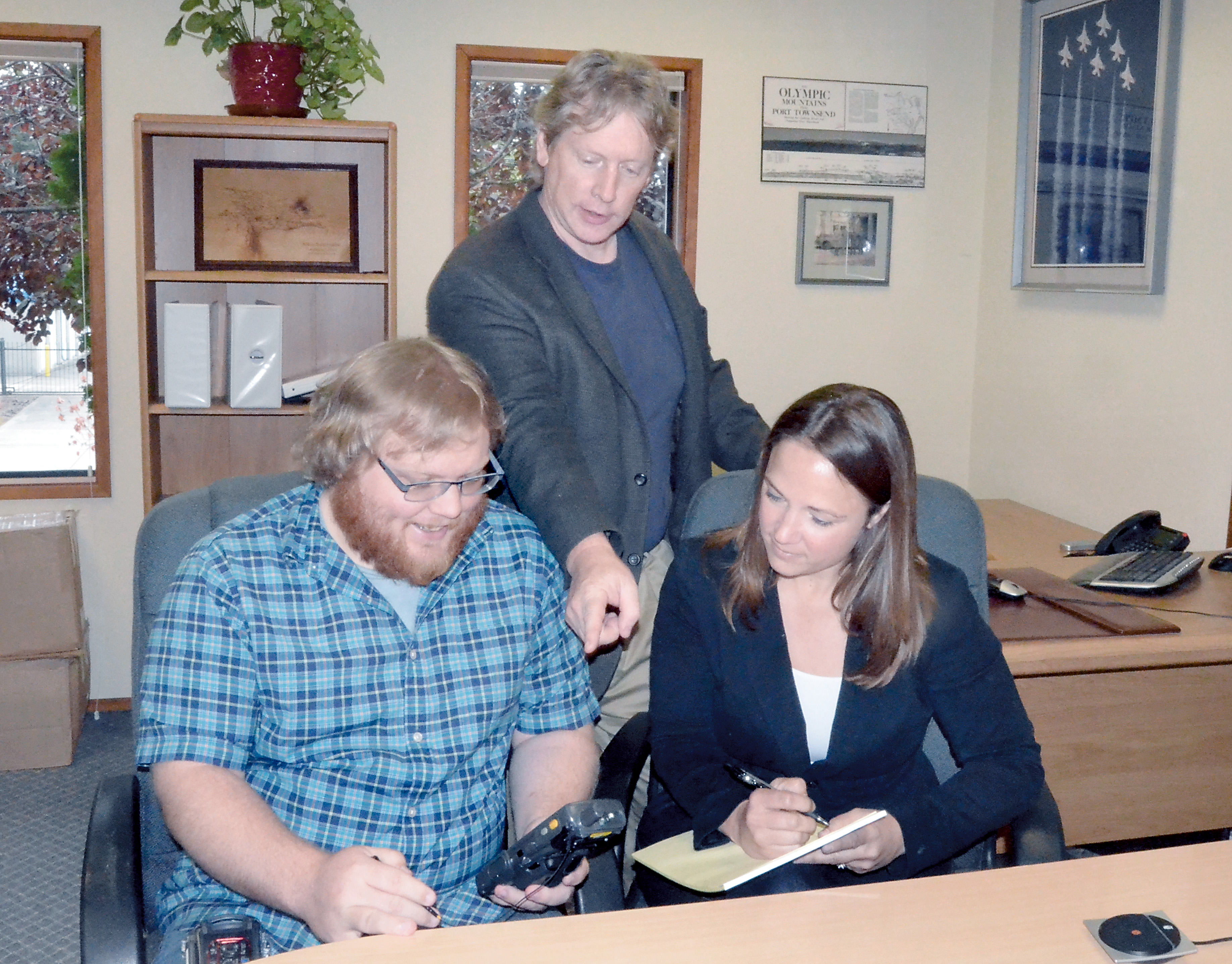
PORT TOWNSEND — Technology entrepreneur Nelson Ludlow is stepping aside from running the company he cofounded, saying he wants to concentrate on big picture issues rather than little details.
“I’m not retiring,” said Ludlow, who founded what became Intellicheck Mobilisa, based in Port Townsend, with his wife, Bonnie, in 2001.
“I’m just going to shift roles and won’t be doing the day-to-day management of the company,” he said.
“It’s time to let someone else run it.”
He will remain a member of the board.
Bill Roof, a former Naval Criminal Investigative Service (NCIS) agent and law enforcement official who is working as the company’s chief operating officer, is scheduled to take over management of Mobilisa, which employs about 30 people, on Oct. 1.
Ludlow, 62, wants to look into technology to power machines through thought.
And he plans to grow back his ponytail.
This is the second time Ludlow has stepped down as CEO. He previously did so in April 2011.
He resumed as CEO in November 2012 for what was expected to be a two-year period.
Ludlow plans to enter a field with a sci-fi edge, one with the long-term goal of building technology that can power machines through thought.
“The last decade was all about DNA, how to understand and manage the human genome,” he said.
“This will be the decade of figuring out the brain and how we can non-invasively create interfaces that respond to human thought.”
The application for such technology, while well in the future, could be used to control everything from video games to fighter jets, he said.
He’s not sure about the technology’s specifics but said the first step is “to get a lot of smart people together.”
Seattle is the perfect place to develop this technology with companies like Boeing and Microsoft and the emerging interest in brain research, he said.
Aside from brain research. Ludlow plans to develop his interest in ham radio, in which he enters a yearly contest to place a radio on a mountain that has the widest broadcast range.
And he’ll probably let his hair grow back, regaining the ponytail he sacrificed when he rejoined the company.
“I recently went to New York City to raise money, and we were told the investors were looking for more off-the-wall types like Steve Jobs and Bill Gates,” he said.
“Our PR representative said something like, ‘He had a ponytail, but he cut it off last week,’ and they got all excited.
“I thought, ‘Really, that’s how you invest?’ It was odd that I had cleaned myself up because I thought that’s what Wall Street wanted, and it turned out they wanted something different.”
Mobilisa, located in a business park south of Port Townsend, employs mostly highly skilled technology workers including software engineers and cable installers.
Intellicheck Mobilisa Inc. resulted from a merger in March 2008 of Intelli-Check Inc. of Woodbury, N.Y., and Mobilisa, Inc. of Port Townsend.
Its first public foray was in 2008 when the company engineered the wireless service for Washington State Ferries, which it supplied for free for about a year before selling the technology to vendors who imposed subscription fees.
“Ideas are easy. I can pop them out. But they can be hard to build,” Ludlow said.
“It was hard to get the Wi-Fi on the ferries, and I knew it would be short-lived because pretty soon, the cellphones would catch up.
“Right now, I can’t understand why they are still doing it.”
More recently, the company has concentrated on security and identification technologies, such as buoys that monitor boat traffic and cellphone apps that make it easy to verify IDs or speed up credit card approvals.
The latest product is called Fugitive Finder, a cellphone app that connects to a smartphone and doesn’t require law enforcement officers to use a terminal or laptop to confirm a potential criminal’s identity.
Ludlow acknowledges that the company’s technology can be invasive and, if improperly used, threaten privacy.
He believes current laws and careful tracking will prevent such misuse.
“There is a record of every search, so if there is anything improper, it will get flagged,” he said.
“I don’t like Big Brother, and I’m not a fan of the NSA [National Security Agency], but no one can argue it’s not a good thing to maintain security on military bases.”
As an example, Ludlow cited an instance when the software determined that a man driving a truck onto Naval Base Kitsap was flagged as a high-risk sex offender from Utah.
“We don’t create any new data or keep any databases,” he said.
“Our software just provides a faster and more accessible front end that connects to what is already there.”
________
Jefferson County Editor Charlie Bermant can be reached at 360-385-2335 or cbermant@peninsuladailynews.com.
