
Peninsula Daily News
and news services
LAPUSH — Anglers and beachgoers along the Pacific coast are being asked to watch for electronic devices from Japan that look like 2-liter soda bottles.
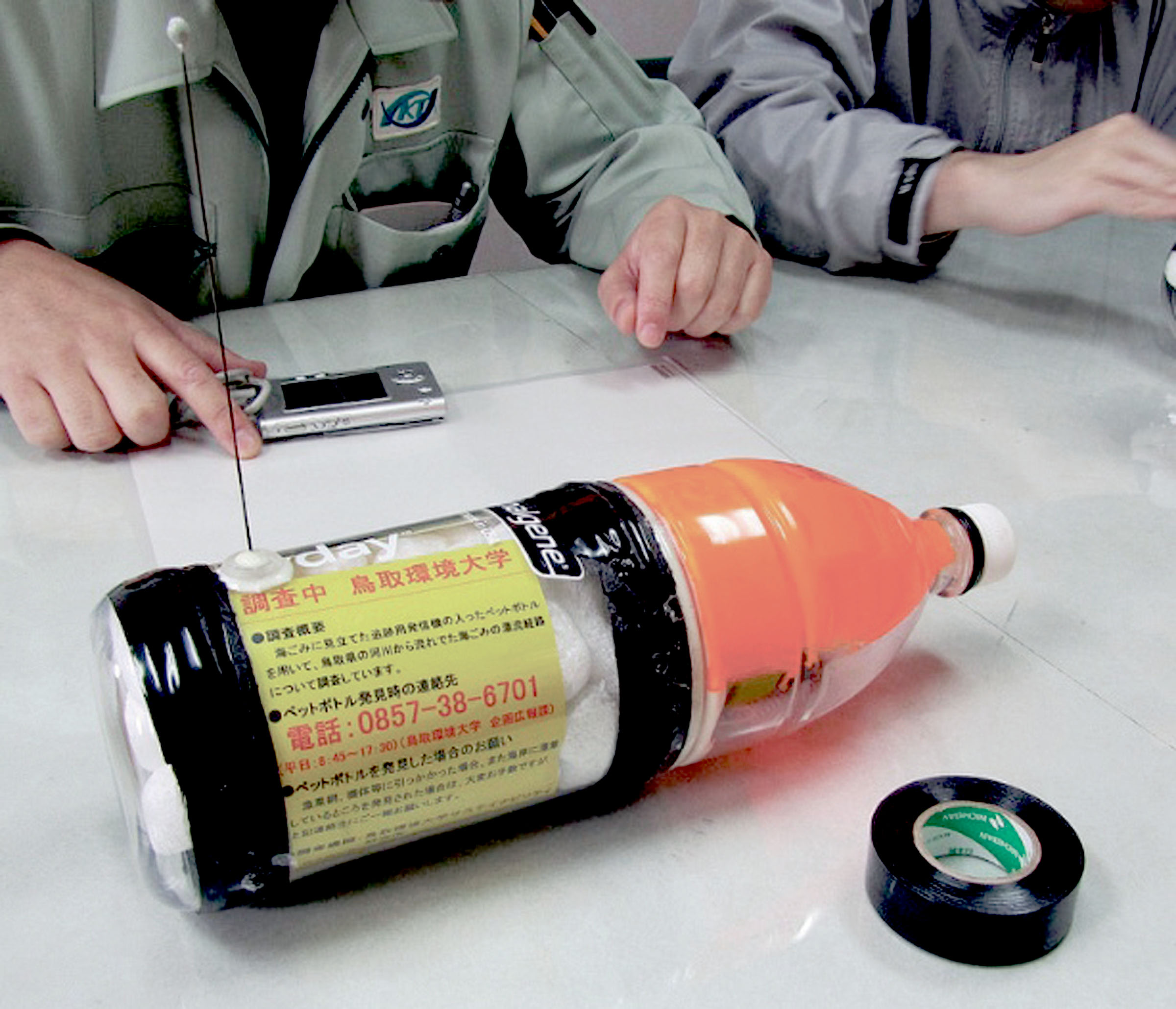
They may be bobbing in the ocean or washed up on shore, and they carry valuable data for scientists about marine debris.
About 30 of these devices, known as transponders, were put in the Pacific at different ports off Japan after the 2011 earthquake and tsunami.
The goal: track the movement of debris from the disaster as ocean currents pushed it toward North America.
An estimated 1.5 million tons of debris washed out to sea — and it is expected to continue drifting ashore along the U.S. West Coast for several years, said Sam Chan, watershed health specialist with Oregon State University.
Researchers from Tattori University for Environmental Studies in Japan have been working on the project with OSU, Oregon Sea Grant and NOAA Marine Debris Program.
Chan said the transponders are past the 30-month life of their batteries and are no longer communicating their location.
The only way to find out where they end up is to physically locate them and report their location.
“These bottles contain transmitters, and they are not a hazardous device,” Chan said.
“If you find something that looks like an orange soda bottle with a short antenna, we’d certainly like your help in turning it in.”
The transponders have a treasure chest of stored data for scientists, Chan said, not only about where the tsunami debris might be going but also information about other debris that is circling around in the Pacific.
The transponders have writing in both English and Japanese that describes what they are.
Originally, three transponders were released in 2011. Two of the three have been found.
One was discovered near Arch Cape, Ore., in March 2013, about 19 months after it was set adrift
Another was found near the Haida Heritage Site, formerly the Queen Charlotte Islands — the same location where a Harley-Davidson motorcycle floated up on a beach in a shipping container long after being swept out to sea in Japan by the tsunami.
The second group of transponders was sent out in 2012. None from this group have been found.
“We figure that they would be arriving any time now through next year,” Chan said.
If you find one
Persons who find a transponder are asked to photograph it and report its recovery to Chan at Samuel.Chan@oregonstate.edu; or to the NOAA Marine Debris Program regional coordinator in their area at marinedebris.noaa.gov/contact-us.
They will provide shipping instructions so the instruments can be returned to the research team.
“These transponders have recorded a lot of important data that will help us better understand the movement of tsunami and marine debris throughout the Pacific Ocean,” Chan said.
“Everyone’s help in recovering these instruments is greatly appreciated.”
