
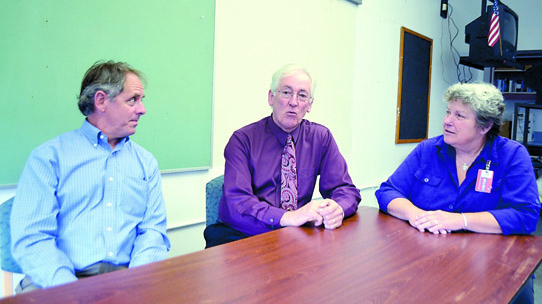
PORT TOWNSEND — A mental health court in Jefferson County could provide needed treatment for those accused of a crime, streamline the local justice system and save the county money, proponents said Tuesday.
“The daily cost of maintaining an inmate in the Jefferson County jail is $78, with an average stay of 27 days,” said Margaret Brammall, an attorney who has worked with several such courts throughout the state.
“The average can be longer for people with mental illness, who are more expensive to house in jail because of medical costs and a need for closer supervision,” she added.
Brammall was one of two visiting speakers at the Port Townsend police station during Tuesday’s public meeting to discuss the possibility of creating a Jefferson County mental health court.
No timetable was presented for a decision on establishing such a court.
Brammall was joined by Alex Blandford, a policy analyst with the Council of State Governments Justice Center in New York City, who is developing a mental health court curriculum that will be provided free of charge to any municipality seeking to establish the service.
Blandford has been working with Jefferson County since the spring and is using the test data assimilated in developing the program.
About 15 people attended the meeting, including at various times representatives from Jefferson County, the Port Townsend Police Department and the mental health community.
Prosecuting Attorney Scott Rosekrans, District Court Judge Jill Landes and Public Defender Richard Davies all attended.
They represented the three-legged stool necessary for a mental health court to succeed, according to Brammall.
“In order for this to work, you need a judge who understands the issues presented by mental illness, a public defender who is willing to keep up with trends in mental health as well as the law, and a prosecutor who is able to work as part of a team instead of in an adversarial role,” Brammall said.
All three support the program in theory but are unsure about allocating the time and money needed in order to make it work.
“Whenever we have a new program like this, we need to spread out our time,” Landes said.
“If mental health court starts, I’m the one that takes it on along with everything else, and it increases what I have to do every day.”
Said Davies: “In court, we are always addressing the symptoms when it comes to a crime.
“With drug court and mental health court, we are addressing the underlying issues and can treat those.”
Screening also is an important part of the process.
Brammall said clients should be competent to stand trial, with mental health playing some role in the crime for which they were arrested.
“You don’t want to admit clients who are going to go berserk and give the program a bad name,” she said.
A team from all of the involved agencies must screen each client for qualifications.
“It needs to be unanimous,” Brammall said. “If someone has doubts, it won’t work.
“It’s like being on a jury: You need to open up your mind to different possibilities,” she added.
Although some of those arrested for a crime might see mental health court as “an easy way out,” going through the process, which takes a minimum of two years, can be more of a challenge than going to jail, Brammall said.
Brammall recommends that a county “start small” in establishing a mental health court; as it progresses, new resources can be secured with grants.
She predicted that counties would allocate more funds to support the court once they see that it saves money in the long run.
Rosekrans said mental health court could be established immediately and without approval by the county commissioners since it would not require any additional funding.
The necessary prosecutor and court staffs are in place, and it is a question of allocating resources and picking a day to meet, he said.
Assistant Prosecuting Attorney Miriam Norman would prosecute the cases and has agreed to take on the new responsibility.
Much of the work in District Court would be assumed by the probation officers, Rosekrans said.
“I expected that when we started talking about this, people would stand up and say it was stupid,” Rosekrans said.
“But everyone we talk to seems to think it is a good idea.”
Jefferson County Reporter Charlie Bermant can be reached at 360-385-2335 or at charlie.bermant@peninsuladailynews.com.
