
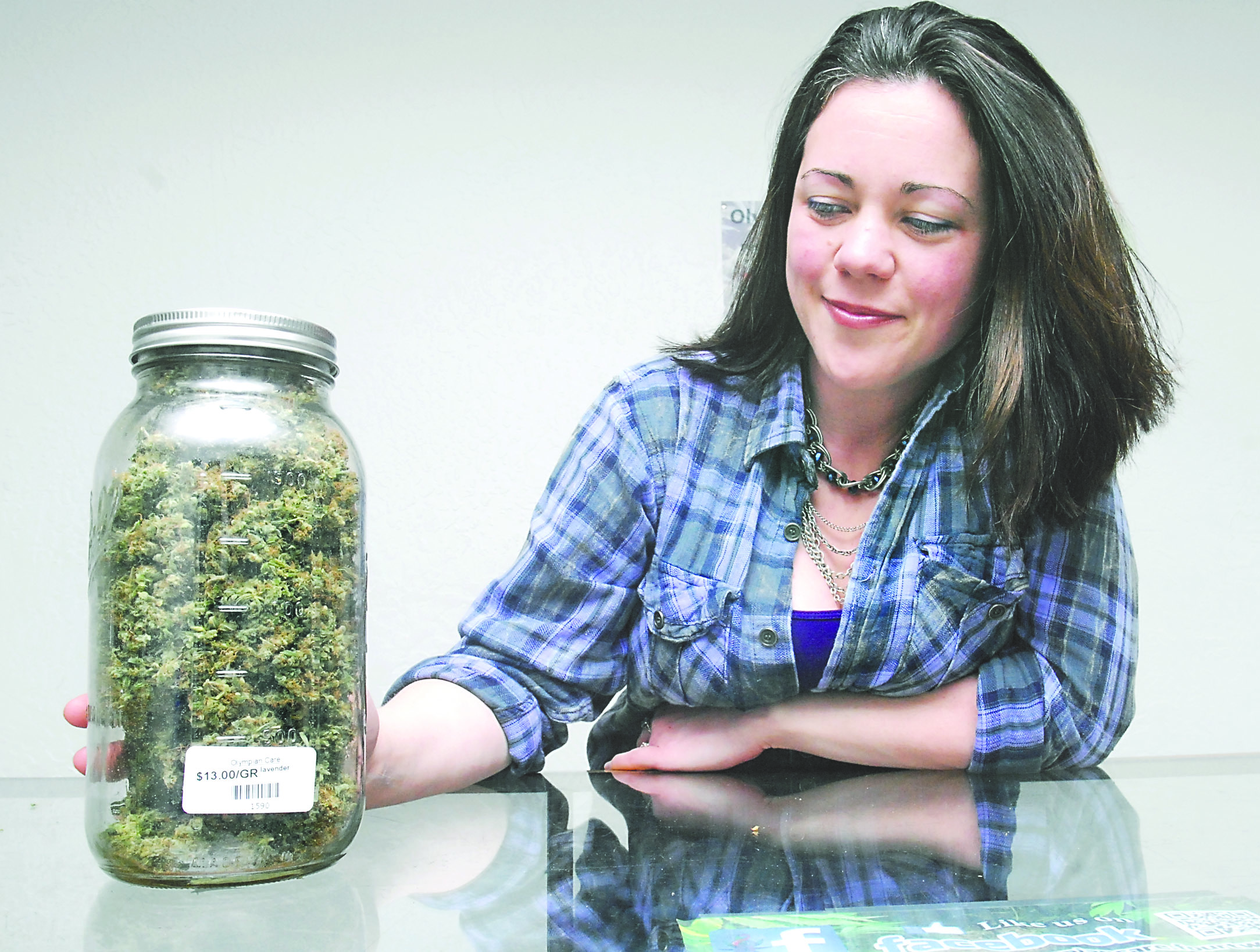
The specter of taxes, fees and regulations appears to be discouraging North Olympic Peninsula suppliers of medical marijuana from considering entering the recreational pot market.
Expected taxes on recreational marijuana are keeping Misty Pharr, owner of Olympian Canna on Tumwater Truck Route in Port Angeles, from expanding her medical marijuana operation into a retail shop.
“I was really thinking about it. I wanted to get into it,” she said.
“But if the taxes make me sell a $10 gram for $17, I just don’t think I could, in good conscience, charge somebody that much more.”
“Legalization was a mistake, and we knew once it happened, the state would screw it up,” said Jeff Halls, a partner in the Port Hadlock Alternative Clinic, which offers medical marijuana.
Hall has no plans to enter the recreational market, saying regulations and taxes on recreational marijuana will make it make difficult to turn a profit.
In November, voters approved Initiative 502, which allows an individual user to possess and legally consume up to an ounce of marijuana, though not in public, with the eventuality of providing a retail channel for recreational use of the drug.
Voters already had approved a process for providing medical marijuana in 1998, and the state Legislature amended the procedures in 2007 and 2010.
The Liquor Control Board is developing rules for a legal recreational marijuana industry involving how plants will be grown, how marijuana products will be tested for strength and quality, and how many retail stores will be allowed.
Officials have been trying to develop a system with rules that would satisfy the federal government, which still considers marijuana an illegal substance.
The state plans to begin issuing growing and processing licenses Dec. 1, clearing the way for the opening of retail outlets in early 2014.
According to the voter-approved initiative, recreational marijuana excise taxes will be levied in three tiers of 25 percent each on producers, processors and retailers — resulting in an effective rate for consumers of 44 percent, The New York Times said.
The state Office of Financial Management estimated that excise taxes, along with retail sales and and business and occupation taxes, would generate more than a half-billion dollars in new revenue each year.
But Peninsula purveyors of medical cannabis aren’t sure they want to get in the game.
“We don’t know what we are going to do because we don’t know what the rules will be,” said DeLynn Hobart, owner of Canna-Copia at 661 Ness’ Corner Road.
“We aren’t sure whether to go into the recreational market or stay with the medical,” she added.
“But we won’t decide until we find out what the government is going to do. Right now, we are just treading water.”
Operators of three other medical marijuana dispensaries on the Peninsula — Secret Garden Supply in Sequim, Karma Wellness Cooperative in Port Angeles and Clallam Bay Coastal Canna Advocates in Clallam Bay — did not respond to requests for interviews.
The sponsor of an unsuccessful bill to impose a 30 percent tax on medical marijuana said it called attention to unresolved differences between distribution of medical and recreational cannabis.
“My purpose was to get the discussion started, and it did that — in spades,” said Sen. Ann Rivers, R-La Center, the Senate Majority Whip who sponsored SB 5887, which died when the Legislature adjourned its 105-day regular session April 28.
Rivers does not think the bill will enjoy a rebirth during the first special session beginning May 13 and instead will have to wait until next session.
“While the bill won’t be addressed this year, we have attached a proviso that instructs the [state] Liquor Control Board to consider medical cannabis when they prepare the guidelines for adult [recreational] sales,” Rivers continued.
“We want to make every effort to make sure that the people who need the medical cannabis can get it, while those who are not authorized cannot purchase through medical channels.”
Brian Smith, spokesman for the state Liquor Control Board, said marijuana use now is often recreational in nature and that referrals have been issued to people without legitimate ailments.
“I think it’s clear that a significant people that are going to medical marijuana dispensaries now are going there for recreational use,” Smith said.
Dr. James Kimber Rotchford, an addiction specialist in Port Townsend, disagreed.
He said the majority of those who ask him for marijuana prescriptions have legitimate pain issues, with only about 5 percent trying to scam the system.
Hobart also finds a distinct difference between medical and recreational pot users.
“My customers have legitimate medical issues. They are really sick,” Hobart said.
“They have arthritis, MS, cancer. They just want to be free of their pain and don’t care about getting high,” she added.
Currently, marijuana sales through dispensaries are not taxed, the same as medicine.
“I don’t want to have to pay a tax on my medicine when I go to the drugstore and I don’t think they should be taxing this because it is medicine,” Hobart said. “It’s not morally right.”
Pharr said she is worried that state involvement will degrade the quality of the product.
Her supply comes from the excess from medical marijuana patients who are allowed to grow for another patient.
Having those close relationships with the growers, and knowing how they grow their plants, is important, she said.
“These are sick people,” Pharr said. “I think there’s a lot of fear that with the government in charge, the quality will not be as high, and the ability to make sure there are no pesticides or fertilizers is going to go away.”
Smith said the layer of government control will ensure quality crops.
“Anytime you apply a state license to something, there’s going to be a higher standard to meet,” Smith said.
Hobart, a retired art teacher, said that though she may enter the recreational market if the conditions are right, she intends to stay in the medical market as long as possible.
“I’m just a little old lady trying to help people,” she said.
________
Sequim-Dungeness Valley Editor Joe Smillie can be reached at 360-681-2390 ext. 5052 or at jsmillie@peninsuladailynews.com.
Jefferson County Editor Charlie Bermant can be reached at 360-385-2335 or at cbermant@peninsuladailynews.com.
