
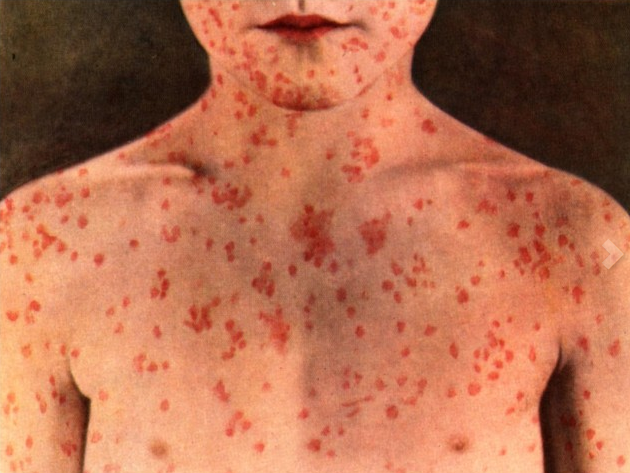
PORT ANGELES — Measles has reared its unwelcome spotty head on the North Olympic Peninsula.
A case appeared Sunday in the emergency room of Olympic Medical Center in Port Angeles, Dr. Scott Kennedy told hospital commissioners Wednesday.
The unidentified middle-aged man was admitted to the hospital, said Kennedy, OMC’s chief medical officer. The man remains there, although he is no longer infectious.
Meanwhile, public health officials are “intensely working now to try to detect any potential contacts [of the ill man] in the community,” Kennedy said.
The contagious period for the disease begins four days before symptoms appear and lasts for four days afterward.
“We’re out of that window now,” Kennedy said.
One health care worker who was in the emergency room when the man arrived had not been immunized and so will be isolated from the workplace until Feb. 24, reflecting what Kennedy called “the abundance of caution” with which measles is treated.
Beyond that individual, “we don’t expect to see any additional cases emerging” from OMC, Kennedy said. Nurses and doctors caring for the patient have been immunized.
The Port Angeles case could be the fourth confirmed in Washington state, Kennedy said.
No cases have been reported in Jefferson County. More than 100 cases in the U.S. have been linked to the so-called Disneyland outbreak in California in late December.
It was unknown if the Port Angeles case was related to that outbreak or came from contact with a traveler who had not been vaccinated but who had visited a measles-prone region, Kennedy said.
Some of Washington’s cases had been linked to travelers from South America passing through Seattle-Tacoma International Airport, said
Dr. Tom Locke, health officer for Clallam and Jefferson counties.
Measles is characterized in its early stages by a fever as high as 105 degrees, cough, runny nose and red, watery eyes (conjunctivitis), Kennedy said.
It is followed by a rash of small spots that may begin in the mouth or on the face and spread to the body’s lower extremities. The illness may last for several days more.
The disease can be fatal but rarely in developed counties, where one to three cases per 1,000 results in death, usually from a brain infection, according to the national Centers for Disease Control and Prevention.
Symptoms may not appear for as long as 14 days after exposure, the CDC said.
Kennedy cautioned people who suspect they have measles or think they may have been exposed to call their health care providers and ask for advice.
Immunization
He urged parents to have their children immunized against measles, saying that suspected links between the measles vaccine and autism “have been disproved, basically.”
According to Locke, people born before 1957 are presumed to be immune to measles. Those born in 1957 or later should have at least one dose of the measles, mumps, rubella (MMR) vaccine.
A blood test can determine if a person is immune.
Available vaccine is prioritized for those at highest risk of exposure, Locke said. As supplies improve, anyone who is a candidate for an
MMR shot should get one, he said. For more information, call 360-417-2274.
“Measles is an airborne illness,” Kennedy said. “It is highly communicable, even more than the flu.”
As for the flu, Kennedy said Wednesday, no new deaths have been reported on the Peninsula, and positive results for influenza tests at the hospital have slightly declined.
Five persons have died of influenza complications at Olympic Medical Center. All the deaths have been of elderly individuals who were chronically ill.
The flu season will last for “at least four to six more weeks,” Kennedy said.
________
Reporter James Casey can be reached at 360-452-2345, ext. 5074, or at jcasey@peninsuladailynews.com
