
By Craig Hill McClatchy News Service
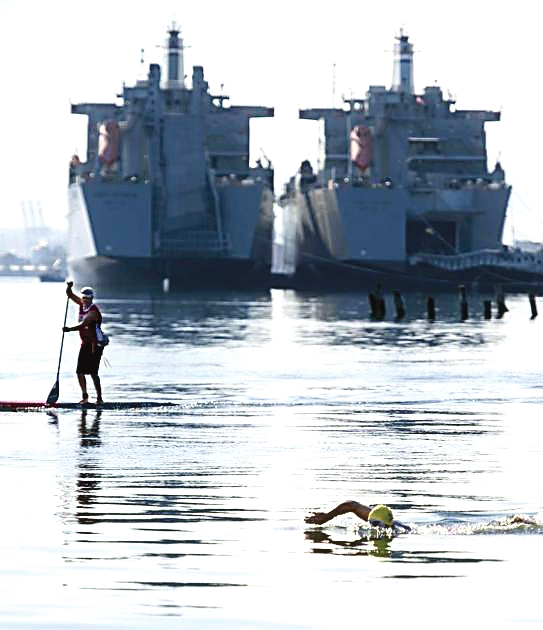
On the morning of June 6, a man in a pink swimsuit waded into Puget Sound on the Tacoma waterfront and started swimming.
He didn’t stop until he arrived in West Seattle, 8 hours, 43 minutes later.
Andrew Malinak, a 28-year-old geotechnical engineer from Seattle, is the first known person to complete the 18.8-mile swim. His inspiration for the swim, Bert Thomas of Tacoma, completed the route in the opposite direction in 1956.
And now he has his sights set on crossing the Strait of Juan de Fuca and making a lap around Bainbridge Island.
Malinak is originally from New York, where he swam in high school and briefly in college before quitting to focus on academics.
He believes this helped him avoid burning out on the sport and find enjoyment in marathon swimming.
Interview
A few days after he finished his historic swim, Malinak talked about the details of the swim and his future plans:
Q: So you did this without a wetsuit?
A: The swim needed to be unassisted. Anything that could benefit you is not allowed by the unassisted rules — drafting off a boat, grabbing onto a float. The wetsuit can increase your speed, your buoyancy and your heat retention.
Q: What did you have to do to get your body acclimated?
A: A whole lot of practice. My first time jumping into the Sound was a struggle, to say the least. Everybody’s body does react somewhat similarly when you first jump in. You hyperventilate. It takes a minute to catch your breath and calm down. . . . Like anybody who does an extreme sport, the more you practice it, the more comfortable you get, the more natural it becomes.
Q: I’ve heard about people greasing up when swimming in cold water. Did you do that?
A: In theory, something like lanolin gives you a little layer against the cold. I tried smearing myself with Vaseline once, and it was more messy than helpful. All I had was sunscreen and a little bit of Vaseline to keep from chaffing.
Q: How often did you take a break?
A: I try not to get too chatty when I swim. It’s easier just to put your head in the water and swim and focus on something like, “15 minutes to my next feed.” But I don’t like to stop and look around because the more you do that, the colder you get.
I would quite often glance up and look around. You could see Vashon passing by . . . and once we got to the top [of the Island] and started crossing and seeing West Seattle getting closer, that was encouraging.
Q: How does nutrition work?
A: Powdered nutrition in a water bottle [tied to a rope] was thrown to me every 20 minutes or so. I take a drink and they pull it back in. It keeps that distance so that I’m still unassisted.
Q: And that’s not considered a violation of unassisted rules?
A: Anything that improves or increases your speed, buoyancy or your heat retention [is against the rules]. Someone giving you food doesn’t violate any of that.
Q: What about cramping?
A: Lots of it, yes. A few hours in, every time I stopped to feed, my hips and my legs would cramp up. It just meant I would take shorter feeds. . . . Muscles and tendons being cold for that long and pulling on things they aren’t used to pulling on, I actually woke up with a sore kneecap the next morning. I felt like I’d run a marathon instead of swam one.
Q: Any encounters with sea life?
A: My crew said they saw the occasional seal or sea lion. . . . Wildlife is always interesting, but it’s nothing you really want to think about or have to look at during the swim. It’s a distraction and potentially something that could get in the way, even if they are only being friendly or curious.
Q: What’s next for you?
A: I’m heading back to New York to assist with a swim I did last year. I’ll be hanging out on a boat and helping a couple swimmers down the Hudson River. Then I’ll start training. I plan to swim around Bainbridge in early August.
How it went
Q: Tell me about the Bainbridge swim?
A: It’s inspired by a group of swimmers I met out there. Every year, they do a relay swim around the island. It’s kind of a circle of inspiration. They were inspired by my attempt in the Strait, and they invited me over for breakfast and to swim in their pool. Last year, three of them actually swam across [the Strait of Juan de Fuca] in wetsuits in about eight hours.
I can see Bainbridge from my office, right now while I’m talking to you, and I can see it when I swim at Alki. So that is where my attention turns now. . . . It’s about 26.5 miles. I think it will take me 10-12 hours. I’m hoping it will be a little warmer.
Q: When will you take another crack at the Strait of Juan de Fuca?
A: My ultimate swim this year is going to be the Strait. If everything goes well [with the Bainbridge swim], the Strait should be easy. I’m looking at mid-September. . . . I think it will take about five hours if I get the currents right and everything goes as planned. I’ll be ready for the worst.
Q: What undid your 2013 attempt?
A: We had 25 mph winds coupled with some fog. . . . We got a bit of a late start waiting for it to clear up, which messed up the [timing of the] current. I was swimming south, and the currents were pushing me north, which I was not expecting in an area where I thought all the currents went east-west.
