
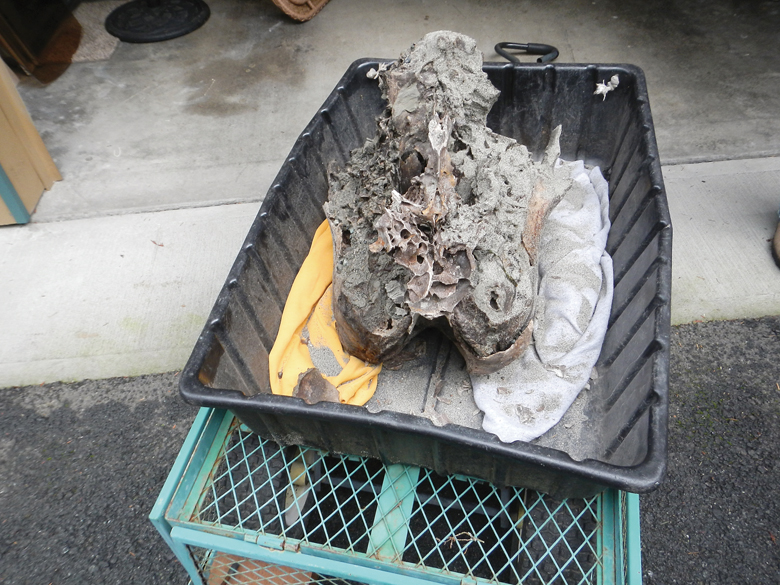
SEQUIM — The eroding bluffs surrounding Sequim Bay are providing a peek into times long since past — 50,000 to 100,000 years ago.
While walking state Department of Natural Resources-owned tidelands east of Sequim early this month, local residents discovered a partial skull of what’s likely a Columbian mammoth emerging from the sandy wall.
Since the discovery of the fossil, officials with the Burke Museum of Natural History and Culture have been working to collect the specimen for conservation and further analysis.
“The fossil likely represents a Columbian mammoth — Mammuthus columbi — as that’s the species typically found in this part of Washington,” Christian Sidor, Burke Museum curator of vertebrate paleontology, said.
“The Columbian mammoth is the state fossil of Washington.”
Sidor and colleagues were able to collect the last of the remains Monday.
“The fossil is currently undergoing conservation in our lab,” Sidor said. “Once it is stabilized, documented and preliminarily studied, the Sequim Museum [& Arts Center] is interested in displaying the specimen. My goal is to work with the local museum to get the fossil on display soon.”
The exact age of the mammoth hasn’t been determined, but based on its size, it’s estimated to be an adult.
The rocks surrounding the specimen date back between 50,000 and 100,000 years ago and represent a gravelly riverbed — giving hints as to why only the skull became unearthed.
“It follows that the animal must have died close to the river, been swept in or scavenged, and then its skull was eventually buried,” Sidor said.
Because most fossils are isolated and broken, Sidor noted he’s not surprised the found fossil is a partial skull.
“In fact, teeth are the most common part to be preserved because they’re durable and don’t have much nutrition value, so they aren’t destroyed by scavengers,” he said.
Weighing about 18,000 to 22,000 pounds, Columbian mammoths were one of the largest of their species.
They roamed North America, including present-day Sequim, during the Pleistocene epoch.
Although it’s difficult to know exactly what Sequim was like when the newly discovered mammoth was alive, Sidor said, Sequim was colder and drier 50,000 to 100,000 years ago.
Several other mammoth and mastodon fossils have been found on the Olympic Peninsula, but each one “provides an important piece of data on our region’s natural history,” Sidor said.
“One example of what we can learn from fossil occurrences like this one is that it helps us understand the timing of advance and retreat of glaciers during the last 100,000 years,” he said.
When and if remains of any kind are discovered, it’s important to ask yourself whether it appears to be an archaeological site, said David Brownell, cultural resources specialist for the Jamestown S’Klallam tribe.
However, because it’s often difficult to determine the type and significance of remains, Brownell suggests to “err on the side of caution” and contact the state Department of Archaeology and Historic Preservation in Olympia at 360-586-3065.
Also, regardless of the age of the remains, if they appear to be human, law enforcement must be contacted.
Both Brownell and Judy Reandeau Stipe, MAC executive director, emphasize the importance of not removing any remains from their location, as it may be illegal and could interfere with future work and evaluation of the site.
“I would like to stress that vertebrate fossils are very rare and important objects that shouldn’t be viewed as trophies,” Sidor added.
Instead, notifying officials with the Department of Archaeology and Historic Preservation or the Burke Museum of found fossils, artifacts or unknown remains “assures that the scientific community can access the data contained within the specimen and that it is [made] available to the people of Washington,” he said.
For more information, contact the Burke Museum at 206-543-5590 or the MAC at 683-8110.
________
Alana Linderoth is a reporter with the Olympic Peninsula News Group, which is composed of Sound Publishing newspapers Peninsula Daily News, Sequim Gazette and Forks Forum. Reach her at alinderoth@sequimgazette.com.
