
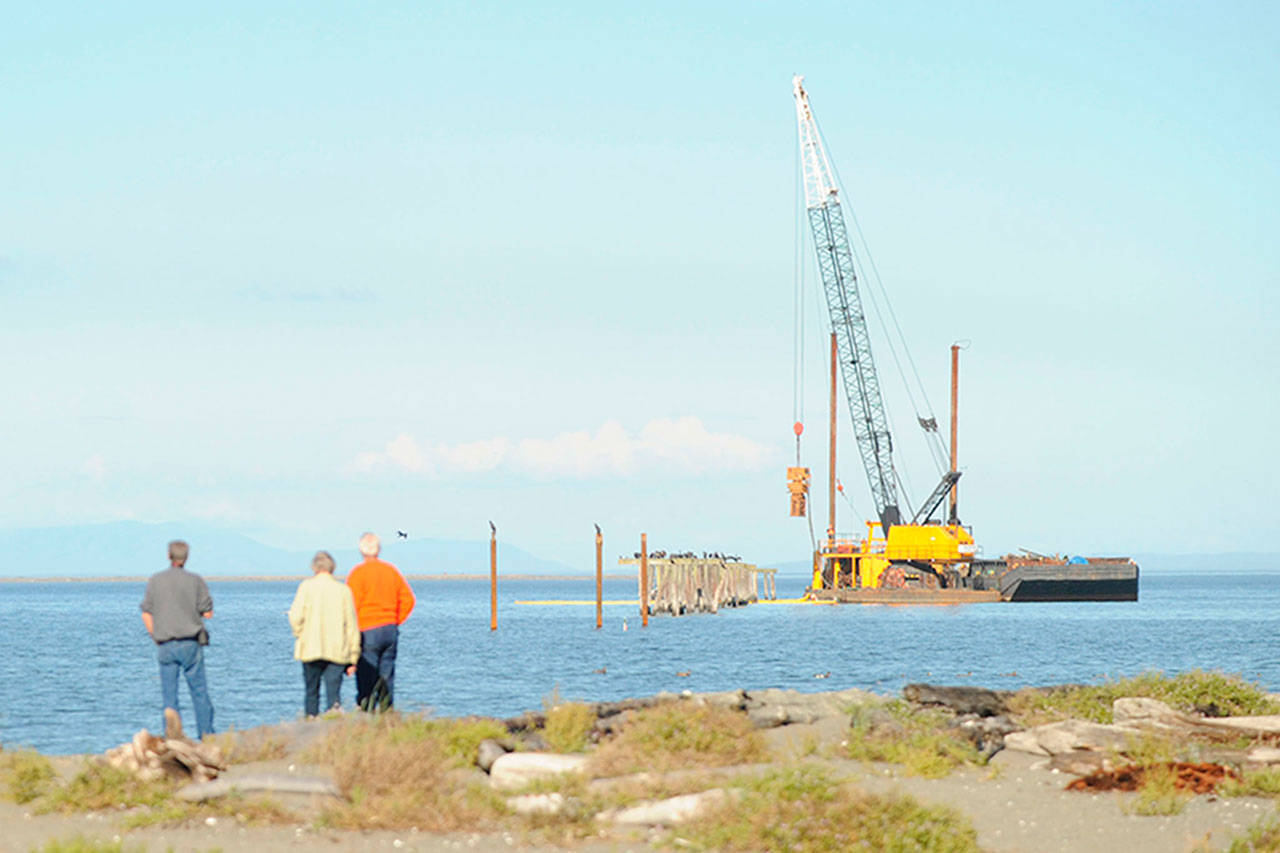
SEQUIM — A weather-worn landmark on the North Olympic Peninsula is making way for improved habitat for salmon, other sea-going creatures and Peninsula residents.
Creosote-laden pilings from the wharf at Dungeness were removed over three days earlier this month, a grant-funded project that looks to reestablish eelgrass beds along with removing toxic substances from the Strait of Juan de Fuca.
Kevin Long, project manager for the North Olympic Salmon Coalition, said the project was part of initial plans in the Three Crabs Estuarine and Nearshore Restoration Project that removed infrastructure, fill and armoring at the site of the former 3 Crabs Restaurant and was completed in 2016.
Funding, primarily through the state Department of Ecology’s Floodplain by Design Program, eventually came through to remove the pilings at Dungeness this fall.
Workers with Aberdeen-based Quigg Bros. used a crane to pluck 171 pilings from Dungeness Bay before loading them onto a barge between Oct. 8 and 10.
Depending on its toxicity level, creosote can be dangerous to many organisms — fish, birds, amphibians and mammals. It can be a cause of cancer and mutation or malformation of embryos and fetuses, according to the state Department of Natural Resources.
Not only toxic in the water, damaged creosote logs that wash up on shore become a danger for beach-going humans and nearby shellfish beds, Long said.
Long said the project was part of former Gov. Christine Gregoire’s goal to have all creosote removed from Puget Sound by 2020.
“We’re just continuing that effort,” Long said. “It’s just not good stuff to have out there.”
The pilings also had an effect on eelgrass beds located near what would be the northern end of the wharf, Long said, acting as barriers either from their physical placement or as shade from the sun.
The eelgrass beds are key migration corridors for juvenile salmon and other species, Long said.
“Between those two things,” Long said, “(the piling removal) was kind of a no-brainer.”
The recent piling removal project did add something to the landscape, Long noted.
Three steel pilings replaced some creosote-laden wood ones that will be used in efforts to help recover numbers of purple martins.
That species has lost shoreline nesting habitat in recent years, and the Admiralty Audubon Society looks to help boost the purple martin population with nesting boxes atop the steel pilings, to be put in place next spring.
While the structure was a local landmark, Long said state historic preservation officials determined the old wharf did not need to be restored or replaced.
“It’s a common thing we hear; people who are supportive of restoration in general are history buffs,” Long said.
“It means something to them. People get used to a sunrise or a sunset behind that (wharf) and we changed that.
“The reality is, Mother Nature was taking this structure one piling at a time,” he said. “It was going out eventually. We took a bunch of toxic, nasty stuff out of the environment (with this project).”
A brief history
With pilings of the old Dungeness Wharf removed, only the memory of a bustling Dungeness town remain.
According to history books, the Dungeness Dock was built by C. F. Seal in the fall of 1890 and finished in the spring of 1891. It was more than 4,300 feet long — almost three-quarters of a mile.
Seal was president of the Groveland Improvement Company and owner of Farmers Mercantile Company at the time.
“The new town of Dungeness grew around a new dock built a mile and a half eastward into deep water. This became the main shipping for the county,” according to an excerpt by Virginia Keeting in “Jimmy Come Lately, History of Clallam County.”
“The town grew and the valley prospered, as reflected in the dock cargo manifests.”
At the foot of the dock was a creamery, and butter was shipped to many markets from Dungeness, along with other produce, such as eggs, milk, cream, dressed hogs, potatoes, apples, crabs, clams, turkeys, hides, wool and pelts.
The Port of Port Angeles bought the dock in 1925 for $1,500. The commission rebuilt the dock and it remained in use until April 1941 when the creamery notified it no longer had use for it. The date of the last revenue was 1921.
“Out in the water stands a double row of ragged piling(s), all that remains of a time when wood burning steamers puffed in and out of the bay, freight wagons rumbled over the dock, and Dungeness was a bustling town.”
Resident perspective
Several residents last week came out with binoculars and cameras to take a look at what was going on in their neighborhood.
Tom Cook, a resident who lives near Three Crabs Road, came out to the beach to look at the pilings removed last week and said he remembers playing on the dock when he was a child in the 1950s and 1960s.
He was born and raised in the area and has lived there much of his life, he said.
“This really is sad to see it go,” Cook said. “There’s so much history and all of a sudden it’s just taken away from us across the street in the place I grew up in.”
Art Rogers, 82, said he grew up in the Dungeness area and has several memories of the old Dungeness wharf from when he was a young boy.
“I used to ride my bike out there with all the kids,” Rogers said.
He said there used to be an old storage house at the end of the dock, and remembers cars driving out on the dock one at a time. At one point, he remembers the dock being closed to traffic in the early 1940s and said after that hunters would go out on the dock to shoot ducks.
Rogers recalled watching the old wood burning boats coming and going from the docks that would burn wood for power.
________
Michael Dashiell is the editor of the Sequim Gazette of the Olympic Peninsula News Group, which also is composed of other Sound Publishing newspapers Peninsula Daily News and Forks Forum. Reach him at editor@sequimgazette.com.
Erin Hawkins is a reporter with the Olympic Peninsula News Group, which is composed of Sound Publishing newspapers Peninsula Daily News, Sequim Gazette and Forks Forum. Reach her at ehawkins@sequimgazette.com.
