
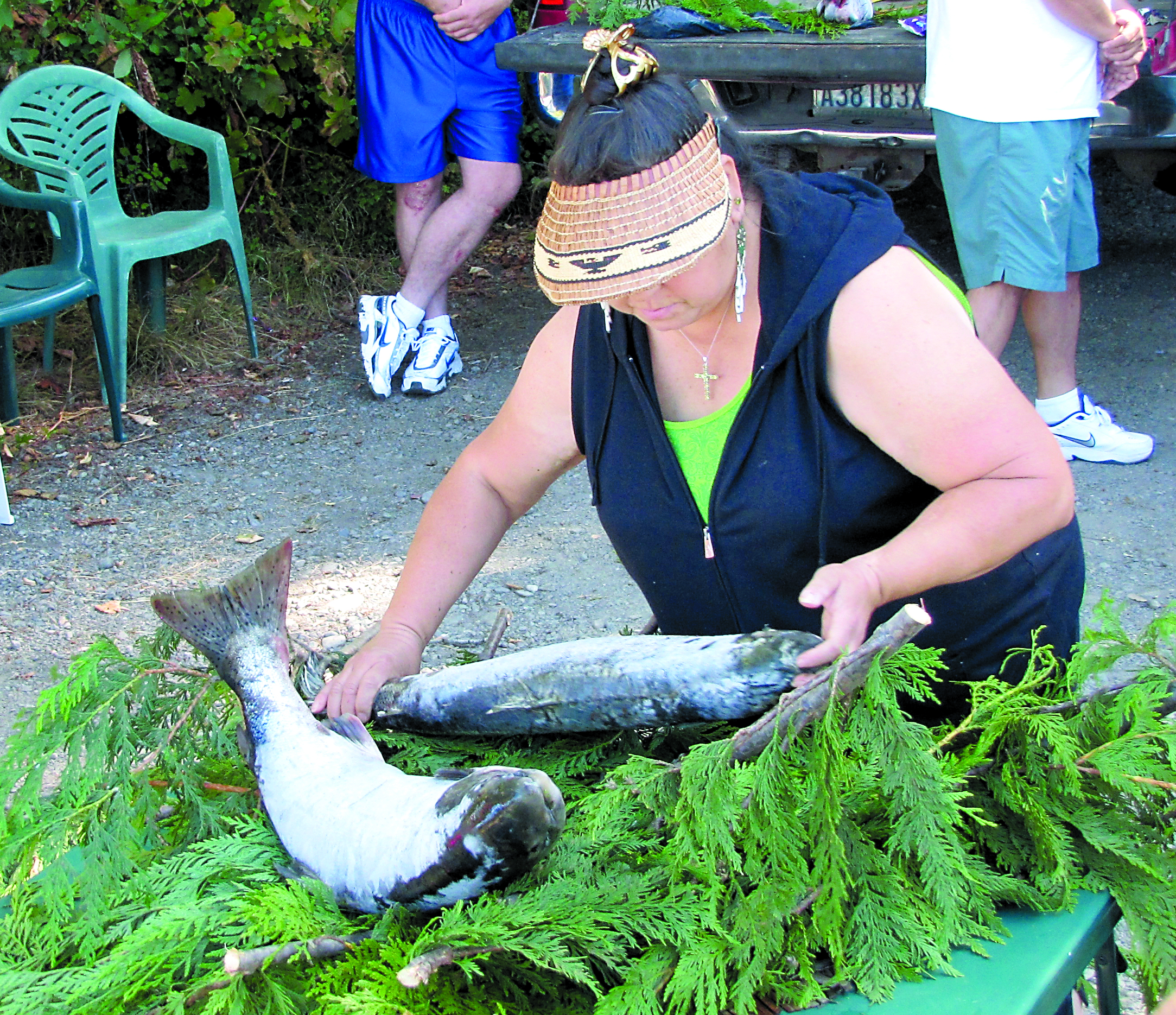
PORT ANGELES — Members of the Lower Elwha Klallam tribe welcomed salmon back to the Elwha River during a ceremony Thursday morning.
About 40 members of the tribe, based west of Port Angeles, assembled on the east bank of the Elwha River and thanked their creator for the annual return of the king salmon, also known as chinook salmon, which is one of seven species known to have spawned in the river.
The tribe has been performing the ceremony since it was revived in 1990, re-created from stories by tribal elders of how the tribe always offered their thanks for the salmon and other things, said Rachel Hagaman, Elwha economic development and fisheries policy committee member.
This year was special, since salmon can swim above the Elwha Dam site for the first time, giving the big fish 8 more miles of riverbed and several tributaries for spawning and for young salmon to colonize.
“There are already reports of salmon returning,” tribal elder Ben Charles said.
Demolition of Elwha Dam— which was built about 5 miles from the mouth of the Elwha River, with construction beginning in 1910 and ending in 1914 — was completed in March, freeing the river up to Glines Canyon Dam, 8 miles upriver.
The 85-year-old Glines Canyon Dam has been knocked down to less than half its original 210-foot height and is expected to be completely gone by early next summer.
The dam demolition is part of the National Park Service’s $325 million restoration project to return the river to its wild state. The tribe is a partner in the project.
Standing on the east bank of the river mouth, Charles spoke to the assembled tribe members and offered a prayer to the creator.
Gains in river restoration seen since demolition work began in September — which includes wild steelhead spotted above the Elwha Dam site in June and the waters receding from the tribe’s creation site in July for the first time in nearly a century — are an answer to the tribe’s prayers, he said.
“Some [of the prayers] have been going on for 100 years,” he said.
“It’s amazing to look and see what’s happening all up and down our river.”
Children from the Elwha tribe day-care center placed small pieces of cedar boughs on a bed of larger boughs, symbolizing their future being closely tied to the river.
“Give them hearing ears, open eyes, open minds and the understanding of the things taking place during their time,” Charles said in his prayer.
Hagaman, with two other members of the tribe, placed two king salmon on the cedar bed and set it in the river to float downstream.
King salmon can be found in the Elwha River beginning in late May, but their numbers peak in mid-August.
The run in the Elwha was legendary, with stories of salmon weighing 100 pounds and swimming in schools that filled the river, before the dams were built without fish ladders.
The dams blocked access to the 70-mile river where salmon had spawned for thousands of years, and the salmon population plunged to a few thousand annually.
Salmon now are stopped 13 miles upriver, where Glines Canyon Dam still stands 90 feet above the canyon floor.
The hope is that the 2013 salmon run will be throughout the entire river system.
The siltiness of the river has made it more difficult to count the returning salmon this year, so the tribe is using a sonar camera to count fish as they pass, said fish biologist Mike McHenry.
King salmon fry, suspected to be the offspring of 24 adults that were released above Glines Canyon Dam last year, have been spotted in the “middle reach” of the river, between the two dam sites, McHenry said.
A fish weir has been set up to capture some wild kings for their offspring to be raised and returned to the river to provide the next generation, while other salmon will be able to pass to naturally repopulate the 13 miles of river that currently are accessible, he said.
There is currently a five-year moratorium on fishing on the river — for tribal, commercial and sport fishermen — to allow the salmon to begin to repopulate the river.
________
Reporter Arwyn Rice can be reached at 360-452-2345, ext. 5070, or at arwyn.rice@peninsuladailynews.com.
