
Peninsula Daily News news services
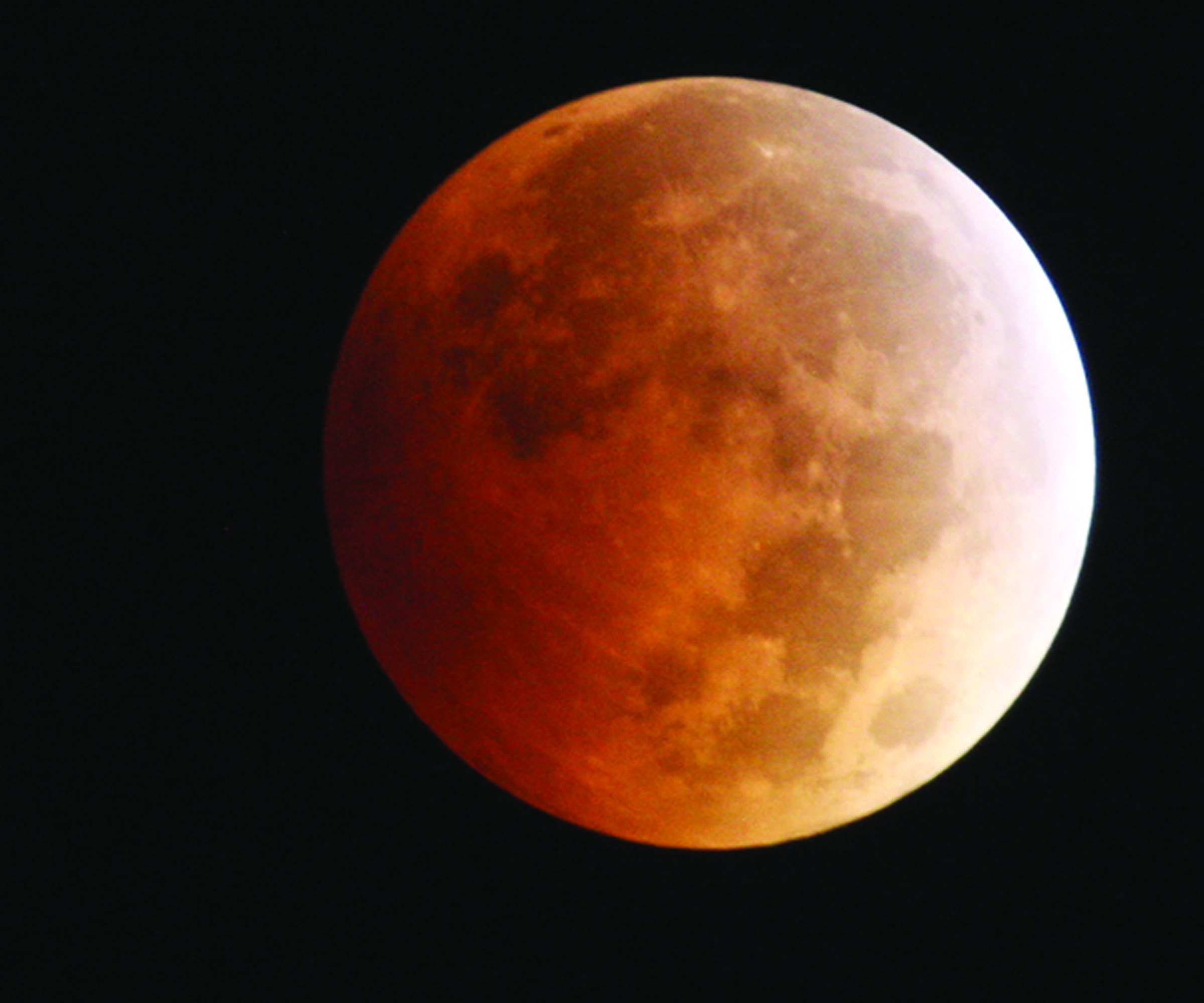
SUNDAY NIGHT WILL bring not only a “supermoon,” the closest and therefore biggest-looking full moon of the year, but also a lunar eclipse and a “blood moon.”
Cross your fingers for clear skies.
It hasn’t happened in 33 years and won’t again for another 18 years — this is the first supermoon eclipse since 1982 and the last until 2033.
In addition, this is also the fourth and final eclipse in a tetrad — four consecutive total lunar eclipses, each separated by six lunar months — which has helped prompt end-of-the-world doomsday declarations from all corners of the Internet.
What is a blood moon?
A supermoon occurs when a full moon happens at the closest point in its elliptical orbit around Earth, making the full moon appear up to 14 percent larger and 30 percent brighter than usual.
A lunar eclipse occurs when the moon is directly opposite the sun, with the Earth in the middle.
“Blood moon” refers to the reddish color our celestial neighbor often takes on during an eclipse.
Supermoon eclipses have occurred just five times since 1900 (in 1910, 1928, 1946, 1964 and 1982).
“Normal” lunar eclipses are much more common.
In fact, an observer at any particular location around the globe can expect to see a total lunar eclipse about once every 2.5 years on average.
The first three eclipses in the unusual lineup of eclipses called a tetrad took place April 15, 2014; Oct. 8, 2014; and April 4, 2015.
September’s full moon, traditionally known as the Harvest Moon, happens just four days after the autumn equinox. Tradition says its glow helps farmers work into the night gathering crops.
With the moon high in the eastern sky, the total eclipse will start at 7:11 p.m. and last for one hour and 12 minutes Sunday.
Almost a half-hour earlier, the Harvest Moon will reach perigee, the closest approach to the Earth in its orbit, at 6:46 p.m.
It will be about 221,750 miles away — more than 17,000 miles closer than its average distance.
It becomes full at 7:50 p.m., but by then, the moon’s larger-than-life face will be engulfed in Earth’s shadow, deep into totality.
The eclipse hits its peak at 7:48 p.m. and ends at 8:23 p.m.
During this event, the Earth’s shadow will block light from the sun that normally reflects directly off the moon.
Instead, light refracts around the edges of the Earth to give the moon a reddish-orange glow of sunset — hence the “blood moon” nickname.
You don’t need special glasses or gizmos to watch it, unlike a solar eclipse.
Feel free to stare directly at the moon, or use binoculars or a telescope.
NASA will provide a live video feed on the Internet (www.nasa.gov) of the entire eclipse — an option in case clouds obscure your own view.
In Forks, stars in the sky
As a warm-up to Sunday’s rare celestial happening, the Olympic Natural Resources Center in Forks is featuring a special program by graduate students in the University of Washington’s astronomy department.
The students will bring a mobile planetarium, which provides a close-up view of the sky at night, to the center at 1455 S. Forks Ave.
Two free programs — each about 20 minutes long — will be offered Saturday.
The first, set from 1 p.m. to 3 p.m., will be a family-focused program, with presentations and activities for children.
The second session, from 7 p.m. to 9 p.m., will be for adults, with more in-depth presentations.
Visitors “will be immersed in a night sky”: They will see the stars move and hear information about them.
The planetarium’s dome, created by the company Go-Dome, is an inflatable room resembling an igloo.
At about 10 feet high and 20 feet across, the dome can fit about 25 people.
It is a fully functional planetarium that offers many of the same images as the high-tech planetarium at the UW.
The planetarium runs Microsoft Research’s World Wide Telescope software on a laptop computer.
A large hemispherical mirror projects the high-density image from the back of the dome across three-quarters of its interior.
For more information, contact F. Hanson at 360-374-4556 or fsh2@uw.edu.
