
PORT ANGELES — Lower Elwha Klallam people stood at their sacred creation site last month for the first time in nearly a century, the tribe announced last week.
“It isn’t a myth,” Tribal Chairwoman Frances Charles said Thursday about the site the group visited in early July.
“It’s a reality, what our elders have been saying all along. It’s there.”
In addition, the park service also reported finding a site in a nearby location that documents human use as far back as 8,000 years ago, establishing it as one of the oldest known archaeological sites on the Olympic Peninsula.
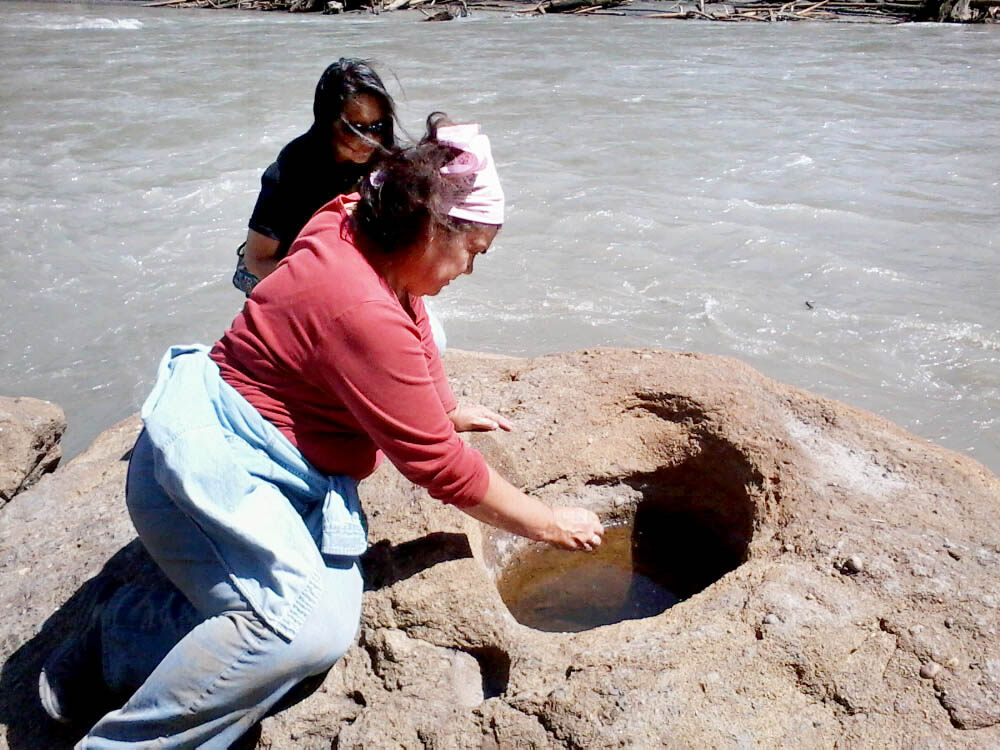
The creation site is a rock with two deep depressions that was covered by water behind the Elwha Dam after it was built in 1913.
Oral tradition and recorded reports dating as far back as 1919 describe the rock as the place where the Creator bathed and blessed the Klallam people and other tribes, said Jamie Valadez, Klallam language instructor.
It also was a place for vision quests, where tribal members would discover their calling in life, she said.
But no one alive today had ever been to the sacred place.
That changed with the demolition now occurring of the two dams on the Elwha River.
The dams’ dismantling began last September as part of a $325 million Elwha River Restoration Project undertaken by the National Forest Service at the urging of many — especially the tribe — to restore the river and its salmon runs.
Elwha Dam, built about 5 miles from the mouth of Elwha River, was gone by March.
Glines Canyon Dam, built upriver in 1927, is expected to be fully removed by early summer 2013.
As the water receded behind the Elwha Dam, Olympic National Park archaeologists informed the tribe in July that the sacred site had been uncovered, Charles said.
‘Power of the rock’
Within days of the news of the legendary creation site, about a dozen people, including some children, walked to it.
“You could feel the power of the rock,” Charles said. “You could feel the emotions. It was really overwhelming,”
“There were a few songs and prayers and just the overwhelming joy of realizing that this is reality. It’s not a myth.”
The walk to the sacred rock was very emotional, Charles said.
“There are really no words that can express it, walking on that land that has been covered for 100 years,” she said.
“We saw the cedar tree stumps. The grass is starting to get green.
“Everything is being exposed,” she added.
“Everything is coming back to life.”
Like a coil basket
The creation site’s name is the Klallam word for coil basket because the holes reminded the Lower Elwha of them, Valadez said.
Valadez was one of those who brought pendants and filled them with water from one of the depressions in the rock.
“We filled them with water from the creation site and made necklaces for our elders,” she said, adding that her necklace went to Adeline Smith.
The creation site is only one of many areas on the river important to the Elwha.
The whole river is sacred, Valadez said.
“We don’t have stories of migration from other places,” she said.
8,000-year-old site
Radiocarbon analysis of a second “culturally sensitive site” found recently on the Elwha River showed that people had lived there as far back as 8,000 years ago, according to Olympic National Park officials.
The second discovery is one of the oldest known archaeological sites on the Olympic Peninsula, the park said.
Material from the second site was collected for further study, and the site was reburied.
Like the creation site, it was recently discovered in an area that had been covered by one of the two lakes that had been behind the dams.
Both sites are off limits to the public, and no specific location information has been released.
“Because of the sensitivity of these sites, we will not be releasing more detailed location information,” said Olympic National Park Acting Superintendent Todd Suess.
Park rangers are offering interpretive walks of portions of the drained lakes — for information, go to www.nps.gov/olym/parknews/elwha_exploration.htm.
“We’re going to continue to find evidence of our history,” predicted Charles, adding that the Lower Elwha lived all up and down the river, and in the Olympics.
The discoveries have fueled the tribe’s desire to steward land being uncovered as the lakes recede, according to The Seattle Times.
The newspaper quoted Suess as saying that the National Park Service eventually wants to launch a public process to decide the long-term disposition of the land.
The tribe was named one of several possible recipients of the new land under congressional authorization of the dam removal in 1992. Other possibilities include setting it aside as a state or national park or as a national wildlife refuge.
Tribal elders have told stories of the Elwha, and the creation site, for generations.
Tribal members told anthropologist T.T. Waterman about the rock in 1919, Valadez said.
That was followed by reports in 1925 by University of Washington anthropology professor Erna Gunther and in 1952 by another anthropologist, Wayne Suttles.
“They were recording elders at different times, and they all described the site,” Valadez said.
Although knowledge of the creation site was kept alive by the elders, none have been able to visit it so far.
“It was a challenge to get there,” Valadez said.
“Our elders want to go there, if it were made more possible,” she said.
One of those is Ben Charles, 74, who saw the rock underwater when he was a child of preschool age following his fisherman brother in walks along the river.
“He would point down at the creation site . . . It took me awhile to see what he was talking about because it was under water. I’d look and look, and all I’d see was water,” the Klallam elder said.
“He finally told me, you have to look beyond the water and see the bottom.
“I finally did see what he was pointing out.”
Ben Charles said he was excited when he heard that the rock had been uncovered.
“I texted back a message saying, ‘I want to go,’” he said.
He has been told it is a difficult hike, but, he said, “as a child I made it and I believe as an elder I could make it yet.
“Sometime, I’ll give it a try.”
________
Managing Editor/News Leah Leach can be reached at 360-417-3531 or at leah.leach@peninsuladailynews.com.
