
By RACHEL LA CORTE, Associated Press
By GENE JOHNSON, Associated Press
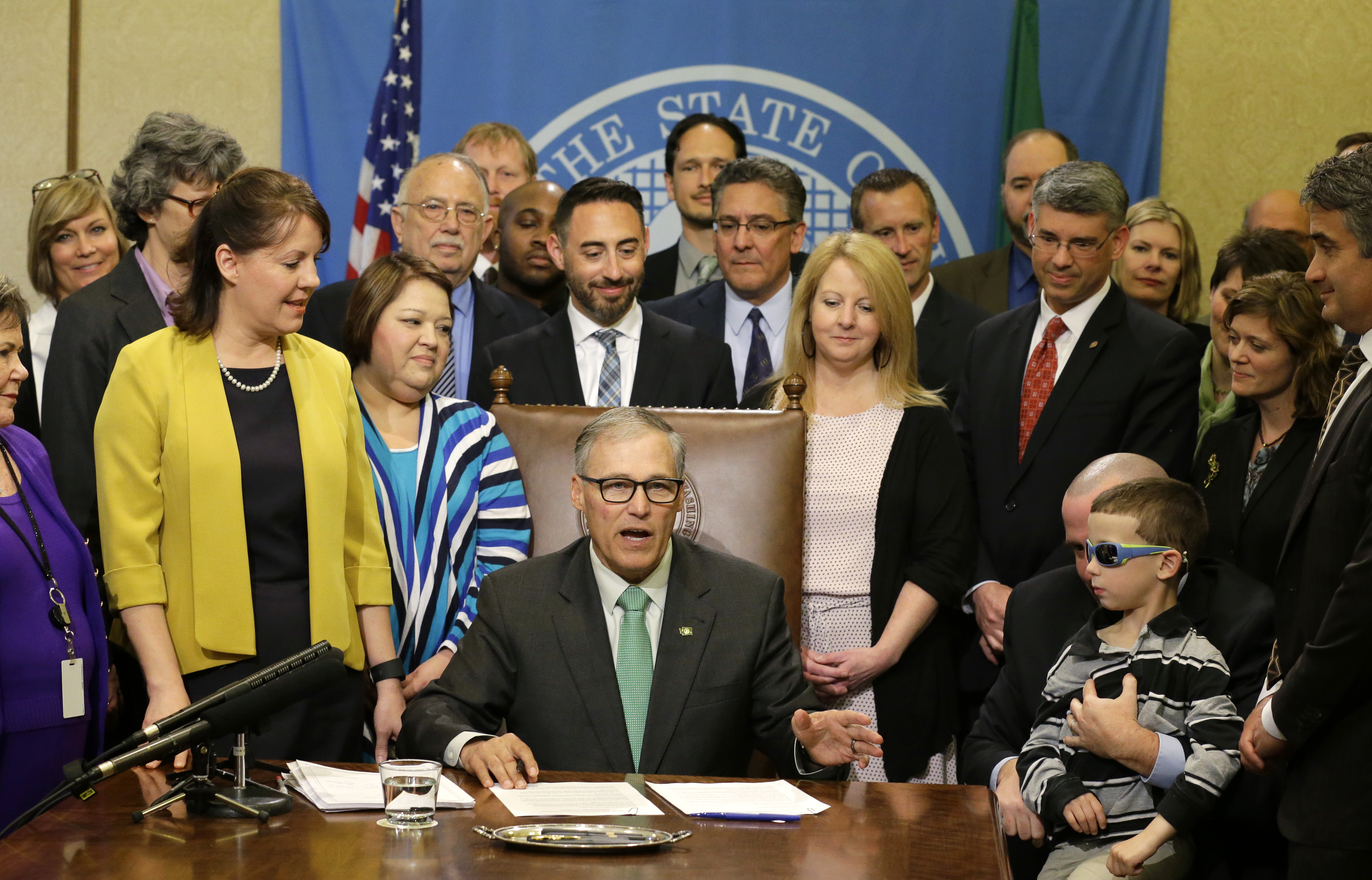
OLYMPIA — Nearly two decades after voters passed a medical marijuana law that often left police, prosecutors and even patients confused about what was allowed, Gov. Jay Inslee signed a bill Friday attempting to clean up that largely unregulated system and harmonize it with Washington’s new market for recreational pot.
The new legislation is effective July 1, 2016.
Among the law’s many provisions, it creates a voluntary registry of patients and, beginning next year, eliminates what have become in some cases large, legally dubious “collective gardens” providing cannabis to thousands of people.
Instead, those patients will be able to purchase medical-grade products at legal recreational marijuana stores that obtain an endorsement to sell medical marijuana, or they’ll be able to participate in much-smaller cooperative grows, of up to just four patients.
And those big medical marijuana gardens will be given what lawmakers describe as a path to legitimacy: The state will grant priority in licensing to those that have been good actors, such as by paying business taxes.
“I am committed to ensuring a system that serves patients well and makes medicine available in a safe and accessible manner, just like we would do for any medicine,” Inslee wrote in his signing message to the Legislature.
The proliferation of green-cross medical dispensaries has long been a concern for police and other officials who decry them as a masquerade for black-market sales. Some proprietors of new, state-licensed recreational pot businesses — saddled with higher taxes — called them unfair competitors.
Washington in 1998 became one of the first states to approve the use of marijuana for medical purposes, but the initiative passed by voters did not allow commercial sales. Instead, patients had to grow the marijuana for themselves or designate someone to grow it for them. The measure did not prohibit patients from pooling their resources together to have large collective gardens on a single property, but the size of some made law enforcement queasy, and raids sometimes resulted.
Medical marijuana growers repeatedly sought legislation that would validate their business model, coming closest in 2011, when the Legislature approved a bill to create a licensing framework for medical dispensaries. But then-Gov. Chris Gregoire vetoed much of the measure.
This time, with the state seeking to support its nascent recreational pot industry after the passage of Initiative 502 in 2012, there was a financial impetus to pull the medical users into the recreational system. The recreational businesses pressed for a tight rein on the medical industry with newfound lobbying muscle, and the medical businesses countered with some of their own.
That left advocates concerned that the people who are actually sick were the ones losing out. Under the new system, patients will be buying more heavily taxed marijuana, and they’ll be allowed to grow fewer plants at home.
“This is pejorative to patients while being friendly to those who are in the business of patients,” said Muraco Kyashna-tocha, who operated a Seattle medical dispensary. “There are sincere patients who don’t have any money. They’re cancer patients who are being bankrupted by their treatment.”
Under the new law, patients who join the voluntary registry will be allowed to possess three times as much marijuana as is allowed under the recreational law: 3 ounces dry, 48 ounces of marijuana-infused solids, 216 ounces liquid and 21 grams of concentrates. Such a patient could also grow up to six plants at home, unless authorized to receive more.
Patients who don’t join the registry can possess the same as the recreational limit of 1 ounce, and grow up to four plants at home — which recreational users can’t.
Sen. Ann Rivers, a Republican from La Center who was the sponsor of the measure, said that part of the reason the registry is so important is to find out if there are enough stores providing medical products to patients.
“We have no idea how many patients we have in this state,” she said.
Inslee, who vetoed some minor sections of the bill, was joined during the signing by Ryan Day and his epileptic 6-year-old son, Haiden. Day says the boy’s seizures have been managed with an extracted liquid form of marijuana.
Day said the new law gives his family more certainty.
“We were under the threat every single year that the system was going to change in a way that was going to take away my ability to help my son,” he said.
