
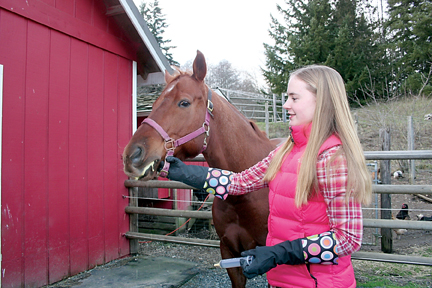
A “cinchy horse” is a common term among horse folks.
It means a horse might turn his mouth and snap or dance around and act cranky when tightening the saddle’s cinch around his girth.
At the least it’s very annoying; at times even dangerous.
Such was the case for Sophie Marchant, 15, and her horse Trooper.
Not only would he snap at her, but, out of his extreme dislike, he’s thrown himself over backward on to his back.
Thankfully he wasn’t hurt, but why was he so cinchy?
Sadly, many write the horse off as “a problem horse with issues.”
Frequently, they try to sell or give the horse away without spending the time to find the root cause.
Then, there are those dedicated horse lovers like young Sophie who try to work through the horse’s issues but lack the experience to truly figure out how to get past it.
True animal commitment
I’m sharing her story because it’s one of true animal commitment. It shows that horse care sometimes is not for the faint-hearted and that she needed outside help to find the answer.
When Sophie and her self-described “non-horsey parents,” brought home her red-roan-colored quarter horse three years ago, she soon discovered his problem wasn’t that the 4-year-old was just “too much horse” for his previous owners; it was that the skittish horse wasn’t properly introduced to the saddle, and he likely had chronic pain issues in his gut.
The problem might never have been discovered had he not gotten hurt attempting to jump over his stall’s lower Dutch door and received a huge gash under his belly.
The attending veterinarian wasn’t told about Trooper’s cinch problem, but it was an important connection.
The veterinarian taught Sophie, then 13, how to care for his wounds including using massage and physical therapy along with flexing techniques to help get him well again.
When he healed, she began taking riding lessons, learning various methods to help overcome some of his issues.
The two seemed to be progressing well together until last summer, when the family noticed Trooper was not looking well and started losing weight.
A trip to Pilchuck Veterinary Clinic in Snohomish and an ultrasound showed the horse had a large abdominal mass measuring 15 by 18 centimeters.
Treated it aggressively
At that time, they hoped it was not cancer, and the veterinarians treated it aggressively with heavy antibiotic dosing.
Actually, the veterinarians will never know if the abdominal mass in his stomach was caused by those severe cuts and bruising from the stall door accident or if it was pre-existing.
But from November through the end of January, Sophie has been preparing two large syringes of medicine, crushing 17 large tablets and mashing it with a little water and feed pellets and stuffing it into the syringe and then plunging its contents into the back corner of Trooper’s mouth three times a day.
That’s 55 tablets a day.
Her mother, Deborah, told me that for the past three months, Sophie’s been getting up at 6:30 in the dark morning to give Trooper his first dose before she goes to school and then immediately after school, and “after we’re all cozy getting ready for bed, Sophie goes back out in the dark at 9 p.m. to give Trooper his last dose.”
Imagine trying to pay for all of Trooper’s veterinarian care.
When I found out to date they have spent upward of $2,500 just in pharmaceuticals, let alone the veterinarian visits and imaging costs, I asked Deborah if they ever considered the alternative, which is to put him down and end the horse’s suffering.
“It’s not like we planned on spending the money or thought it through,” said Deborah.
“We’ve definitely gone through the expenses, and it’s not been easy,” she said.
She said somehow they’re managing it, and the family’s all made sacrifices to make it happen.
Trooper’s now ended the maximum time he can be on antibiotics, and he’s still not fully recovered, so at this point, Sophie and Deborah are researching natural ways to help build up his immune system and get a healthy gut.
While Trooper’s not out of the woods yet, he is on the road to good health and to hopefully becoming the riding horse Sophie desires.
Even if he doesn’t, Sophie, who has decided to become a veterinarian, is in it for the long haul.
Could she do it without the help and support of her parents?
In a word, no, Deborah said, and she does not think they could have done it without the support of the girl’s 4-H group, Silver Spurs.
“We’ve felt a lot of support from our 4-H group. If it was just our little family coping with this by ourselves, I don’t know how we could have done this.
“Sometimes as parents, we get tired of all this extra work, but the other 4-H parents are so encouraging.”
And hopefully when he’s fully healed, Trooper will no longer be cinchy.
________
Karen Griffiths’ column, Peninsula Horseplay, appears the second and fourth Sunday of each month.
If you have a horse event, clinic or seminar you would like listed, please email Griffiths at kbg@olympus.net at least two weeks in advance. You can also write Griffiths at PDN, P.O. Box 1330, Port Angeles, WA 98362.
