
By Gene Johnson
The Associated Press
SEATTLE — A King County jury has awarded the Lummi Indian tribe $595,000 over the 2017 collapse of a net pen where Atlantic salmon were being raised — an event that elicited fears of damage to wild salmon runs and prompted the Legislature to ban the farming of the nonnative fish.
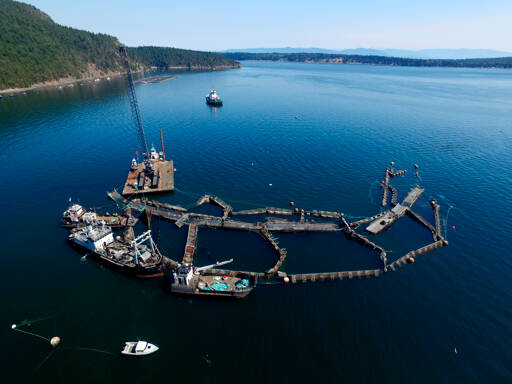
About 250,000 Atlantic salmon escaped into the Salish Sea when the net pen owned by Cooke Aquaculture — an anchored, floating enclosure off Cypress Island — collapsed. The northwest Washington tribe quickly mobilized to capture the fish, and Cooke paid a bounty of $30 apiece for the more than 43,000 recovered by the tribe’s fishers — $1.3 million in all.
The Lummi Nation sued in 2020, saying that while the fishers themselves had been compensated for their efforts, the company had not reimbursed the tribal government for responding to the spill, including organizing the fishers and tracking the Atlantic salmon they brought in.
In addition, the tribe sought damages for what it described as the “existential threat” the collapse posed to its culture.
The King County Superior Court jury on Wednesday declined to award damages on that cultural harm claim, but it did grant the tribe $595,000 on its claims of negligence and unjust enrichment against Cooke, the tribe’s attorneys said.
Lummi staff attorney James Stroud said in an email the tribe was pleased the jury found the tribe should be compensated for having to “clean up Cooke’s mess.”
“While we regret having to litigate this issue, the Lummi Nation remains committed to improving the health of the waters of the Salish Sea,” Stroud wrote.
A spokesperson for Cooke Aquaculture, Joel Richardson, said the company accepts the verdict and will not appeal.
“We understand that salmon is sacred to the Lummi Nation’s ancestral tradition, tribal mythology and living culture,” he wrote in an email.
“We look forward to continuing dialogue with the Nation to understand their perspectives and needs. … As a company with both wild and farmed fish interests, we share a commitment and expertise that we believe can be beneficial to the Lummi Nation.”
According to its website, Cooke Aquaculture has more than 10,000 employees in nine countries.
The state Department of Ecology fined the company $332,000 over the collapse, which it blamed on negligence, including poor maintenance of the nets.
Cooke also agreed to pay $2.75 million to settle a Clean Water Act lawsuit brought by the organization Wild Fish Conservancy. That money was directed toward environmental projects benefiting salmon and orcas in Puget Sound, as well as toward the group’s legal fees.
At the time of the collapse, Cooke officials said they were planning to upgrade the net pens.
Since the Legislature banned the farming of nonnative Atlantic salmon in the state’s marine waters in 2018, Cooke pivoted to farm steelhead, a native species, with fish altered in the hatchery to be sterile.
The state Supreme Court in January unanimously upheld Cooke’s permits to do so.
That bolsters a 2019 agreement between Cooke and the Jamestown S’Klallam Tribe to rear all-female native steelhead in the Port Angeles Harbor.
DNR had terminated Cooke’s lease for a salmon fish farm in Port Angeles Harbor in December 2017, citing violations at the farm, which was growing 690,000 Atlantic salmon that included a defective anchoring system, Styrofoam discharges that were occurring at the site and fish-farm operations that were placed outside of the leasehold area.
In the Lummi lawsuit, Cooke had argued that there is no evidence any of the escaped Atlantic salmon survived past April 2018. Indeed, the company’s lawyers noted, even when humans have tried to establish Atlantic salmon populations along the West Coast, those efforts have failed.
“Atlantic salmon do not survive here and do not compete or breed with wild salmon,” they wrote in a trial brief. “Plaintiff itself attempted — and failed — to cultivate Atlantic salmon in Washington waters in the 1970s.”
________
Peninsula Daily News Executive Editor Leah Leach contributed to this story.
