
By Nicholas K. Geranios
The Associated Press
SPOKANE — Conservationists and others have renewed a push to remove four giant dams from the Snake River to save wild salmon runs, after a federal judge criticized the government for failing to consider whether breaching the dams would save the fish.
The judge earlier this year rejected the government’s fifth and latest plan for protecting threatened and endangered salmon in the Columbia River system.
Agencies must take a new look at all approaches to managing the southeast Washington dams, including breaching, said U.S. District Court Judge Michael Simon in Portland, Ore.
”This is an action that [government agencies] have done their utmost to avoid considering for decades,” he wrote.
His order triggered 15 public meetings in Washington, Idaho, Montana and Oregon, where the dam removal issue has percolated for two decades.
The first meeting was held last month, and the final one is scheduled for Dec. 8. After that, a plan to save the salmon must be created.
The Snake River, at just over 1,000 miles, is the 13th longest in the United States, flowing from the western border of Wyoming to its confluence with the mighty Columbia River in Washington. For much of its history, the river and its tributaries produced salmon runs in the millions that sustained Native American tribes who lived near its banks. The best salmon spawning grounds were in Idaho, and were hampered by the construction of the four dams.
Environmental groups said restoring the salmon runs is impossible with the four dams in place.
The dams provide about 5 percent of the region’s electricity, roughly enough power for a city the size of Seattle. A recent report by the federal Bonneville Power Administration said if the Snake River dams are removed, a new natural gas plant would be required to replace the lost electricity.
Thirteen runs of Columbia and Snake river salmon and steelhead remain endangered or threatened despite billions of dollars spent over decades to save them.
Sam Mace, a spokeswoman for Save Our Wild Salmon, said the dams’ benefits are not worth the loss of the iconic fish.
“There is more than one way to get wheat to market,” Mace said. “But salmon only have one way to travel, and that’s in the river.”
Salmon supporters say restored salmon runs will help the economy.
“Healthy salmon populations could support tens of thousands of jobs and billions of dollars annually in the recreation and tourism economy,” said Liz Hamilton of the Northwest Sportfishing Industry Association.
Idaho’s Nez Perce tribe also has called for removing the dams and restoring the fish to harvestable levels.
“The four dams on the lower Snake River have had a devastating impact on salmon,” said McCoy Oatman, the tribe’s vice chairman.
Opponents of breaching the dams say they provide irrigation, hydropower and shipping benefits, and allow grain barges to operate all the way to Lewiston, Idaho, more than 400 miles from the mouth of the Columbia River.
Wheat from as far as North Dakota is shipped downriver by barge for export to Asia. The Snake River also is used to transport about 60 percent of Washington’s wheat and barley crop to Portland. A tug pushing a barge can haul a ton of wheat 576 miles on a single gallon of fuel.
Northwest River Partners, which represents a coalition of businesses and river users, called the dams an important part of the regional economy.
“I think both salmon and the dams are co-existing,” said Terry Flores, director of the Portland-based group. “Why would you take out dams that are providing clean energy and billions of dollars’ worth of commerce?”
However, critics note the river’s barge traffic has experienced a 20-year decline because of competition from trucks and trains.
The four dams were built in the 1960s and 1970s, roughly between Pullman and the Tri-Cities.
Breaching them isn’t something that could be ordered by a court. Because the dams are federal projects, removing them would require action by Congress.
According to the Army Corps of Engineers, more than 90 percent of the river’s young fish survive passage through each dam’s fish ladders. But the total effect from dams and slackwater reservoirs adds up to mortality rates of 50 percent or more for Idaho-spawned fish as they migrate to the ocean. The fish then have to survive several years in the ocean before running the gauntlet of dams again when they return to the Northwest to spawn.
Removing the dams would provide migrating salmon with easier access to thousands of miles of pristine rivers and streams that even with climate change remain cold enough to support salmon and steelhead spawning, environmentalists say.
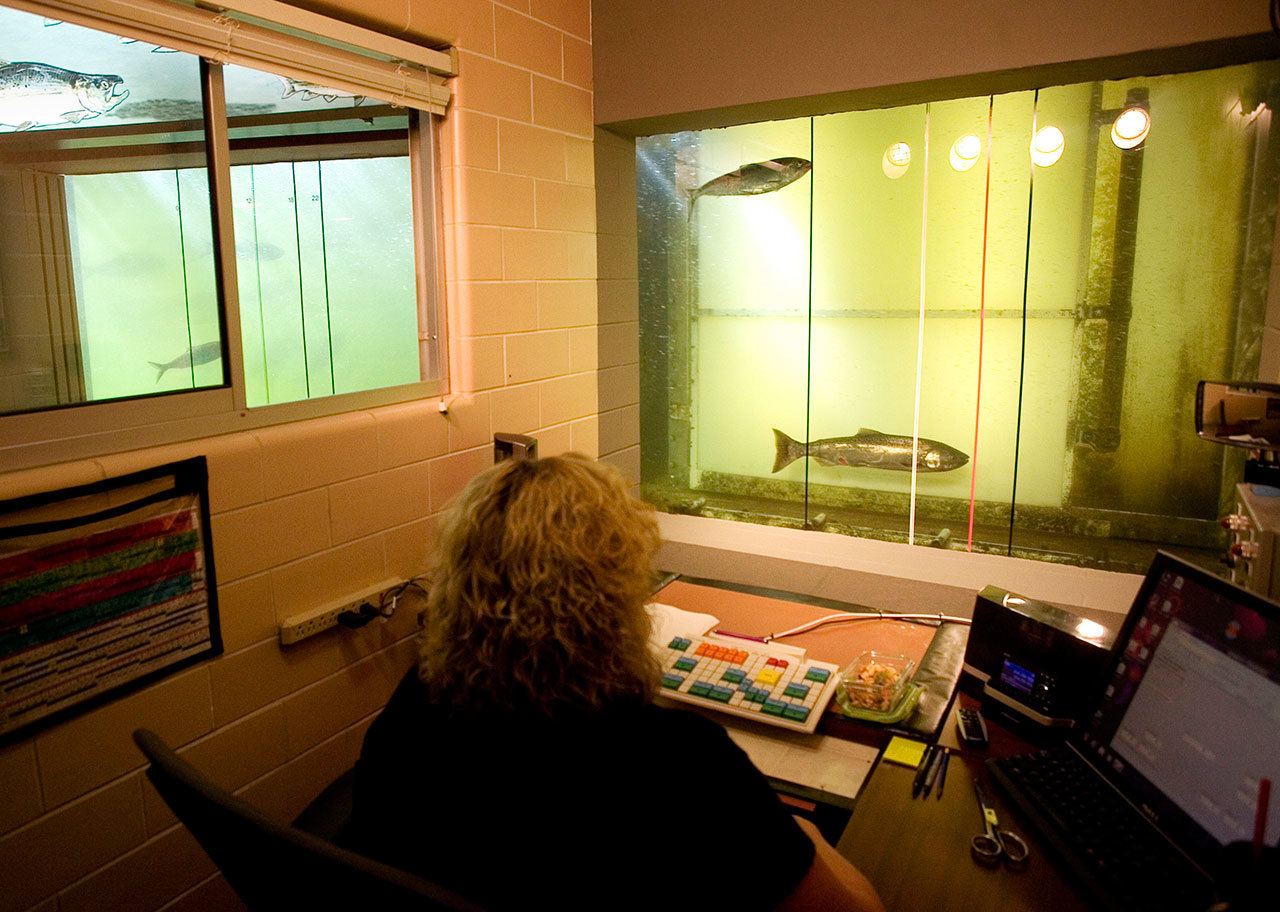
Debby Stallcop watches for sockeye salmon while counting fish coming through the fish ladder in July 2015 at Lower Granite Dam on the Snake River in Washington state. (Geoff Crimmins/The Moscow-Pullman Daily News via AP, File)
