
By Gene Johnson
The Associated Press
SEATTLE — An administrative law judge has recommended that the Makah Tribe once again be allowed to hunt gray whales — a major step in its decades-long effort to resume the ancient practice.
“This is a testament to what we’ve been saying all these years: that we’re doing everything we can to show we’re moving forward responsibly,” Patrick DePoe, vice chairman of the Makah Tribe in Neah Bay, said Friday.
“We’re not doing this for commercial reasons. We’re doing it for spiritual and cultural reasons.”
DePoe was in high school in the late 1990s when the Makah were last allowed to legally hunt whales — occasions that drew angry protests from animal rights activists, who sometimes threw smoke bombs at the whalers and sprayed fire extinguishers into their faces.
Since then, the tribe’s attempts have been tied up in legal challenges and scientific review. A federal appeals court ruled in 2002 that the Makah needed a waiver under the Marine Mammal Protection Act the tribe applied for one in 2005 but still hasn’t received one.
On Thursday, nearly two years after he presided over a hearing on NOAA Fisheries’ proposal to approve the waiver, administrative law Judge George Jordan issued his 156-page recommendation to the U.S. Department of Commerce, finding that the tribal hunts would have no effect on the healthy overall population of the whales.
The recommendation, along with a public comment period and further environmental analysis, will inform the department’s final decision, though no timeline for that has been set.
As proposed, the waiver would allow the tribe to land up to 20 Eastern North Pacific gray whales over 10 years, with hunts timed to minimize the already low chances of the hunters accidentally harpooning an endangered Western North Pacific gray whale.
While Jordan found the waiver’s issuance appropriate, he also recommended additional restrictions that could drastically cut the number of whales the tribe kills — perhaps as low as five whales over the decade-long waiver period. DePoe said the tribe is reviewing that recommendation but called it a potential source of frustration and further discussion.
“We are reviewing the recommended decision and early next week will open a 20-day public comment period as called for in our regulations,” NOAA spokesperson Michael Milstein said Friday in an email.
“This marks the beginning of the next phase of this process, which requires several more steps as described on [fisheries.noaa.gov].”
At the end of the 20-day period, NOAA’s Assistant Administrator for Fisheries Janet Coit, who oversees NOAA Fisheries, will decide about going forward with the waiver and final regulations, according to the website.
A decision to issue the waiver and proposed regulations would be followed by a formal rule-making process that would include a trial-type hearing and a final decision to grant or deny the request.
If the waiver is approved, it would go through a federal Marine Mammal Protection Act permit process which, if approved, would need to be authorized under the Whaling Convention Act, and the National Marine Fisheries Service would enter into a cooperative agreement with the tribe.
The Fisheries Service would publish annual notices allocating the U.S. quota of gray whales to the tribe, which would manage and monitor the hunt and file reports with the agency.
If the waiver request is denied, a final environmental impact statement would be published with a record of decision and responses to comments.
The tribe hopes to use the whales for food and to make handicrafts, artwork and tools they can sell.
Chuck Owens, who founded Peninsula Citizens for the Protection of Whales with his wife, Margaret Owens, said that they are reading thorugh the ruling before deciding their next step.
He said he appreciated the judge’s care of the endangered wester gray whales but worried about the future of local whales.
“For us, it is a win-lose,” the Joyce resident said Saturday. “He’s telling them to save and not harm or even harass the western grey whales but that puts more more pressure on resident whales.”
Illegal hunt
After the 1999 legal hunt, efforts renewed to have another hunt approved. Before that process was completed, in September 2007, five Makah men illegally shot and harpooned a gray whale that died of its injuries and sank in the Strait of Juan de Fuca.
Cascadia Research scientists determined it was a resident whale identified as CRC-175.
The Makah Tribal Council said the hunt did not have its permission.
Neah Bay residents Andy Noel and Wayne Johnson were sentenced to federal prison for their roles in the illegal hunt, Johnson to five months and Noel to 90 days.
Frankie Gonzales, Theron Parker and William Secor pleaded guilty to one misdemeanor count each of violating the Marine Mammal Protection Act and were placed on two years’ probation.
Opposing whale hunts
The Sea Shepherd Conservation Society and Animal Welfare Institute are among those who oppose the hunts. They argued that NOAA’s environmental review has been inadequate, that the Marine Mammal Protection Act may have voided the tribe’s treaty right, and that the tribe cannot claim a subsistence or cultural need to hunt after so many decades.
The Sea Shepherd Conservation Society said in an email Friday it was reviewing the decision and had no immediate comment. The Animal Welfare Institute did not respond to an email seeking comment.
Evidence presented to the government showed that the Makah, who now number about 1,500 members, have hunted whales for more than 2,700 years. The tribe’s 1855 treaty with the U.S. reserved the “right of taking fish and of whaling or sealing at usual and accustomed grounds.”
The Makah continued subsidence whaling until the 1920s, when they voluntarily gave it up because commercial whaling had devastated gray whale populations. The whale population rebounded in the eastern Pacific Ocean by 1994 — it’s now estimated at 27,000 — and they were removed from the endangered species list.
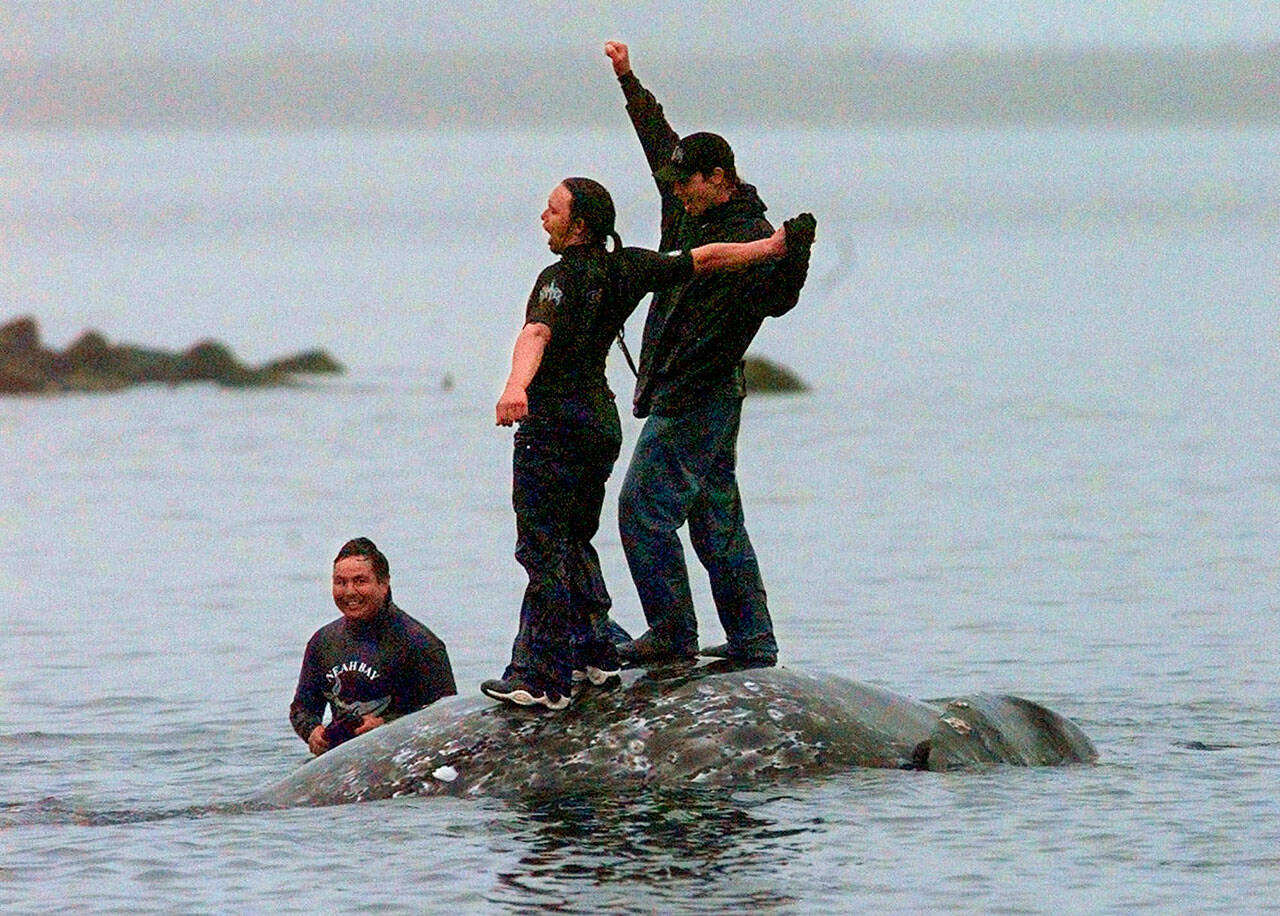
The Makah trained for months in the ancient ways of whaling and received the blessing of federal officials and the International Whaling Commission. They took to the water in 1998 but didn’t succeed until the next year, when they harpooned a gray whale from a hand-carved cedar canoe. A tribal member in a motorized support boat killed it with a high-powered rifle to minimize its suffering.
DePoe was on a canoe that greeted the returning whalers as they towed in the whale, and his high school shop class worked to clean the bones and reassemble the skeleton, which hangs in a tribal museum.
“The connection between us and the whales is strong,” he said. “Tribes across the Northwest have always considered ourselves stewards of the land, stewards of the animals. We’re not trying to do anything that is going to add to the depletion of these resources.”
________
Peninsula Daily News Senior Reporter Paul Gottleib contributed to this story.
