
WHEN JOHN HOPE was growing up in England in the 1950s, he’d spend weekends with an uncle who lived in St. Albans, north of London.
His uncle was a retired marine steam engineer who had a workshop where he and John would build miniature steam engines and boilers.
They installed the engines in radio-controlled model boats, then took them to the lake on the grounds of St. Albans Cathedral for test runs.
John said the outings must have taken place on Sundays, as they were the only people walking on the grounds who were not smartly dressed.
“Some probably thought it was an unsuitable activity for a Sunday,” John said of their steamboats.
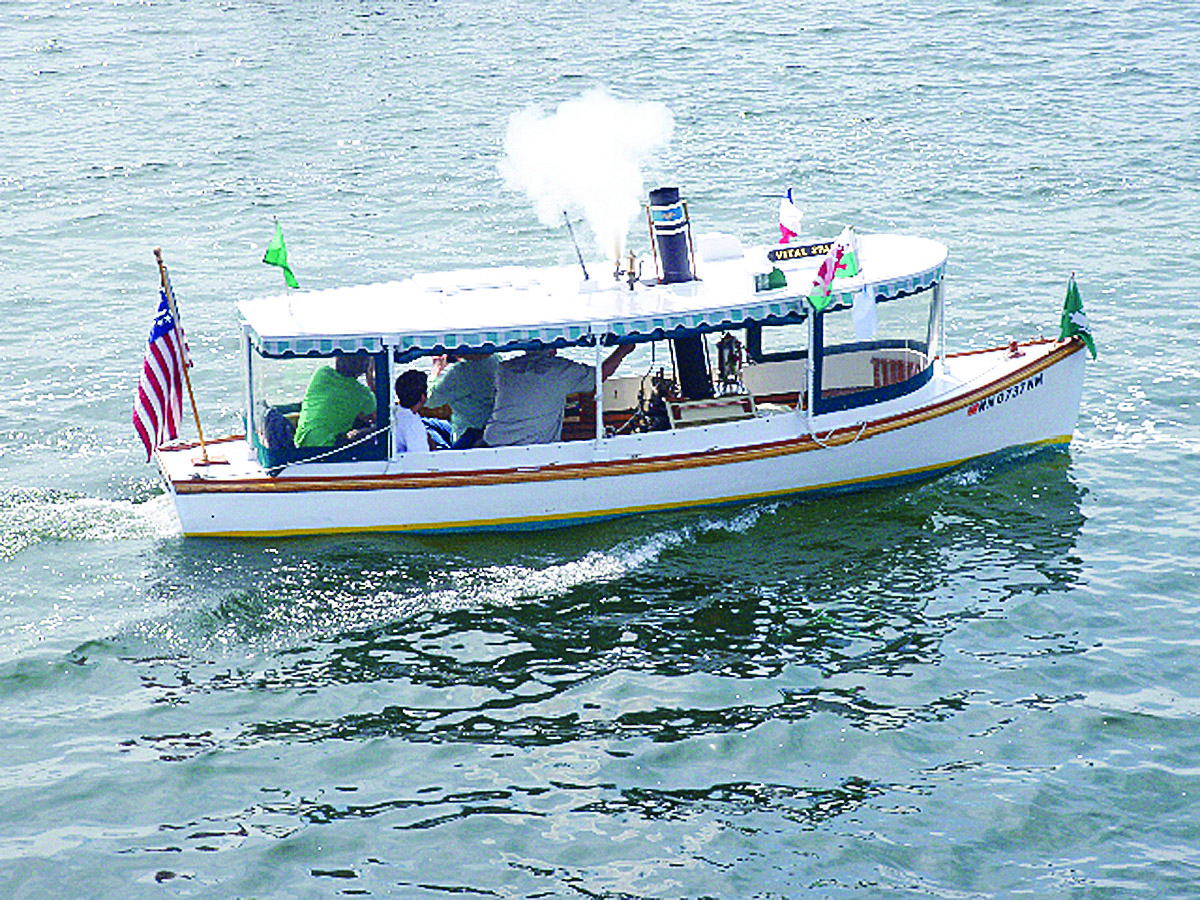
Times have changed, and this weekend, John and spouse Joellen Hope will be in town to show off their 18-foot steamboat, Vital Spark, which will be here for the Victorian Heritage Festival.
One of three vessels that Northwest Steam Society skippers are bringing to Port Townsend, it represents the real version of the models John built as a boy.
“I always knew whether I would build one or buy one, I would end up with a steamboat,” John said.
John, who lives in Seattle, is a retired Boeing engineer who worked on the 747 flight crew training simulator and, in the last decade of his career, was director of flight operations engineering, overseeing eight departments that dealt with aerodynamics and operation of every plane Boeing made or bought.
Retiring in 2004, he joined the Northwest Steam Society and acquired the Vital Spark six years ago.
Built with gas engine
Built in Victoria in 1911, the boat, ironically, was one of the first to be built with a newfangled gasoline engine, John said.
It had been out of the water for several decades when a steamboat collector saw it, and noticing that it had perfect lines for a steam vessel, bought it.
The hull was restored, and a new boiler and engine commissioned in 1969.
“It’s like a smaller version of the African Queen, but more dignified,” John said.
“It’s not very fast, but it goes through the water with great dignity.”
Steam was his first love, but since it wouldn’t make the family fortune, he studied electronics at the University of Kingston and earned graduate degrees, then worked in research and development at Farnborough, the center of airplane research in England at the time.
Hearing that Boeing was coming to London to recruit engineers, he applied.
His goal: to live in the United States like dashing Uncle Jack.
“My mum had a cousin who flew B-17s,” John said.
“I was so impressed with his uniform and his John Wayne accent. I thought, wherever he lives, I want to live there.”
In the late 1960s, the best aeronautic research, he said, was being done in the United States.
He also was drawn to a country that had large cars and cheap gasoline.
Even though John wasn’t an airframe engineer, Boeing hired him, telling him to come over any way he could.
Made trip by freighter
He opted to make the trip by freighter, crossing the Atlantic, going through the Panama Canal and up the West Coast to Seattle.
An experienced pilot, he said used to take the giant 747s out for a spin.
The jet engines had the same power capacity as a small city — “it just goes faster,” he said.
His steamboat, in contrast, can do 5 or 6 mph, depending on the number of passengers.
In addition to driving the engine and blowing the whistle, the boiler also provides steam to heat water in the silver teapot welded to the top of the boiler. Called a Windermere Kettle, it was invented in the Lake District of England.
“The ladies got irritated when their gentlemen friends who took them steaming didn’t get them back in time for 4 o’clock tea,” John said.
“Some bright spark realized you could use the steam to boil water quickly.”
The Vital Spark’s kettle, which has lion-paw feet, is like an emersion heater — 60 feet of tubing, which, when filled with 360-degree steam, will boil a gallon and a quart of water in 20 seconds.
Not that John and Joellen have time for tea.
“The truth of the matter is, we’re quite busy when we’re steaming,” he said.
“To drive a modern boat, you put a key in a hole. In a steamboat, you have to look after the fire, the boiler and the water; monitor the boiler pressure; and manage all the pumps. It’s quite a complicated system.”
John keeps Vital Spark in his boat shop during the winter, doing upkeep and making new parts as needed.
When the weather warms up, he and Joellen, often accompanied by grandsons Lucas and Logan, like to steam over to Gene Coulton Park on the southeast shore of Lake Washington, then go to get fish and chips at Ivar’s.
It takes about five minutes to get the steam up, he said, and another five minutes to get underway.
Small steamboats were used to take people from the dock out to a larger ship, or around the harbor. They are quiet, he said, apart from the whistle, which is comparable to that of a freight train.
“When you blow the whistle, everyone comes running,” John said.
Steam is in his genes in more ways than one. John’s grandfather was the superintendent of electric generation for the Bank of England, which ran on steam power in his grandfather’s time, between the two world wars.
John was born in 1941 at Knill Farm near Radnorshire, Wales, where his mother and older brother had evacuated. They returned to Dorking, near London, before the end of the war — John remembers scaring his older brother by mimicking the sound of the doodlebug bombs.
At St. Albans
Spending Sundays with his uncle on the grounds of St. Albans, the oldest site of continuous Christian worship in England, John remembers hearing the cathedral choir singing in the distance as they launched a model boat.
It didn’t seem quite the right time to blow the whistle, he said — but they did it anyway.
“Well, you had to see if it worked,” he explained, adding, “It was very satisfying.”
Also on display during the Victorian Heritage Festival will be the Bonnie Jean II , a restored 1940 Poulsbo Boat owned by Dave and Bonnie Hogan of Everson, and William Fredrick, a 23-foot Elliott Bay owned by Harv and Kim Lillegard of Montesano. The boats will be on view Saturday from 10 a.m. to noon, and Sunday from 2 p.m. to 5 p.m., and Sunday morning before noon at Point Hudson Marina. No charge. Look for the Northwest Steam Society Banner. For more information, go to www.victorianfestival.com.
For more information about the Northwest Steam Society, go to www.northweststeamsociety.org.
________
Jennifer Jackson writes about Port Townsend and Jefferson County every Wednesday. To contact her with items for this column, phone 360-379-5688 or email jjackson@olypen.com.
