
THERE’S A FROGGY Bottoms pub near St. Olaf’s University in Northfield, Minn., and a bar by that name in North Carolina.
On New York’s Long Island, people wear Froggy Bottoms Clogs to keep their feet dry at horse shows.
There’s a Froggy Bottom Bar in Washington, D.C.’s Foggy Bottom district.
Michael Millard custom-builds Froggy Bottom guitars in Chelsea, Vt.
In Port Townsend, most people know Froggy Bottoms as the seasonal pond and wetland adjacent to San Juan Avenue, south of New Song Church.
But they might not know about Froggy Forest, which is what residents call the wooded slope at the other end of their neighborhood, where Cedar Street curves uphill to Cherry.
Or that Froggy Forest continues to be a source of concern among the neighbors, who have banded together to form the Friends of Froggy Bottoms.
Neither had Ewan Shortess, a Port Townsend High School student, when he chose Froggy Bottoms as the focus of his honors research project this spring.
Science presentations
Last Thursday, Ewan and other students in Lois Sherwood’s sophomore science class gave their presentations.
None had as strong a local interest as Ewan’s.
“It’s a real-world project,” said Bonnie Buckley, a local resident who came to hear his presentation.
It was Buckley, who, hearing that Sherwood’s students were looking for research subjects, suggested checking on the condition of the wetland.
Sherwood passed the idea along to Ewan, who was interested in environmental research.
But she also had a connection.
“My daughter, Anna Sherwood, did her senior high school project on it in 1998,” Sherwood said. “She worked with Sam Gibboney, the engineer who designed it.”
Ewan talked with Gibboney about the history of Froggy Bottoms, part of the Kai Tai Valley, which used to be traversable by canoe for its entire length.
Ewan also talked to City Manager David Timmons and Erik Kingfisher, stewardship director at Jefferson Land Trust.
The name originated, Kingfisher said, with John Barr, who became concerned about the disappearance of wetlands — and the frogs — along San Juan Avenue near his home on 35th Street.
Contacted by phone, Barr said he coined the term in a letter to the editor.
“The name is unusual,” Barr said. “All the other wetlands in the city except for Kai Tai are named for a person.”
Barr also expressed his concern to Bob Wheeler, then-public works director.
City bought it
So, instead of installing a storm pipe to carry the water to the Chinese Gardens Lagoon, the city purchased the Froggy Bottoms property in 1997 to create a seasonal pond.
The pond at the north end of the city golf course also was saved from bulldozers, Barr said, and proposed development of land on the west side of San Juan Avenue tabled.
“Froggy Bottoms is at the bottom of a closed basin,” Barr said. “The whole Kai Tai Valley is a seasonal wetland.
“When they started filling Froggy Bottoms with gravel, Fremont Street flooded. It was cheaper to buy the property and develop the wetland than install a storm drain.”
The Friends of Froggy Bottoms believe logging Froggy Forest would create a similar situation.
The largest of three orphaned islands of land below Cherry Street, the 125-foot-by-300-foot plot borders a section of Beech Street that was never put in.
The prospect of development arose last spring, when the city listed Froggy Forest as a possible site for low-cost housing.
The Beech Street rezone, as the proposal was called, would have allowed a structure with up to seven units.
Letters of protest
A Planning Commission hearing in November drew letters of protest from neighbors, who pointed out the instability of the slope and the potential for destabilization and neighborhood flooding if logged.
The city withdrew the rezoning request as well as the statement of non-significance for the property.
There was neighborhood oppostion to the rezone, said Judy Surber, city planner.
“The neighbors wanted the city to designate the property as a park in conjunction with the Park and Recreation open space plan,” she said.
“We still need to update that plan,” Surber said,a dding that the city is not currently working on it, and that Froggy Forest may be considered.
“It’s not NIMBYism,” said John Miricle, who lives north of Froggy Forest. “It’s a key piece of environmental property.”
Although those development plans are off the table, Froggy Forest’s future remains cloudy.
But Froggy Bottoms’ does not.
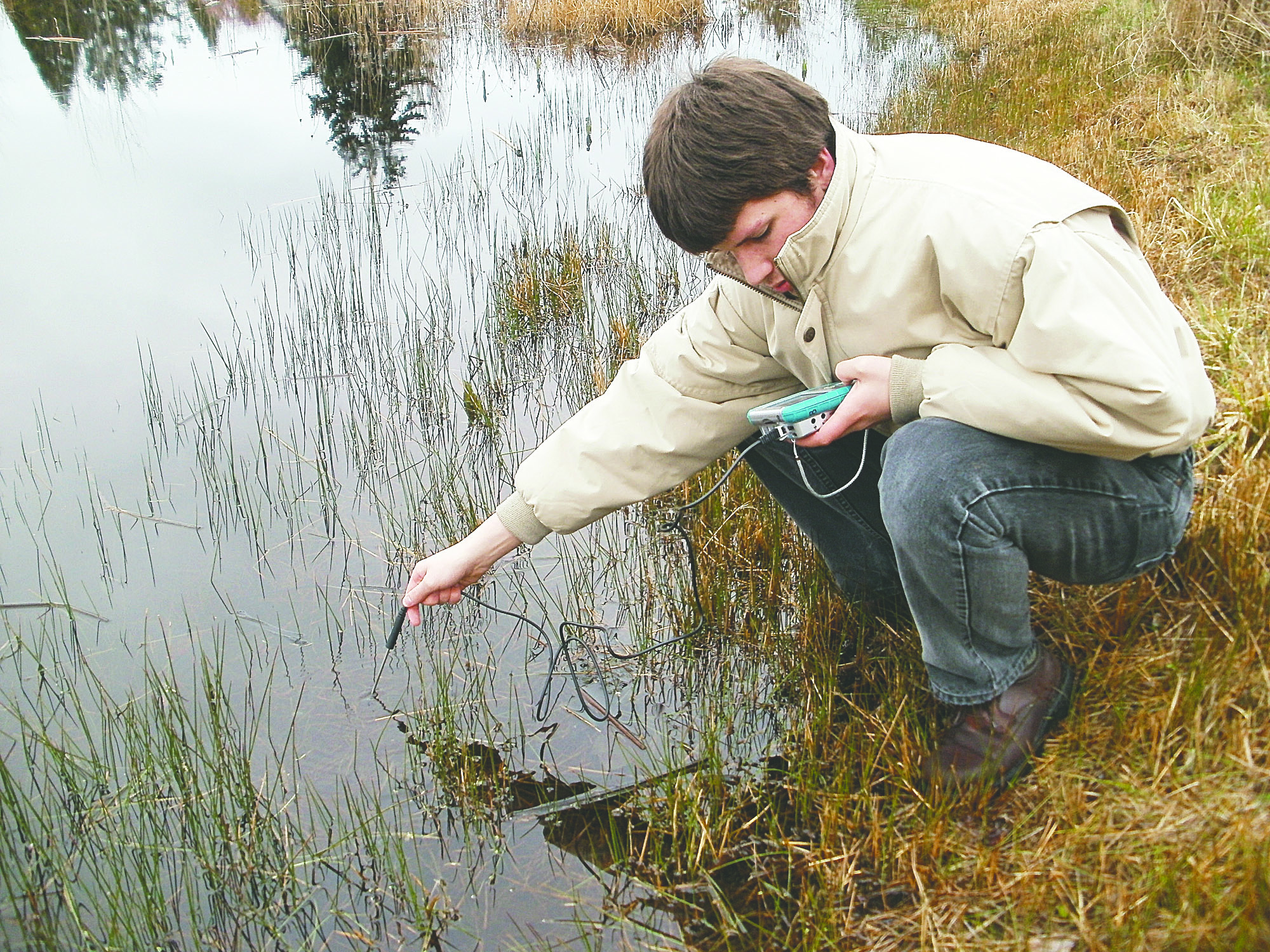
For his research project, Ewan visited the site this spring, testing pH, conductivity and dissolved oxygen levels at three points — the small settlement pond into which four storm grates drain and each side on the large pond.
He found that all except the settlement pond passed standards set for sustainable, healthy wetlands and that it was understandable the pond did not quite reach standards for conductivity since it gets a lot of runoff from the road, Ewan said.
The increase in noise as the water temperatures rose also was an indication of the wetlands’ viability.
“The frogs were really active at night,” Ewan said. “It was real loud.”
Other projects
Other student research with a local slant:
■ Molly Brown and Rose Gitelman, whose father works at a fish hatchery, compared methods of growing algae.
■ Calvin Franklin tested the effectiveness of cold laser on healing, a treatment his teacher’s husband, Jim Sherwood, uses in his veterinary practice.
■ Stein Pratt, who likes to work on boats, explored the physics of pulleys.
■ Ian Graham researched wireless transfer of electricity.
■ Hana McAdam and Anna Moore, whose father is a glass toolmaker, researched the Stirling engine, which runs on heat differentials and is used in submarines, the space station and for auxiliary power on yachts.
■ Analis Rubida and Madison Braden, whose brother, Tate, is in a rocket club, designed and tested rockets.
■ Eamonn Clarke built an underwater remotely operated vehicle.
■ Grayson Pennell and Harry Doyle tested alternative ways of growing mushrooms, Natalie Toews and Daniel Charlton compared the temperature conductivity of outdoor clothing, and Frances Paoli studied the effect of solar radiation on yeast cells.
Her conclusion: “Tanning is really bad for you.”
Ewan is sending a copy of his Froggy Bottoms research to the city, and Friends of Froggy Bottoms expressed interest in a copy for their website, http://tinyurl.com/froggybottoms.
If you look up Froggy Bottoms, you’ll also come across a cottage business on Pacific Street in Port Townsend.
Within croaking distance of the pond, Froggy Bottoms Pottery is where Lori Bernstein makes pots, platters and bowls — some with little frogs on the side.
________
Jennifer Jackson writes about Port Townsend and Jefferson County every Wednesday. To contact her with items for this column, phone 360-379-5688 or email jjackson@olypen.com.
