
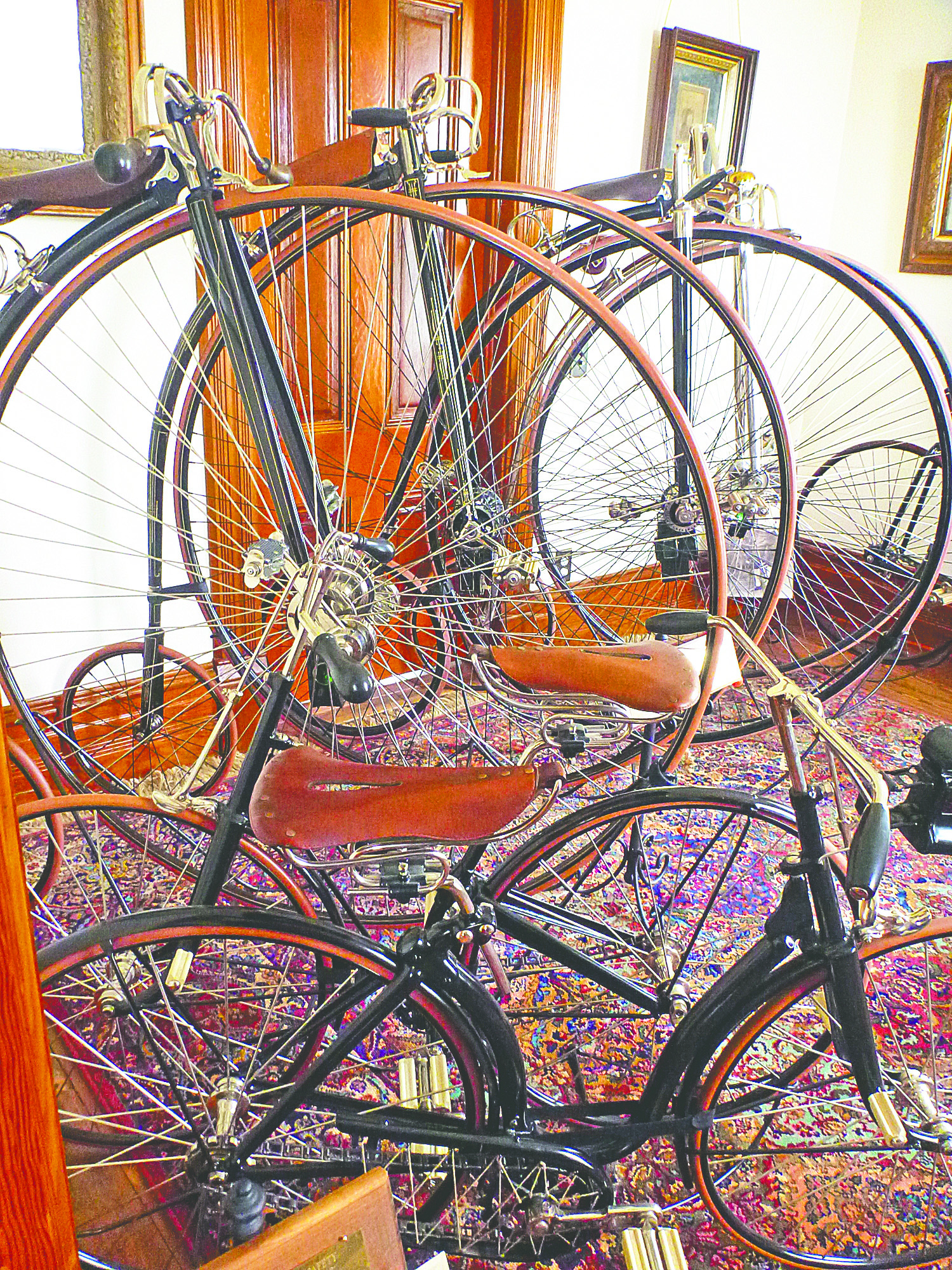
WHEN JACK SEBBEN of Port Townsend was 8 years old, he got his first bicycle: a maroon Schwinn coaster.
It was the basic bike of the time — no gears, no hand brakes, just Jack pedaling away as he rode to school and back.
The school was a mile from his house in Centerville, Iowa, as was the town square, his other destination.
The bicycle expanded his territory, but like most boys, Jack was looking further down the road.
“I couldn’t wait to turn 16,” he said.
Jack went from bikes to cars and in college to motorcycles. That led to a hobby of collecting and restoring antique motorcycles, which led him back to bicycles — but not the two-wheeler of his youth.
“Antique bicycles totally took over,” he said.
Collecting and restoring antique bicycles took over not only his free time, but also his home.
But the collection didn’t look right in his modern house near Sacramento, Calif.
So 3½ years ago, Jack moved to Port Townsend, bought a large, two-story Victorian home and proceeded to furnish it with antique bicycles.
Last Saturday, he gave a presentation on his hobby as part of the Victorian Heritage Festival, illustrating the talk with three bicycles from his extensive collection.
How extensive?
“I have three around the dining room table and 20-some in my parlor,” he said, “and that’s only scratching the surface.”
Jack’s talk at the Northwest Maritime Center on Saturday morning covered key stages of bicycle evolution, from the Draisine, invented in 1816 by a German baron, Karl von Drais, to the safety bicycle, which replaced high-wheelers.
With wheels the size of a modern bicycle, the Draisine had a saddle mounted on a wooden frame that the rider straddled, then pushed the bicycle along with his feet.
Pedals came later
Pedals were added in the 1860s, Jack said, but because speed was required, the wheel was enlarged, producing the high-wheeled or “ordinary” bicycle.
In England, it was called a penny farthing, because the ratio of the large front wheel to the back one was similar to that of an English penny and a farthing.
“It’s like a half-dollar and a dime,” Jack said, holding up a tiny model made from English coins.
Riding the high-wheeler, as Jack demonstrated, wasn’t easy.
Putting one foot on the back step and pushing with the other, you hopped onto the seat and pedaled.
The original high-wheelers were ridden only by men and were purchased like a pair of pants: You ordered one to fit your inseam, Jack said.
They also were very dangerous, as the rider sat directly atop the bike’s center of gravity, his legs in front of the axle of the large wheel.
Spills could be deadly
If he had to stop suddenly, the rider took a header, which could be fatal.
Modifications pushed the seat slightly farther back and connected the pedals with levers.
“Once you get a little bit of speed, it’s like a giant gyroscope; it’s very stable,” Jack said, noting that he has done a century — a 100-mile ride — on the modified high-wheeler.
The next important improvement to the bicycle came in the late 1880s, when someone figured out that by using chains, you could get the same speed as a large wheel, and the safety bicycle was born.
Pneumatic tires, invented by a Belfast, Ireland, veterinarian named John Boyd Dunlop, made the ride comfortable.
By the late 1890s, women had started participating in the sport, which offered a way to get out and explore the countryside.
“Before that, if you wanted to travel, you had to have horses,” Jack said.
Whale oil lamps
Jack also collects bicycle lamps, which originally burned whale oil and were installed on a spring to reduce bouncing.
The next innovation was carbide lamps, like those used by miners, fueled by carbide pellets.
Lamps on high-wheelers were attached to the hub of the front wheel, not the handle bar, he said, since it would have been too high to illuminate the road.
His bicycle-related collection also includes bells, bicycle club badges, race medals and lithographs of bicycle ads, which adorn the walls of his 1890 house.
At the turn of the century, three main companies made bicycles: Columbia, Victor and Gormully-Jeffrey, a Chicago firm that became American Motors.
“The bicycle models were named ‘American’ and ‘Rambler,’” Jack said.
Reproduction high-wheelers are available; Chauncey Tudhope-Locklear of the Port Townsend ReCyclery rides one around town.
Gabriel Chrisman, a Victorian enthusiast, has an antique model that usually requires extensive repairs, Jack said.
Caught the bug
Jack got the collecting bug when he went to look at an antique motorcycle he was considering buying from a man, Karl Edwards, in Nevada.
In addition to collecting motorcycles, Edwards also restored antique bicycles and taught Jack the spokes, so to speak.
When Edwards got out of collecting bicycles, he passed some of his collection along to Jack.
Today, several rooms of Jack’s house resemble a bicycle museum.
“I sometimes give tours,” he said.
He also has a collection of bikes he rides and a tandem Victorian-era bicycle that he and Jeanette Wilson ride around town.
On Saturday, they appeared at the Victorian Fashion Show in riding costumes, walking the tandem bike down the aisle to the front of First Presbyterian Church.
The opposite of a modern tandem, the handle bars for the front seat, where the woman sits, are fixed. The man rides on the back seat and steers.
Carding the guests
The Victorian Heritage Festival presentations were held at the Northwest Maritime Center’s Assembly Room, where beer, wine and food items were available to buy at one end.
So guests younger than 21 had to sit on the opposite end of the room.
Steve Ricketts, dressed in Victorian attire, served as doorman for the adults-only section, asking everyone, “Were you born on or before this date in 1889?”
Each presentation — on fencing, bare-knuckle boxing and antique firearms — attracted 50 to 60 people, festival organizers said, and the steamboat owners who brought their craft to town said they had a steady stream of people coming to Point Hudson Marina to see the boats and take a spin around the harbor and into the bay.
The annual Victorian Heritage Festival is organized by the Victorian Society in America, Northwest chapter, which welcomes people interested in the era.
For more information, visit www.victoriansociety-northwest.org or phone 360-379-2847.
________
Jennifer Jackson writes about Port Townsend and Jefferson County every Wednesday. To contact her with items for this column, phone 360-379-5688 or email jjackson@olypen.com.
