
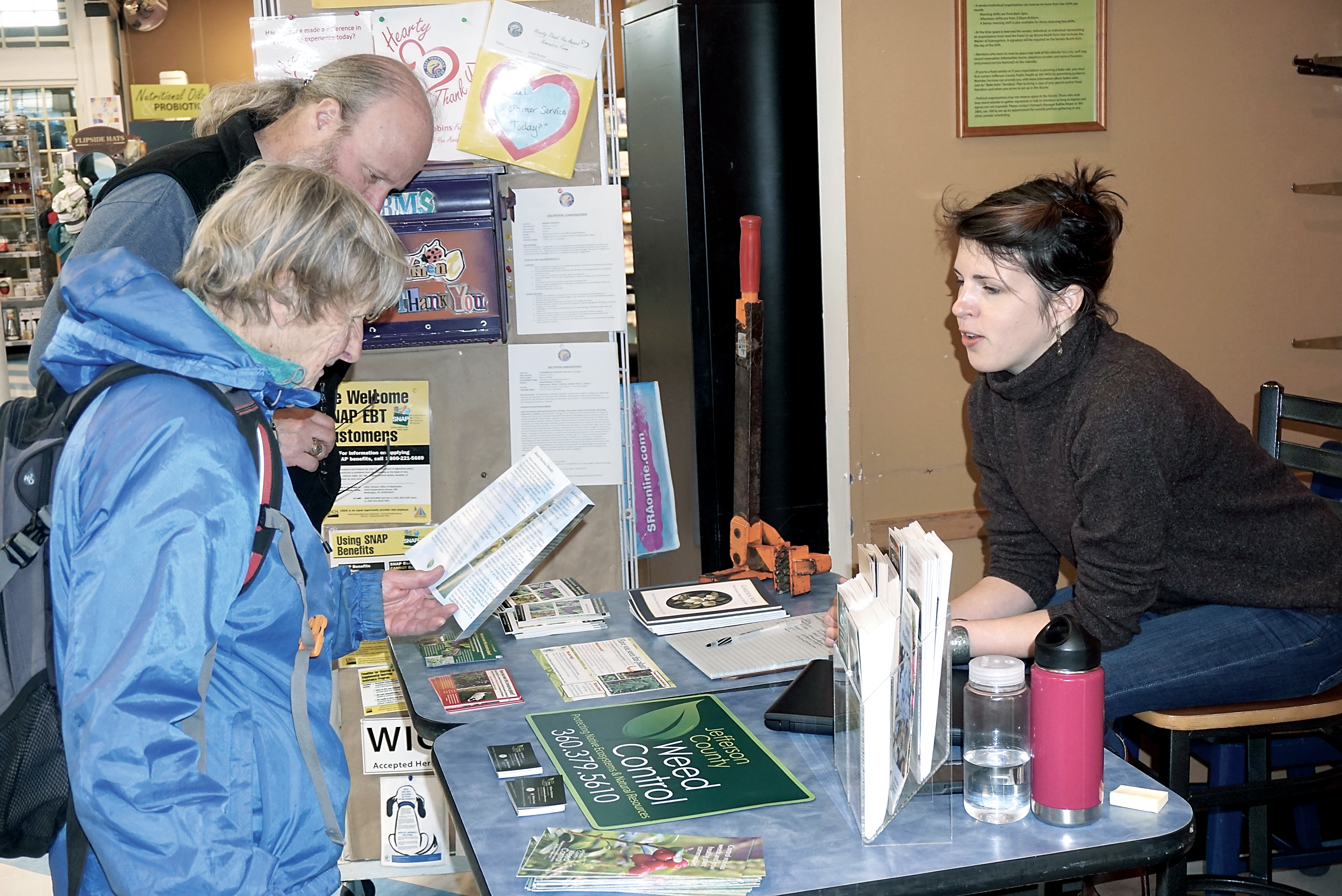
PORT TOWNSEND — Weed eradication takes more than spraying or removing them, according to Jefferson County’s weed control coordinator.
“If you pull a weed out, you need to put something else into the soil, or you won’t get anywhere,” said Joost Besijn, who was hired to fill the newly created full-time position in June.
“You also need to know what you are doing. If you mow down a thistle, you quadruple it by spreading the seeds, and if you spray at the wrong time, it doesn’t do any good.”
On Monday, Besijn presented his agency’s annual report to the Jefferson County Board of Commissioners, providing data about its accomplishments since it received an increased subsidy.
After the retirement of Eve Dixon, whose position was part time, the commissioners decided to make a greater weed control effort and charged Besijn with creating a fee structure.
He suggested a fee for all property owners of $4 per parcel and 30 cents an acre, which is included on current property tax statements.
The fees generate about $150,000 per year, which covers salaries for Besijn and his part-time assistant, along with program support.
According to Besijn’s report, his staff spent 130 hours in 2015 surveying Jefferson County to determine the locations, infestation sizes and growth stages of noxious weed populations.
The most common species were wild chervil, tansy ragwort, spotted knapweed, scotch broom, Himalayan blackberry, teasel and reed canary grass.
After determining locations needing chemical treatment, the agency mailed 92 letters to property owners adjacent to the rights of way that were to be sprayed, offering landowners the option to maintain the area themselves.
Two organic farmers chose this option, according to the report.
The agency is tasked with weed removal on county rights of way, while individual property owners are expected to control what is on their own land.
Besijn said landowners were helpful and cooperative when contacted about toxic weed treatment.
“People in Jefferson County are generally conscious about the environmental impact of noxious weeds and are very responsive to us,” Besijn said.
During 2015, the agency spent a total of 309 hours removing toxic weeds from rights of way; of this, 49 hours were contracted to third parties.
The 2016 goal is to continue to survey and control noxious weeds on rights of way and work to update the current map of all known infestations in both east and west Jefferson County.
Besijn said there is an enforcement process that has not yet been used in Jefferson County but could in the future.
Under this structure, the agency would first determine that a property owner is remiss in weed control and send a series of three letters: the first informing the landowner of the problem, the second a more firmly worded version and a third stating that the county will come onto the property and remove the weeds.
In that case, the landowner would be billed for the cost of clearing the weeds, Besijn said.
Besijn said weed eradication takes about two or three years before it is effective.
The agency has a budget for hiring clearing crews but would like to develop a list of active volunteers, Besijn said.
There are no special skills required except the ability to dig out plants.
To volunteer, call 360-379-5620 or email noxiousweeds@co.jefferson.us.
_________
Jefferson County Editor Charlie Bermant can be reached at 360-385-2335 or cbermant@peninsuladailynews.com.
