
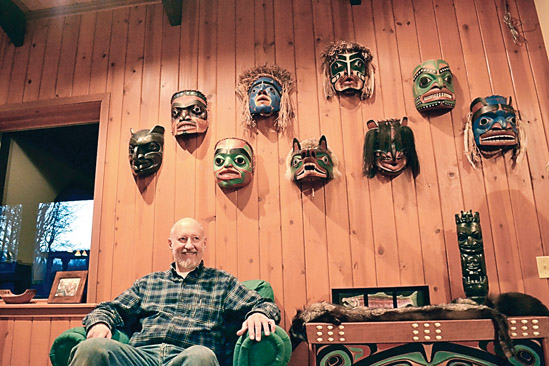
SEQUIM — For 20-plus years, Dale Faulstich, 65, has put a face, or faces, to the stories of the Jamestown S’Klallam tribe.
The soft-spoken, non-native artist from Missouri has served as the tribe’s master carver since 1994, designing and helping create totem poles, masks, signs and more in an official capacity for “The Strong People.”
Faulstich retired Jan. 8 from his 50- to 60-hour weekly routine to pursue other artistic passions, with plans to do some occasional work with the tribe.
“I spent my entire adult life doing art for the sake of money,” he said.
“Now I’m going to do art for the sake of fun. It feels wonderful. I have no idea what I’m going to make.”
The iconic art Faulstich has made remains everyday fixtures for those driving through Blyn, Sequim and Dungeness.
He’s designed and helped carve more than 60 totem poles including the 10 poles in and around 7 Cedars Casino with its center pole at the entrance his first project in his full-time role for the tribe.
“I thought it was going to be a temporary contract, maybe take six months, but 22 years later here I am,” he said.
His designs continue to welcome visitors and/or share the tribe’s history following different styles from the Oregon/Washington coastline to Southeast Alaska.
Tribal Chairman W. Ron Allen said in Faulstich’s book, Totem Poles of the Jamestown S’Klallam Tribe, that the poles “remind our citizens of their history and heritage and to create a memorable experience for our visitors and guests.
“Our hope is that these poles will cause all who see them to have a deeper appreciation and respect for our people, culture and contributions to our community,” Allen continued.
“These Totems welcome now and for generations to come all visitors and guests to our territory, the gateway to our beautiful Olympic Peninsula.”
Prior to moving to the area in 1974, Faulstich served four years active duty with the U.S. Coast Guard and two years in the reserves.
He opened an art gallery on 3 Crabs Road, which later became a commercial sign shop.
His friendship with Allen segued his career into making signs and designs for the tribe in the 1980s and the announcement of 7 Cedars Casino opening in the 1990s brought Faulstich into full-time tenure with the tribe.
To hone his skills and be as accurate as possible, Faulstich spent thousands of hours researching the styles and history of the tribe.
There has been a lot of trial and error, he said, and the hardest part is coming up with the totem’s stories.
Depending on the piece, Faulstich will create a totem using written history or oral stories to design it.
“People interviewed weren’t always storytellers so sometimes you have to combine them and make them legible,” he said.
Once he’s finished the story, he’ll design the totem, measure the log — a Western red cedar — scale the drawings and begin carving, which he said is the easy part.
Before 1994, Northwest art was a hobby for Faulstich, while he was doing commercial art as a living.
“I basically taught myself how to do it,” he said.
His favorite project is always the one he’s presently working on, Faulstich said.
“It’s the challenge of making that drawing, taking this block of wood and turning it into this drawing,” he said.
“Once it’s finished and out the door, and even before it’s out the door, I’m thinking about the next project.”
Even a few days before retirement, his studio didn’t look like an artist winding down.
Faulstich carved on an eagle for a planned veterans memorial at the tribal center, while designs sat on his drawing board for the first of three totem poles going in at Jamestown Beach.
He had spent the previous two weeks designing 12 concrete panels, each one 5 feet, for the new trestle connection in Dungeness River Railroad Bridge.
“Ron Allen always gives me an endless supply of projects,” Faulstich said.
Over the years, Faulstich has worked with dozens of artists, and as he eases into other artistic ventures, Dusty Humphries, a S’Klallam tribal citizen, and Bud Turner will continue Faulstich’s work for the tribe.
Faulstich will remain on as a consultant designing pieces.
Humphries said it took him about two months to convince Faulstich to give him a chance five years ago.
“I would bring in little things I had worked on and I persistently asked them for a job,” he said. “Finally he told me to come up on this certain day.”
Humphries will continue his studies in Faulstich’s studio for the immediate future.
“I just hope to soak up as much as he has to offer,” Humphries said.
“I don’t know even know if I have a lifetime to do that. I’m so grateful he’s willing to teach me these things.”
Turner, who runs the sign shop for the tribe, said he started helping Faulstich with projects in the early 1990s and they’ve made at least 15 totem poles together.
“I’ve learned so much from him. He’s such a knowledgeable artist,” Turner said.
“Through the years, he’s been one of the nicest, kindest men. He’s very generous with his knowledge.”
Both Humphries and Turner feel Faulstich has left a lasting impact.
“He’s really set a vision around the area,” Turner said.
“It’s locally recognized. It’s globally recognized. He’s put a sense of style to his work that’s really quite great.”
Humphries said his work starts a conversation that might not otherwise happen.
“It really opens up people’s eyes to the culture and how much the native people have depended on the cedar,” he said.
The tribe plans to honor Faulstich in a private gathering Tuesday.
Faulstich plans to travel with his wife, Heather, to Tasmania to see their son and his family and then return to pursue his art.
“I’m going to spend the rest of my life in this building [his studio] on rainy days and go out hiking when the sun is out,” he said.
“I had one hell of a time playing. I spent my whole adult life playing and it worked for me.”
________
Matthew Nash is a reporter with the Olympic Peninsula News Group, which is composed of Sound Publishing newspapers Peninsula Daily News, Sequim Gazette and Forks Forum. Reach him at mnash@sequimgazette.com.
