
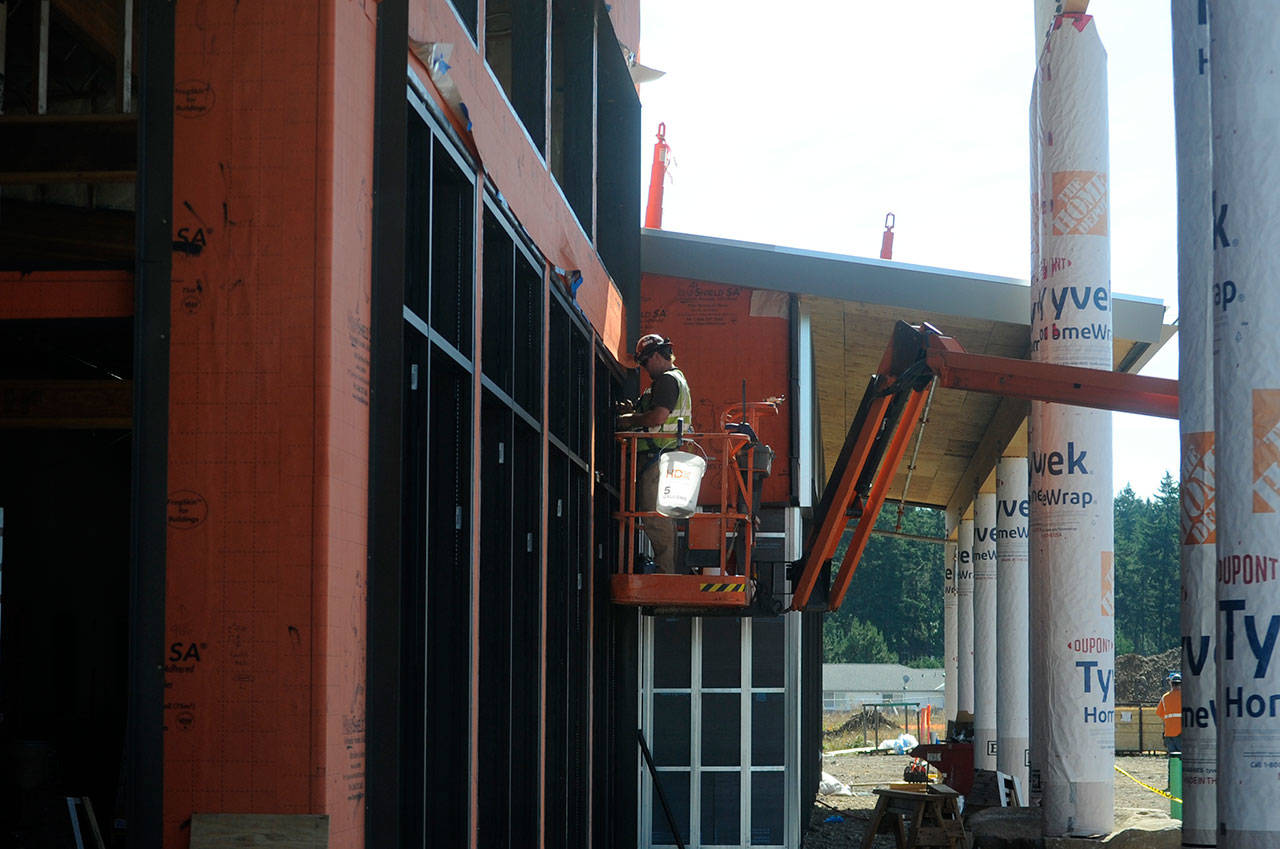
SEQUIM — The Jamestown S’Klallam Tribe’s medication-assisted treatment clinic realistically won’t see patients until March 2022.
“We’ll tentatively finish construction by the end of the year,” said Brent Simcosky, director of tribal health services, in an interview earlier this month at the site of the medication-assisted treatment (MAT) clinic at 526 S. Ninth Ave., in Sequim.
“We won’t see patients immediately because (crews) have to move in furniture and staff have to get ready to come in.
“We’ll tentatively see patients at the beginning of March.”
Named by the tribe the Jamestown Healing Clinic, the 16,806-square-foot facility now under construction has remained a divisive talking point in Sequim for more than two years.
Simcosky said the clinic’s purpose has remained the same throughout — to help patients with opioid-use disorder (OUD) through treatment with daily doses of methadone, Suboxone and Vivitrol, along with wrap-around services such as dental care and counseling.
The clinic has faced opposition, in part because of its types of treatment, its location on South Ninth Street behind Costco, and its size.
Members of Save Our Sequim, which a Clallam County Superior Court judge ruled in February as lacking standing in the its last appeal, have argued for smaller drug-treatment centers “strategically placed with a local focus,” saying that the regional MAT is a “misguided approach fraught with dangerous consequences.” (www.save oursequim.org)
The clinic will be open six days a week with a patient load of between 200 and 250 people seen daily and/or through the week depending on treatments.
“The capacity is 250 to 300 but it’ll be closer to 200 to 250 patients,” Simcosky said. “By the end of the first year (in operation) it could be up to about 200.”
As he and other health officials testified during hearings for the clinic, about 100 OUD patients already are being treated through a Suboxone prescription program at the Jamestown Family Health Clinic on North Fifth Avenue.
Demand for OUD services continues to grow, he and other health officials have said.
“We’re seeing about 12 more new patients added each month since the pandemic began,” Simcosky said.
“Overdosing is going through the roof. People have been falling off the wagon, and it doesn’t take much stress to do that, particularly during a pandemic.”
Safety
Through the public comments, emails and calls, Simcosky said he and tribal leaders continue to hear residents’ calls for safety.
“We understand people’s concerns; that’s why we agreed to all the mitigation and offered many solutions that weren’t required, like a Social Services Navigator,” he said.
“We want to cause people less stress and successfully help people without hurting the community.”
One community member position is left to fill on the Community Advisory Committee. Simcosky said the tribe likely will open up applications late this fall. That resident will help a group of local law enforcement, city officials and health officials form mitigation measures for any potential negative impacts from the clinic on local services, he said.
“It has to be very exact, things we can measure,” Simcosky said.
Tribal leaders are considering additional community outreach efforts to hear more concerns and share more information about the clinic.
“We want to talk to people about what we’re doing and what we can work together on solutions,” Simcosky said.
Tribal members have met with neighbors to hear such concerns as wanting fencing and/or lighting installed.
Once open, the facility will host three security staff members, two inside and one outside during regular hours, and the site will be monitored after hours by additional trained security staff, he said.
The clinic also will have emergency buttons throughout, a safety feature Simcosky said is standard protocol for clinics like this.
Patients will be from throughout the North Olympic Peninsula and will be sent back to their homes daily, the tribe has said
As for concerns about tent camps and an increasing homeless population, Simcosky said the tribe has “no interest in tent camps” and already has escorted one individual off the site.
“While most of the people won’t be patients, we do have an interest in meeting with city officials in helping these people find a solution,” Simcosky said.
The clinic sits on about 45 acres now owned by the tribe, he said, with no additional plans for any of the property other than a potential goal to connect the property to River Road years from now.
Early in the clinic’s application, tribal leaders nixed a proposed 16-bed hospital, an evaluation and treatment facility. Simcosky said it’s not directly related to MAT services and would require a conditional use permit, a lengthy application process and more funding from the legislature.
Construction
Construction on the clinic has been delayed for such reasons as court action against the facility and the COVID-19 pandemic, according to Simcosky.
Tacoma’s Korsmo Construction leads construction of the tribe’s approximate $16 million project. Funding is made up of about $9 million of the tribe’s own money and state and federal grants.
One decision Simcosky said tribal officials are especially proud of is buying the clinic’s lumber last year before this year’s price increases, which saved them hundreds-of-thousands of dollars.
Child care will be offered next to the entrance separated from the rest of the clinic.
Patients will sign in at a kiosk where they’ll see their schedule, Simcosky said. They’ll be randomly selected for urinalysis about 18 times a year, an average of 1.5 times a month, he said, with staff monitoring to prevent false tests.
The clinic will host three dosing rooms where a patient will show their identification to a nurse before a computer distributes the dosage.
“We have to account for every drop,” Simcosky said.
“All methadone and other daily medications is locked in a $35,000 safe that’s inspected by the DEA (Drug Enforcement Administration) in the pharmacy, too,” he added.
Each patient also will receive a mental health analysis by the medical director and behavioral analysis staff, he said.
The tribe received a $1.5 million grant over three years from Indian Health Services to develop a program that merges counseling programs for behavioral health and substance abuse treatment, Simcosky said.
The grant will also help staff do outreach to help patients better integrate back into family life, he added.
With 10 counseling rooms, and four meeting rooms, he said there’s space for individual and group therapy sessions, on topics such as behavioral health triggers, introduction to treatment and more.
The tribe also plans to hire dentists to offer on-site X-rays, treatments and surgeries as needed.
In total, there will be upward of 40 staff in the building once at full capacity, Simcosky said.
The executive staff has yet to be announced, he said, but they’re all local to Sequim and the northwest.
Exterior, interior
The clinic’s exterior will feature a retention pond, totem carvings by Bud Turner and more than a dozen carved cedar logs. Inside, many rooms will face the Olympic Mountains.
“People ask us why we chose this property, and we say it’s so people can reflect on life,” Simcosky said. “We want a peaceful environment without stress.”
Only patients and staff will be allowed inside the main clinic, so the aim is make the exterior beautiful for all.
W. Ron Allen, tribal council chairman, has had a hands-on role throughout the building process, Simcosky said, with Allen picking out the types of landscapes for the property and the Native American art throughout the facility.
Inside, a carving with tile throughout the clinic’s flooring shares the idea that a rock removed from a stream can change the flow of a person’s life.
“That’s what our patients are doing,” Simcosky said.
For more information on the clinic, visit jamestownhealingcampus.org.
________
Matthew Nash is a reporter with the Olympic Peninsula News Group, which is composed of Sound Publishing newspapers Peninsula Daily News, Sequim Gazette and Forks Forum. Reach him at mnash@sequimgazette.com.
