
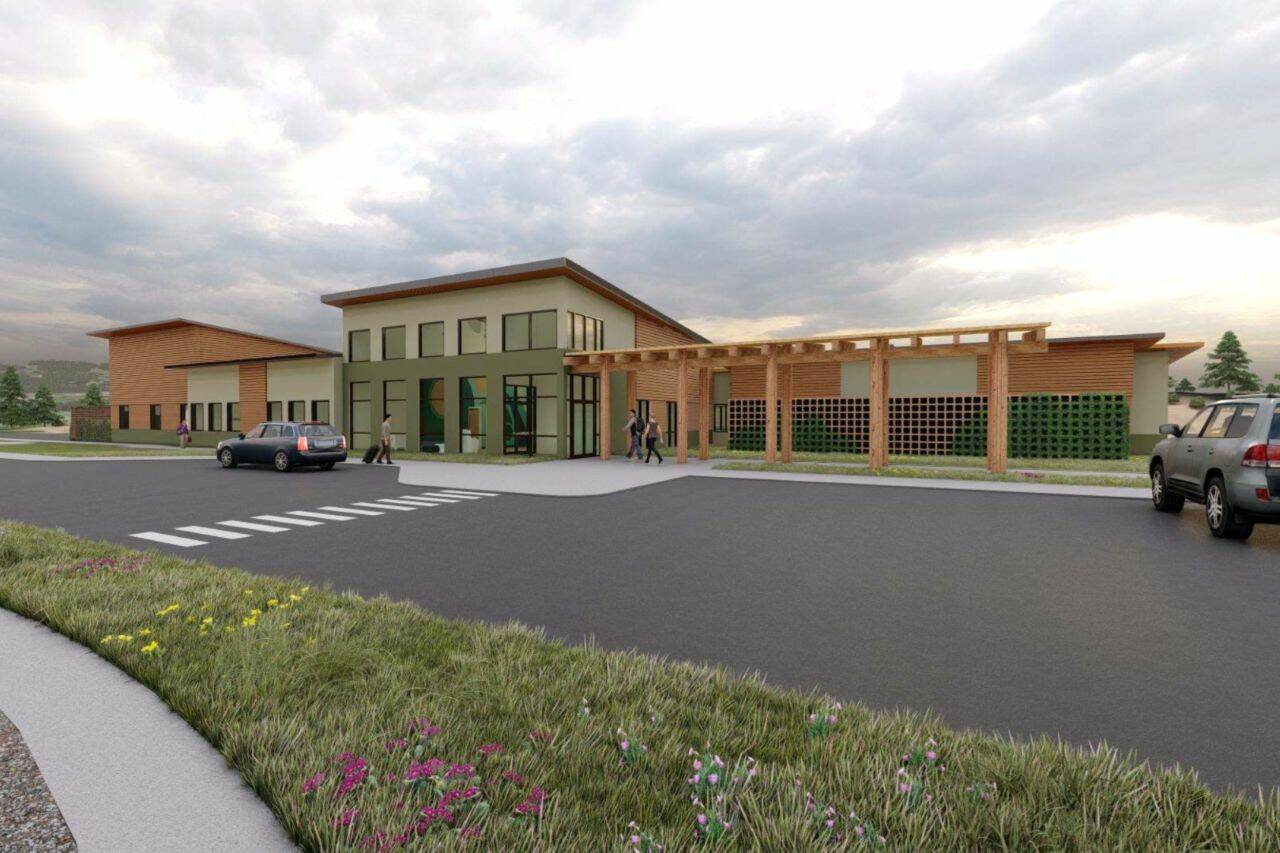
SEQUIM — Jamestown Salish Seasons, a $31.25 million psychiatric evaluation and treatment clinic, is set to open this summer.
Matt McKnight, the clinic’s executive director, said they’ve targeted a July 1 opening date, but due to various factors, it could be delayed into August.
Jamestown Salish Seasons is the first tribally owned and operated psychiatric evaluation and treatment clinic in the state, he said. It will operate with patients voluntarily seeking admission.
McKnight said patients would have acute psychiatric symptoms such as people who are depressed, typically suicidal and those who cannot meet their basic needs of health and safety due to a psychosis of some kind.
“They need a safe space to heal and recover, and that’s what we hope to provide here,” he said.
Jamestown Salish Seasons (JSS) will include 16 private rooms in a 20,000-square-foot building at 706 S. Ninth Ave., south of the Jamestown Healing Clinic, a medication-assisted treatment (MAT) clinic.
Korsmo Construction is leading the project designed by Rice Fergus Miller. Both firms previously worked on the healing clinic.
McKnight said JSS will serve Clallam and Jefferson county residents and tribal citizens of Washington’s recognized tribes.
“We do anticipate being busy with just that, and because this is the first tribally owned and operated E&T in Washington that is an inpatient site, many tribes have expressed a great deal of interest about sending their members to our facility, so we think that a significant amount of our patients will be American Indian,” he said.
McKnight noted, however, that they won’t reserve or hold beds for any specific group.
“While our data and conversations with other tribes suggest that 25 percent to 50 percent of our patient population may be American Indian, this is strictly a demographic projection based on regional needs and Health Care Authority data,” he said.
“Our policy remains that we will not turn away Clallam or Jefferson County residents if a bed is available.”
Voluntary admission
Administrators said most of Washington’s freestanding evaluation and treatment clinics are by involuntary admissions where a patient has been placed on hold by a designated crisis responder or from a court order.
Cindy Lowe, a senior adviser for Jamestown, said hosting involuntary admissions wasn’t something the tribe wanted to offer.
“It was something that didn’t sit well with us to have to take away people’s rights in order to provide treatment to them,” she said.
“That’s just not something that a tribe would ever want to do if there was any other way of helping a patient or taking care of somebody without doing that.
“We’re not saying it’s wrong when other people do it that way. It’s just not right for a tribe to do something like that.”
McKnight said they’ve also found there to be a “massive lack of voluntary options right now.”
“So many tribes are sending folks out of state to get inpatient mental health care because there’s a massive shortage or lack of voluntary service here in Washington,” he said.
From a business perspective, McKnight said there are more involuntary options because patients who have a court order or a designated crisis responder hold are guaranteed payment for their stay.
For voluntary admissions, he said payments are more complicated because clinics that treat voluntary patients run the risk of insurance providers not covering costs and saying it’s not a medical necessity for that level of care and they’re not going to pay for any of the treatment already provided.
For JSS, Lowe said the tribe is “going out on a real limb because we actually don’t even know how we’re going to get paid, or what our rate is going to be, but we are starting the business anyway.”
“So the risk for us in getting away from involuntary treatment was we have to figure out the whole payment system model, and we have to negotiate that,” she said.
“So we are well aware of the risks of trying to do a voluntary model versus involuntary, but, as a tribe, it’s the model that we felt like we could stand behind and believe in, so we’re willing to do the work to try to figure out how to get a payment system for that model, even though it doesn’t exist.”
McKnight said the tribal encounter rate, an all-inclusive rate via the Indian Health Service to reimburse tribal clinics for Medicaid services, does not apply to residential treatment facility inpatient services to be offered at JSS.
“We have to find a completely new system that does not exist right now to get paid for that, and this is a massive risk and gamble that Jamestown is actually taking to operate this thing,” he said.
Administrators said they’re in negotiations with the state about coverage rates now and that the process could take several months.
“As someone who’s worked here for 34 years, I can tell you we pretty much do everything the hard way,” Lowe said.
“We figure out what we want it to be like and how we want and what we want the patient’s experience to be, and then we go backwards from there and try to figure out if anyone is going to be able to cover the cost of these services if we’re the provider.
“It’s challenging, but healthcare needs to be challenged.”
Building logistics
JSS will offer 24/7 care, 365 days a year, McKnight said. With security systems similar to the healing clinic, it will require everyone to be buzzed in or out by staff to enter or leave.
The building’s rooms will be anti-ligature, meaning objects inside cannot be used to harm patients or staff.
“All of those things have been labored over very extensively from the very start of the project,” McKnight said.
The facility is the only E&T he knows of in Washington with only private rooms.
After touring multiple other E&Ts in Washington, administrators said they made some recommendations, such as intermixing patient rooms and staff offices throughout the patient wings to better increase foot traffic and visibility for safety.
How long a patient stays depends on their individual treatment plan, McKnight said, but administrators anticipate the average stay for a patient being about two weeks.
“It’s heavily individualized though, so it’s going to be based on the person, their level of crisis, their symptoms, and if they need medication or not,” he said.
“You need to make sure that they get stabilized and that they’re safe to discharge.”
He said staff also will need time to ensure patients have good environments and resources before they’re safely discharged.
As for staffing levels, McKnight said their first phase would include about 41 people as they negotiate the day rate, on inpatient reimbursement rate, with the state. Of that total, about 30 percent will be treatment aides, staff responsible for safety and transportation of patients.
McKnight said other R&Ts typically have a low ratio of staff to patients at night, but they plan to be staffed a little higher at night to ensure safety and comfort.
Other key positions to hire include a medical director, clinical manager, operations manager and a board-certified psychiatrist, which McKnight said is typically rare in E&Ts as they cannot afford them.
Jamestown leaders also are exploring hiring a traditional healer.
McKnight said there are different activities that can fall under what is called traditional healing, and Washington allows every tribe to designate a traditional healer.
Lowe said Jamestown’s tribal council wants to share their culture and history with other people, and that she envisions the position helping share that connection.
“We just know that part of the success of other tribal treatment programs includes traditional practices and culture, and in some way, we want to extend that,” she said.
At the healing clinic, she said as an example they’ve added some cultural activities for patients, such as singing, drumming and arts and crafts.
Project beginnings
Brent Simcosky, CEO of Jamestown HealthCARE, said JSS is a collaboration between the tribe, Washington and healthcare agencies such as Olympic Medical Center and Peninsula Behavioral Health.
Originally, he said the tribe’s plan was to own the property and allow OMC to operate the E&T, but following the COVID-19 pandemic and OMC’s financial struggles, the tribe pivoted to own and operate the facility.
“We decided to do it ourselves, and we’ve seen after 3 1/2 years, we’ve been very successful with the MAT,” Simcosky said.
The healing clinic, which opened in July 2022, now treats slightly more than 300 patients for opioid use disorder, he said.
Simcosky said they’ll slowly ramp up operations for JSS like the healing clinic.
Wendy Sisk, CEO for Peninsula Behavioral Health, said at the facility’s 2024 groundbreaking that it’s a “game changer” because, through her career, they’ve sent many people out of the community for “basic, essential crisis healthcare.”
Under permitting in the city of Sequim, JSS was reviewed under the design review process (A-2) similarly to the healing clinic where the director of Community and Economic Development issued a decision on the facility’s schematics and impact on city services.
As previously reported, feedback for JSS was much less than the healing clinic when groups formed for and against the clinic as tribal staff brought it through the city’s application process.
McKnight said since he started with the tribe in March 2025, he’s only heard positive comments about the evaluation and treatment clinic.
“My hope is the negativity around any healthcare services that Jamestown is involved in has gone away, and now, maybe we’re all on the same page of when patients need help, when you’re a small community, you have to figure it out yourself and make it work yourself,” Lowe said.
“If you’re going to sit around and wait for the federal government and state government to come to our little town and help us figure out health, it’s never going to happen.
“We have to figure it out ourselves and do it ourselves, and the tribe’s been a big part of that.”
For more information about Jamestown Salish Seasons, email info@jamestownsalishseasons.org, or visit https://jamestownsalishseasons.org.
________
Matthew Nash is a reporter with the Olympic Peninsula News Group, which is composed of Sound Publishing newspapers Peninsula Daily News, Sequim Gazette and Forks Forum. He can be reached by email at matthew.nash@sequimgazette.com.
