
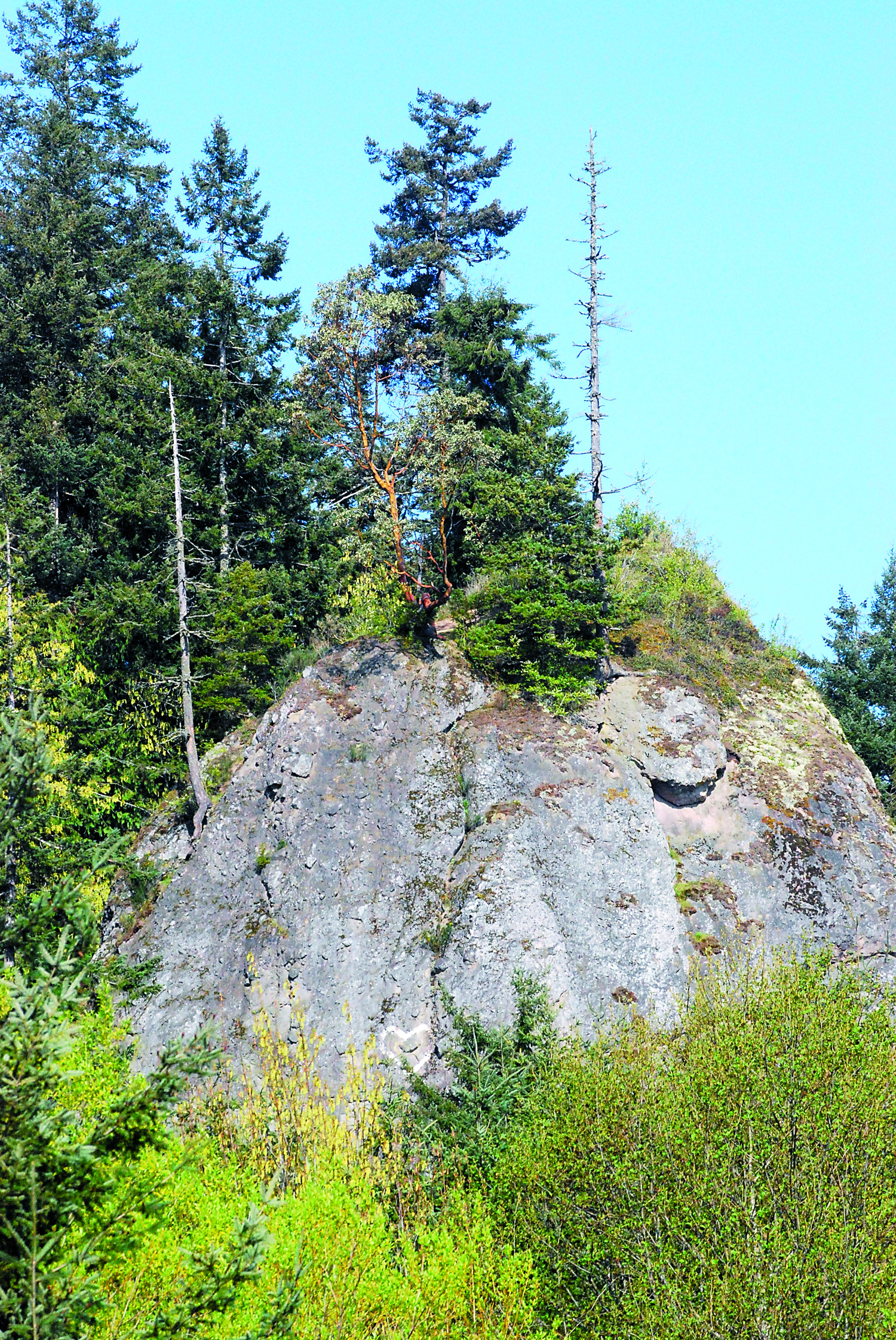
CHIMACUM — After decades of work to preserve Tamanowas Rock, the ancient tribal site is now legally in the hands of the Jamestown S’Klallam tribe, which plans to make one major change in management:
There will be no rock climbing. Period.
“It is like allowing people to climb the Sistine Chapel,” Leo Gaten, governmental policy liaison for the tribe, said.
Tamanowas Rock, shaped like a pointed egg, stands more than 150 feet from the valley floor to the east of Anderson Lake State Park.
On Dec. 21, the 62 acres around Tamanowas Rock, including the rock itself, were purchased by the tribe for $600,000, the tribe announced.
The purchase has been added to an adjacent 22-acre property that has been owned by the tribe since the 1990s.
The combined properties, known as the Tamanowas Rock Sanctuary, “will be protected in perpetuity from development and inappropriate uses with respect to a cultural and religious Indian site,” according to the tribe’s official announcement of the purchase.
The rock was known by Salish people as a place of power and spiritual bonding, Gaten said.
Tamanowas, in the Klallam language, means “spirit power.”
“Tamanowas Rock is one of those rare sacred sites that can be traced back to ancient times,” said Liz Mueller, Jamestown S’Klallam tribal council vice chairwoman and member of the tribe’s culture committee.
“Tribes as far north as the Lummi Nation would travel down for the sacred ceremonies,” she said.
In 1976, Tamanowas Rock, also known as Chimacum Rock, was listed in the Washington Heritage Register (www.dahp.wa.gov/washington-heritage-register) — as having significant archeological interest, and efforts are being made to get the site listed in the National Register of Historic Places, said Betty Oppenheimer, spokeswoman for the tribe.
Until 2008, the rock was owned by George Heidgerkin, a developer who purchased the property in 1993 with plans for as many as 46 homes on the land surrounding the rock.
It was purchased from Heidgerkin by Washington State Parks in 2008, transferred to the Jefferson Land Trust, then purchased by the tribe in December.
The land trust and the tribe will manage the property together, and the land trust will keep a conservation easement on the property, said Caroline Robertson, outreach director for the Jefferson Land Trust.
The rock has been used as a recreation site for decades, and the tribe had concerns about hikers who left litter, vandalism and other damage to the sacred site, Gaten said.
There has been a lack of respect shown to the site and the surrounding property, he said.
Climbers who frequent the rock have argued that they protect it — and Gaten agreed that their argument is true to some degree.
However, the rock itself — a 43 million-year-old volcanic rock formation — is not the type that holds up well to the chipping that is caused by rock-climbing equipment, Gaten said.
Gaten said parts of the rock where climbers make their ascent are flaking and chipping away.
A new management plan has been developed that will allow continued but controlled public access, he said.
Tribal plans include the addition of information kiosks to teach visitors of the history of the site; its cultural, religious and historic importance; and how to show respect to the land and the rock itself — including no rock climbing.
Geologists believe Tamanowas Rock — an immense monolith with caves, crevices and cliffs — is a rare example of “slab window volcanism,” an unusual process that occurs when a sea floor spreading ridge enters a subduction zone, with mixed characteristics of adakite lava and volcanic breccia.
Tribal oral histories regarding Tamanowas Rock include tales of it being used as an outlook for hunting mastodons, when the area around the rock was a savannah, approximately 8,000 to 10,000 years ago.
One story that has survived is of Tamanowas Rock being used by people from a local village as an anchoring point when a flood occurred.
The only flood that could have occurred of that magnitude, at the elevation of Tamanowas Rock, would have been a tsunami.
The geological record shows the most recent one occurred about 3,000 years ago.
Over time, the loss of native spiritual practices nearly eliminated the rich, indigenous ceremonial history from institutional memory, and Tamanowas Rock has become a recreational site enjoyed by hikers, equestrians and rock climbers, Gaten said.
________
Reporter Arwyn Rice can be reached at 360-452-2345, ext. 5070, or at arwyn.rice@peninsuladailynews.com.
