
SEQUIM — Jamestown S’Klallam tribe scientists have teamed up with Western Washington University’s Huxley College on the Peninsulas as part of a Dungeness River floodplain restoration effort.
“The big question is to plant or not to plant,” said Jenise Bauman, the college’s assistant professor of environmental science.
To help determine whether planting and/or seeding native shrub and tree species in an area like Railroad Bridge Park where there’s “a lot of seed source” is beneficial, Huxley students from Peninsula College and Olympic College are working with the tribe’s habitat biologists to study different restoration approaches and their outcomes.
The project area is in the floodplain surrounding the recently repaired bridge at Railroad Bridge Park.
“We’ve built this brand new awesome bridge and we’ve given the river a lot more room to move than it had in the past,” said Hilton Turnbull, habitat biologist for the Jamestown S’Klallam tribe.
“This type of floodplain revegetation work is pretty much a part of every project we [the tribe] do whether we’ve acquired new property along the river or after removing floodplain obstructions like dikes or levees — planting it is part of our restoration design.”
Collaboration with Huxley College students and professors, however, isn’t part of every restoration project.
“Often we have to just go in and do what we think is best,” Turnbull said.
“So I was really excited to have the opportunity to work with students and do an experimental design.”
To better understand how different restoration methods might impact the amount of plant coverage throughout time and how to best prevent erosion and control invasive species, Bauman is having her students use a block design.
For this project, a “block” or mapped area, is broken into four smaller plots where students have applied four different restoration “treatments.”
The treatments are: do nothing; seed alder only; plant native bare root seedlings and seed alder; and plant native bare root seedlings only.
To ensure the treatment outcomes aren’t because of surrounding factors, like a nearby tree for example, the block design is replicated twice, for a total of three, Bauman said.
“A block design gives us some spatial control on our treatments and the biology of our system,” she said.
“It is great to be able to set up a design and see what we come up with,” Turnbull said. “We’re always trying to learn and improve.”
The project will span multiple seasons. In the fall, another Huxley College class will collect data, like the percent of ground cover, water quality, amount of erosion and invasive species.
“The results of the study will help to inform future restoration decisions,” Bauman said.
One of the primary goals driving the tribe’s commitment to restore native plant and tree species within the river’s floodplain is to create salmon habitat and control invasive species like butterfly bush and scotch broom, Turnbull said.
“Over time salmon have evolved to require services native species provide,” he said.
Examples of services include the habitat and protection a large tree can provide after it’s fallen into the river or the shading or soil stabilization it can provide.
Adding to the overall restoration work underway in Railroad Bridge Park, the Olympic Peninsula Audubon Society also has a volunteer group planting native species west of the floodplain where heavy equipment was kept and used during the construction of the new bridge.
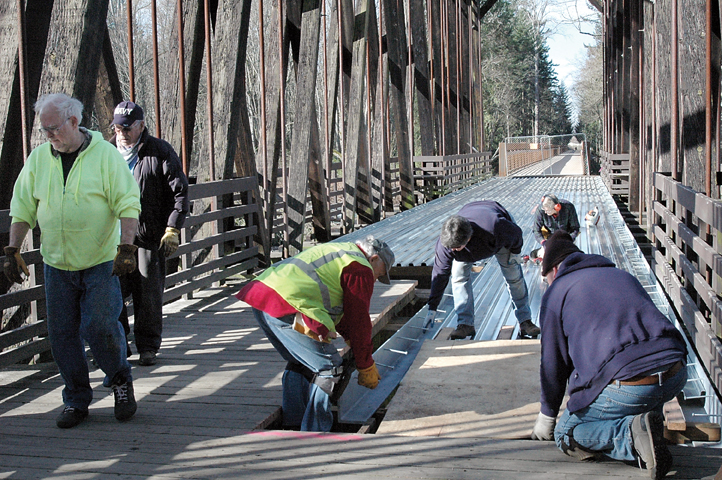
Moving out of the floodplain and up onto the bridge, the work to resurface the wooden ramp and historical Dungeness Railroad Bridge is on track.
The bridge, which acts as a pivotal part of the Olympic Discovery Trail, was closed to through traffic Feb. 15 to allow volunteers to remove the aged wooden decking, reinforce the bridge’s supports and install the infrastructure necessary for the planned concrete surface.
Since then, Peninsula Trails Coalition volunteers have logged about 300 volunteer hours per week. The Clallam County chain gang also provided one day of labor.
“If we’re lucky,” the crew will finish within the first week of this month, Gordon Taylor, Peninsula Trails Coalition special projects manager, said.
As the volunteers near the end of the bridge and begin to address the ramp portion, Taylor expects their progress to slow because the ramp has more “complex” angles.
Once the bridge and ramp are ready, a Sequim-based company, Hiday Concrete Inc., will install the concrete, a task estimated to take two to four days, Taylor said.
Volunteers will cap off the project by reconfiguring some of the guardrails and rebuilding the observation deck.
“It will be rewarding when it’s finished,” Taylor said.
Beyond aesthetics, the new bridge and ramp surface will be safer than the former wood decking.
“Several of us have fallen because the wood can get so slick,” Taylor said, adding the majority of the wooden decking removed was rotten and in need of replacement.
Weather depending, the bridge is expected to reopen in mid- to late March, Taylor said.
Once resurfaced, the historical bridge and adjoining steel trestle completed in late December will “look like one continuous piece.”
A $100,000 donation from the First Federal Community Foundation to the Jamestown S’Klallam tribe, owner of the park property and bridge, was used to fund the project.
________
Alana Linderoth is a reporter with the Olympic Peninsula News Group, which is composed of Sound Publishing newspapers Peninsula Daily News, Sequim Gazette and Forks Forum. Reach her at alinderoth@sequimgazette.com.
