
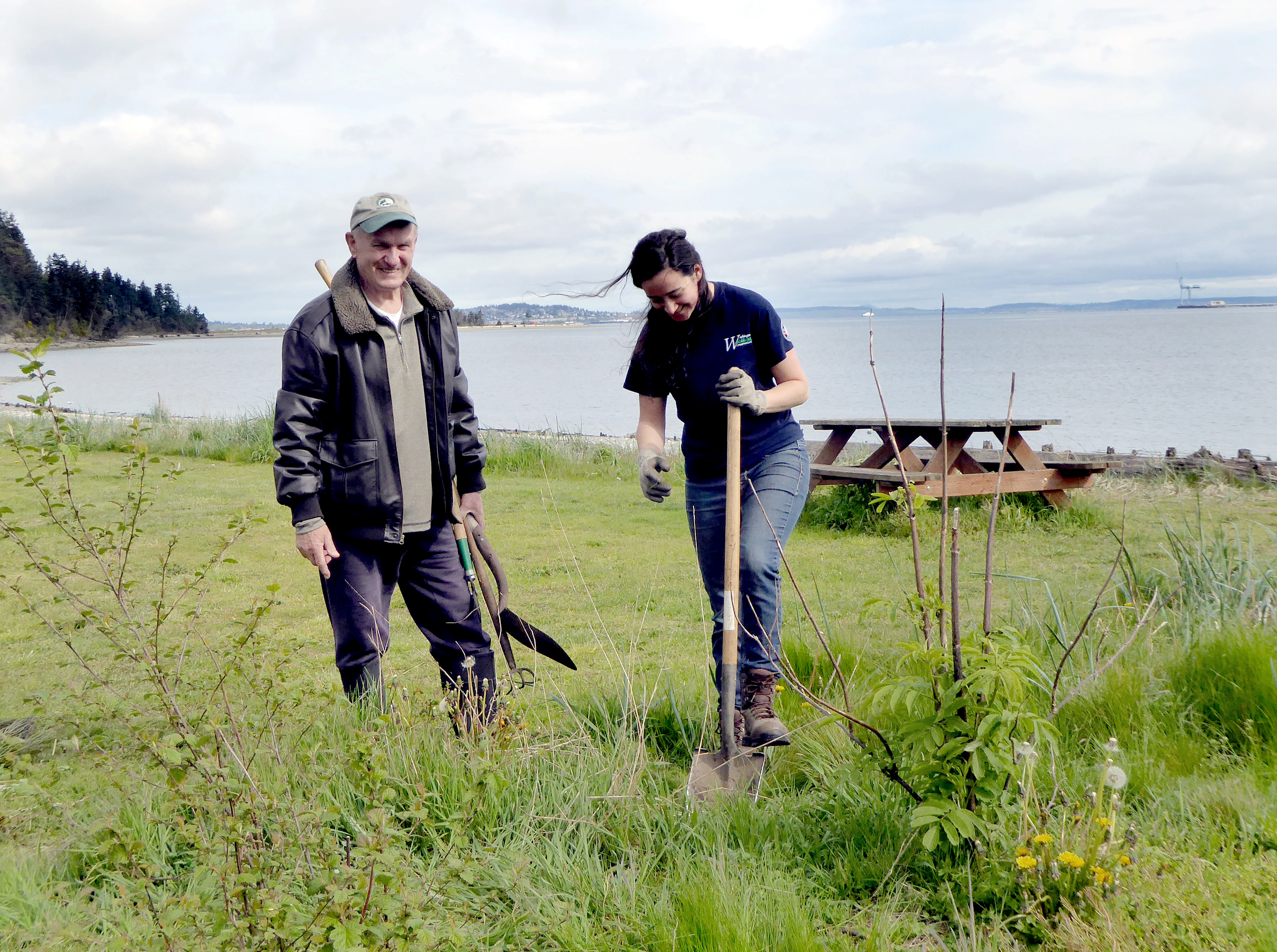
IRONDALE — A former industrial site will serve as an example for efforts to banish invasive plants after a crew spends the next two weeks at Irondale Beach Park, restoring it to a pristine condition.
“If we don’t get the invasives out of here, the natives we’ve planted aren’t going to do well,” said John Longsworth, an arborist who is directing a crew as part of the Urban Forestry Restoration Project, which was created by a partnership between the state departments of Natural Resources and Ecology and the Washington Conservation Corps.
“We hope people come down here and see this to determine what their own landscape should be.”
Longsworth is supervising a crew of five AmeriCorps volunteers, all students of forestry and ecology, in the removal of blackberries, English Ivy, English Holly and poison hemlock from three locations in Jefferson County.
The crew will spend about two weeks at Irondale Beach Park followed by about a week each at Trailhead Park and Courthouse Park.
That project has special importance due to its affiliation with the Jefferson County juvenile offender program.
Juvenile Court Administrator Barbara Carr called the project “a terrific match” for the community service program.
“While working off court-ordered hours, they are learning valuable skills, getting exercise outdoors, beautifying this wonderful space and giving back to their community,” Carr said.
“The opportunity to interface with the [Natural Resources] crew will be an added bonus that should enhance every aspect of this park project.”
The crew spent three weeks in Port Townsend in March and is scheduled to spend July in Port Angeles cleaning up trails and city streets, Longsworth said.
Many of the invasive plants are pulled up by their roots while some larger plants are cut down to ground level, Longsworth said.
At that point herbicide is applied to the exposed roots with a paintbrush.
“We are very careful with this,” Longsworth said of the herbicide.
“A lot of times, pulling large plants out by the roots can broadcast their seeds.”
The land that is now Irondale Beach Park was once considered of little value until the discovery of iron-oxide deposits up to 4 feet deep, which led to the creation of Irondale Iron and Steel plant, which started operating in 1881.
In its prime, Irondale had a population of 1,500 with three hotels, a mercantile, a post office and a hospital, and it was once thought on track to become “the Pittsburgh of the Pacific.”
The processing plant closed in 1919, and the property was contaminated with petroleum hydrocarbons and metals during the plant’s operation.
Jefferson County took control of the property in 2001 and its cleanup was completed in 2007.
For more information about the Urban Forestry Restoration Project, contact Micki McNaughton at 360-902-1637 or micki.mcnaughton@dnr.gov.
For more information about County Parks, contact Matt Tyler, Parks and Recreation Manager at 360-385-9129 or email mtyler@countyrec.com.
________
Jefferson County Editor Charlie Bermant can be reached at 360-385-2335 or cbermant@peninsuladailynews.com.
