
By Gene Johnson
The Associated Press
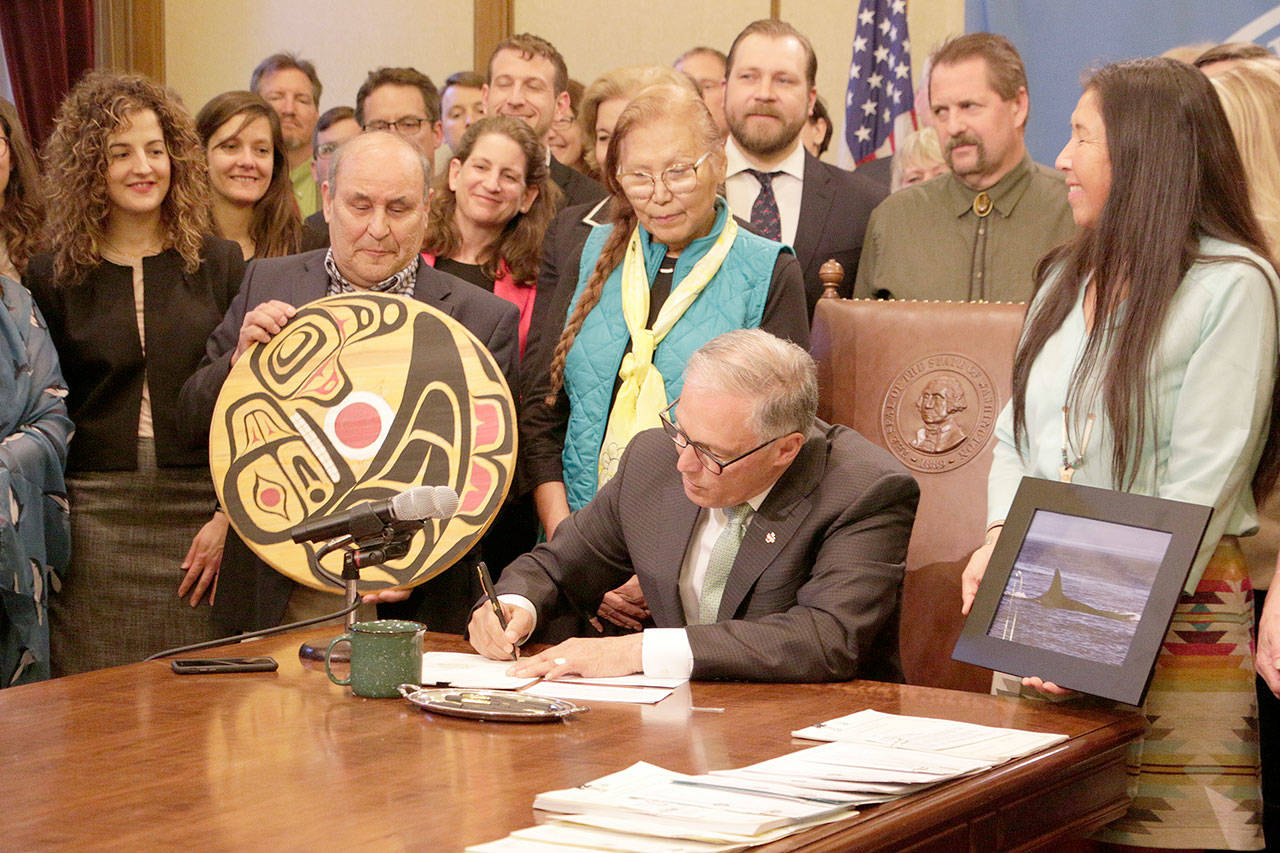
SEATTLE — Gov. Jay Inslee has signed several bills designed to help the endangered Southern Resident orcas, measures that he said gave him hope the species might be saved.
The measures signed Wednesday include requiring more oil shipments near the San Juan Islands to have tugboat escorts to prevent spills, allowing anglers to catch more walleye and bass that prey on young salmon, and giving state agencies the authority to ban toxic chemicals in consumer goods.
Other important parts include improving the state’s ability to enforce permit requirements for work that hardens shorelines, such as by installing bulkheads near homes, and making vessels stay farther away from orcas and go slower when they’re near them.
“These bills are helping to improve the ecosystems that sustain both salmon and orcas, quiet the waters in which the orcas hunt and provide them more prey,” Inslee said as he signed the bills in Olympia. “While there will be more to do next session, these bills give me hope that we can protect these iconic species for decades to come.”
The legislation grew out of recommendations made by Inslee’s orca recovery task force last fall. The orcas that return every year to the waters between Washington and British Columbia are struggling against toxins that accumulate in their blubber, vessel noise that interferes with their hunting, and, most seriously, a dearth of chinook salmon, their preferred prey. There are just 75 of the orcas left, and researchers say they’re on the verge of extinction.
In December, Inslee, who is running for the Democratic nomination for president, proposed what he described as a “herculean effort” — and $1.1 billion in spending — to help the orcas. Much of the money was to go toward protecting and restoring salmon habitat.
The Legislature directed about $50 million to some important salmon-restoration efforts, including a dam removal on the Nooksack River and flood-plain work along the Dungeness and Cedar rivers.
Lawmakers agreed to pay $750,000 to begin planning for what might happen if four huge dams on the Snake River were breached; conservationists said getting rid of the dams is a crucial step toward bringing back salmon and orcas alike, though it faces steep political opposition in eastern Washington.
Lawmakers didn’t give Inslee everything he wanted, though, especially when it came to money. They agreed to spend only $100 million — about one-third of what Inslee asked for — to comply with a federal court order to replace more than 400 culverts that block fish passage by 2030. That makes it unlikely the state will meet the court’s deadline.
Conservationists nevertheless celebrated. Mindy Roberts, Puget Sound director of the Washington Environmental Council, called the bills Inslee signed “the biggest wins for Puget Sound recovery for over a decade.”
Activists and researchers have long known that the threats to the whales are urgent, she said, but it took the deaths of several — and the apparent mourning of one mother, named Tahlequah, who carried her dead calf on her head for 17 days last summer — to penetrate the public consciousness.
“The visibility of the plight of the orcas — that’s what got people to act,” Roberts said. “People were talking about it at grocery stores. I heard people talking about it at a wedding — and these were not your typical activists.”
The bills include:
• Senate Bill 5135, which gives the state Department of Ecology the ability to ban certain chemicals, including PCBs and PFAS, in consumer products such as carpets, personal care products, building materials and electronics. Researchers say the chemicals can accumulate in the blubber of whales, posing health risks as the whales burn through their fat as they search for scarce salmon. Toxic-Free Future, a nonprofit advocacy group, said the bill gives Washington the nation’s strongest policy regulating toxic chemicals in products.
• Senate Bill 5577, which requires vessels to keep 300 yards away from orcas and creates a go-slow zone within half a mile of them. It also requires commercial whale-watching vessels to obtain a license.
• House Bill 1578, which requires smaller-sized oil tankers to have a tug escort in certain areas near the San Juan Islands. Tugs were already required for larger vessels.
• House Bill 1579 , which requires the Department of Fish and Wildlife to allow anglers to catch more bass, channel catfish and walleye. The fish prey on young salmon as well as the forage fish that salmon depend on. The bill also requires a fishing license for saltwater smelt. It protects natural shorelines and salmon habitat by increasing the ability of the state to enforce permit requirements for, and impose fines related to, projects such as bulkhead and rock wall construction.
