
Olympic Peninsula News Group
Gov. Jay Inslee has issued an emergency order urging immediate action and legislative funding to address the population growth of the invasive European green crab after the Lummi Nation reported 70,000 counted in its sea pond in 2021 and the Makah reported a count higher than any since 2017.
The emergency order issued Wednesday is aimed at eradicating the invasive species, which competes with native life and preys on juvenile clams, to prevent its permanent establishment in the state.
It directs the state Department of Fish and Wildlife to implement emergency measures with funding already available while urging the state Legislature to provide additional emergency funding as requested by Fish and Wildlife as soon as possible.
Fish and Wildlife has requested $8.9 million.
Inslee’s order also directs the state Department of Ecology — and asks the state Department of Natural Resources and the State Parks and Recreation Commission — to identify European green crab management as a high priority on state-owned aquatic lands and to facilitate implementing the emergency measures.
The crab — native to Europe and northern Africa — is highly adaptable and preys on juvenile clams before they reach harvestable age, out-competes native crab species such as Dungeness crab, and wreaks havoc on marine and estuary ecosystems near shore, such as eelgrass beds that are important nursery habitats for a variety of species, including salmon.
Controlling the numbers is important to the Makah Tribe, said Adrianne Akmajian, a marine ecologist for Makah Fisheries Management. She reported that she and her team caught 1,460 green crabs in 2021, the most ever in a year since trapping started in 2017.
“Green crabs can compete with other native species utilizing the rivers and nearshore waters, such as juvenile Dungeness crabs, which may impact tribal fisheries,” Akmajian added.
“Regionally, it is really important to try to limit the numbers of crabs to reduce the chance of local reproduction and larvae or crabs being spread from the Reservation down the coast or into the Strait.”
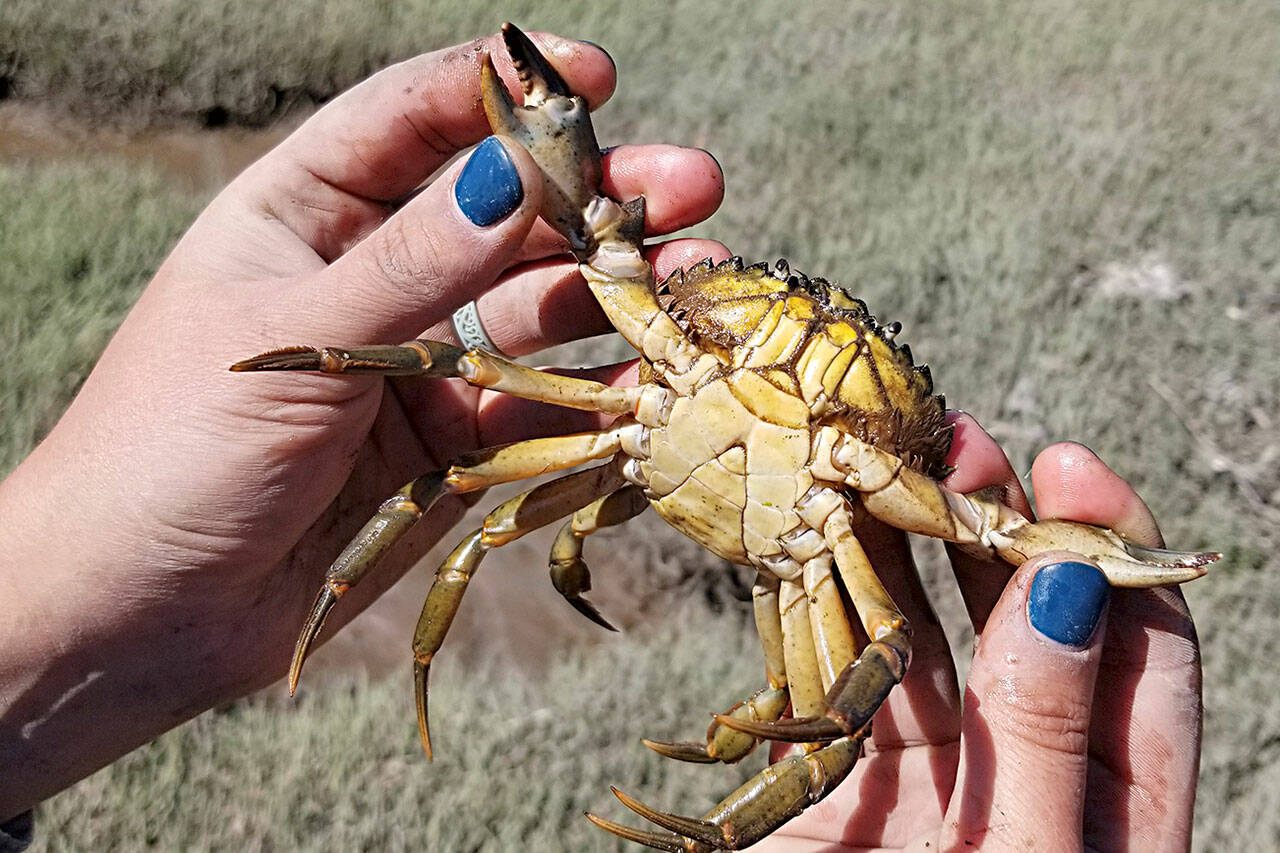
European green crab, known by their five spines on the side of each eye, were first discovered in Washington in 1998 in Willapa Bay and Grays Harbor and have spread throughout coastal areas.
The species was first detected on the Lummi Reservation’s salt water pond in 2019. Counts jumped from 41 to 2,670 in 2020 to more than 70,000 in 2021, Fish and Wildlife reported, which prompted the Lummi Indian Business Council to declare a disaster in November. Washington Sea Grant’s Crab Team reported the Lummi outbreak to be the state’s largest infestation along inland shorelines.
While the number is large, Emily Grason, marine ecologist and Crab Team program lead, and Bobbie Buzzell, lead biologist for Lummi Natural Resources, say that the range has not expanded.
“The only places green crabs were captured were generally sites and water bodies with a known presence of European green crab in previous years,” they reported.
However, resource managers are concerned that larvae could leak out into the Salish Sea and spread to neighboring areas so tribal leaders plan to continue researching and trapping with state, tribal and other partner agencies.
Grason has said in previous interviews that green crab larvae can travel over 60 miles, and a female can release up to half-a-million larvae per brood with the possibility of more than one brood per year.
In contrast to those at Makah Bay and the Lummi reservation, counts in Sequim-Dungeness areas remained relatively low in 2021.
Resource managers with the Washington Maritime National Wildlife Refuge in Dungeness and Jamestown S’Klallam Tribe at Sequim Bay reported 24 combined captures (eight and 16, respectively) last year.
In Dungeness, captures were slightly up from 2020, with three crabs from more than 1,800 traps to eight crabs in 2021 with 839 traps placed, reported Lorenz Sollmann, deputy project leader at the National Wildlife Refuge.
“With so few crabs caught for a second year in a row we might be able to scale back a little more in the channel on Graveyard (Spit) like we did at the base lagoon,” Sollmann said. “Last year we only did the monthly monitoring there and for a second year caught no green crabs.”
Green crabs were first detected in Dungeness in 2017 after years of monitoring with 96 green crabs caught and then declining to 69 in 2018 and 57 in 2019. Grason said none of the crabs there in 2021 were “young of the year, which is hopeful news for continued low numbers of crabs next year.”
Along Sequim Bay, Neil Harrington, environmental biologist for the Jamestown S’Klallam Tribe, reported 16 green crabs in 963 traps through early November after not catching any in 2020.
“While the total is still smaller than some other sites, and the capture rate is relatively low, the increase compared to previous years is large enough to raise concerns,” Grason said.
Harrington said he plans to continue trapping in Sequim Bay’s south end marshes.
“I would imagine the level of effort will be similar to 2021, maybe a bit higher since we will start earlier in the season,” he said.
In Jefferson County, Emily Grason, marine ecologist and Crab Team program lead, reported that Fish and Wildlife staff captured two green crabs by Bishop’s Point last May but found no others at nearby sites.
Grason said that the Strait of Juan de Fuca “provides a semipermeable barrier to dispersal of larvae into the Salish Sea from coastal waters.
“However, we know from both genetic and ocean modeling evidence that occasional reversals of surface water flow can carry green crab larvae into the Salish Sea, particularly along the southern shoreline of the Strait,” she said.
“Even if these reversal events are relatively infrequent, recent dramatic population increases in coastal estuaries of Willapa Bay and Grays Harbor might provide enough of a boost to the number of larvae in the surface water during the time of year that reversals occur, that we could be starting to see the carry over of coastal populations to inland shorelines.”
Grason added that the local numbers “are still very low compared to anywhere on the coast, or other inland hot spots like Lummi sea pond.”
Washington Sea Grant will continue a network of 55 early detection/monitoring sites along inland shorelines in 2022, including Pysht (one site), Dungeness Bay (four), Sequim Bay (two) and Discovery Bay (one) along with newer sites in coastal estuaries, such as Makah Bay monitored by tribal, agency and shellfish growers, and volunteers.
Resource managers say if you find a green crab or its shell, report it online to crabteam@uw.edu, but leave it in place.
For more about green crabs, see www.wsg.washington.edu/crabteam/.
________
Matthew Nash is a reporter with the Olympic Peninsula News Group, which is composed of Sound Publishing newspapers Peninsula Daily News, Sequim Gazette and Forks Forum. Reach him at mnash@sequimgazette.com.
Peninsula Daily News Executive Editor and The Associated Press contributed to this story
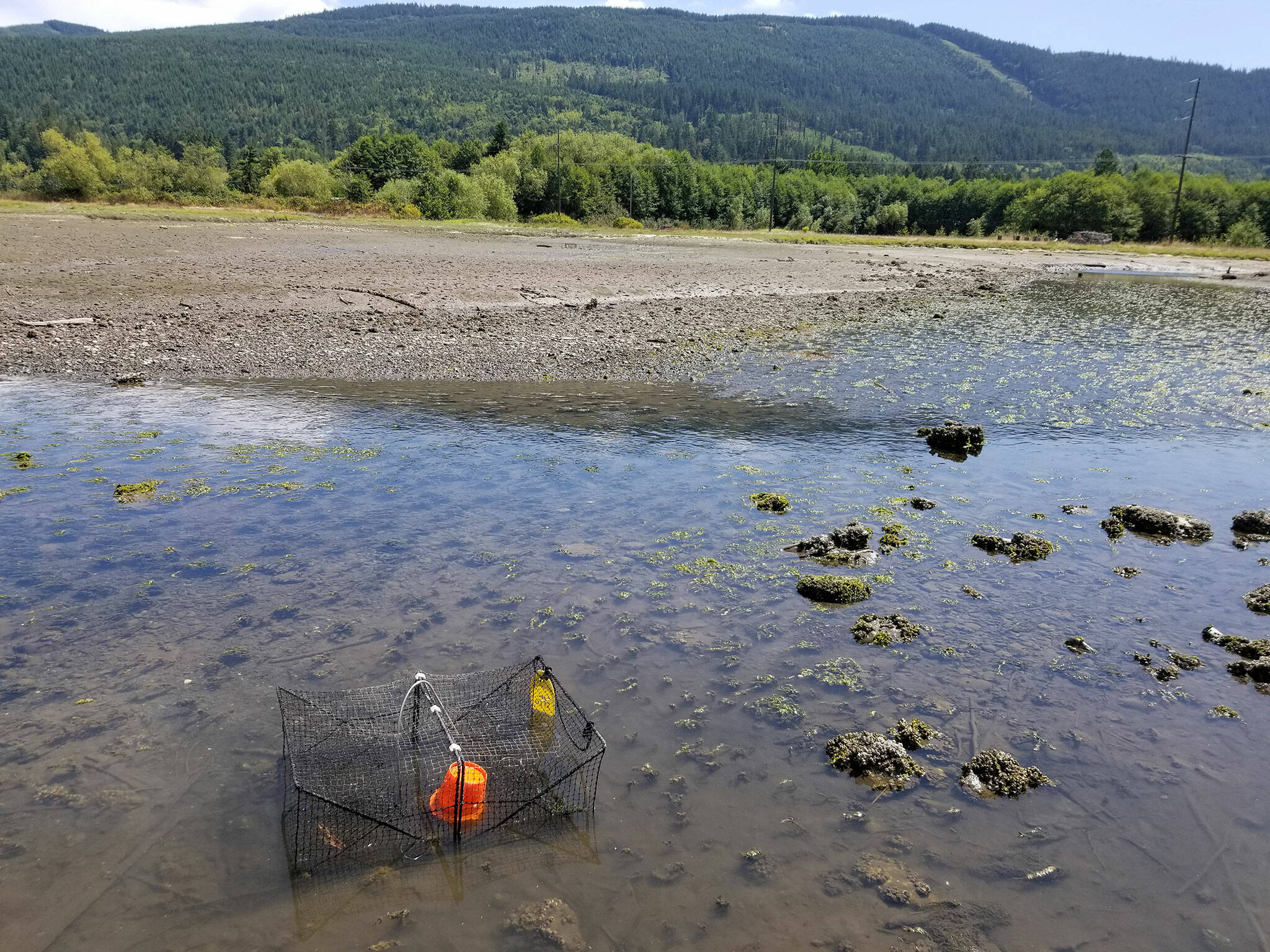
Along Sequim Bay, Neil Harrington, environmental biologist for the Jamestown S’Klallam Tribe, reported 16 green crab captures after placing 963 traps through early November after not catching any green crabs in 2020. (Photo courtesy Neil Harrington/Jamestown S’Klallam Tribe)
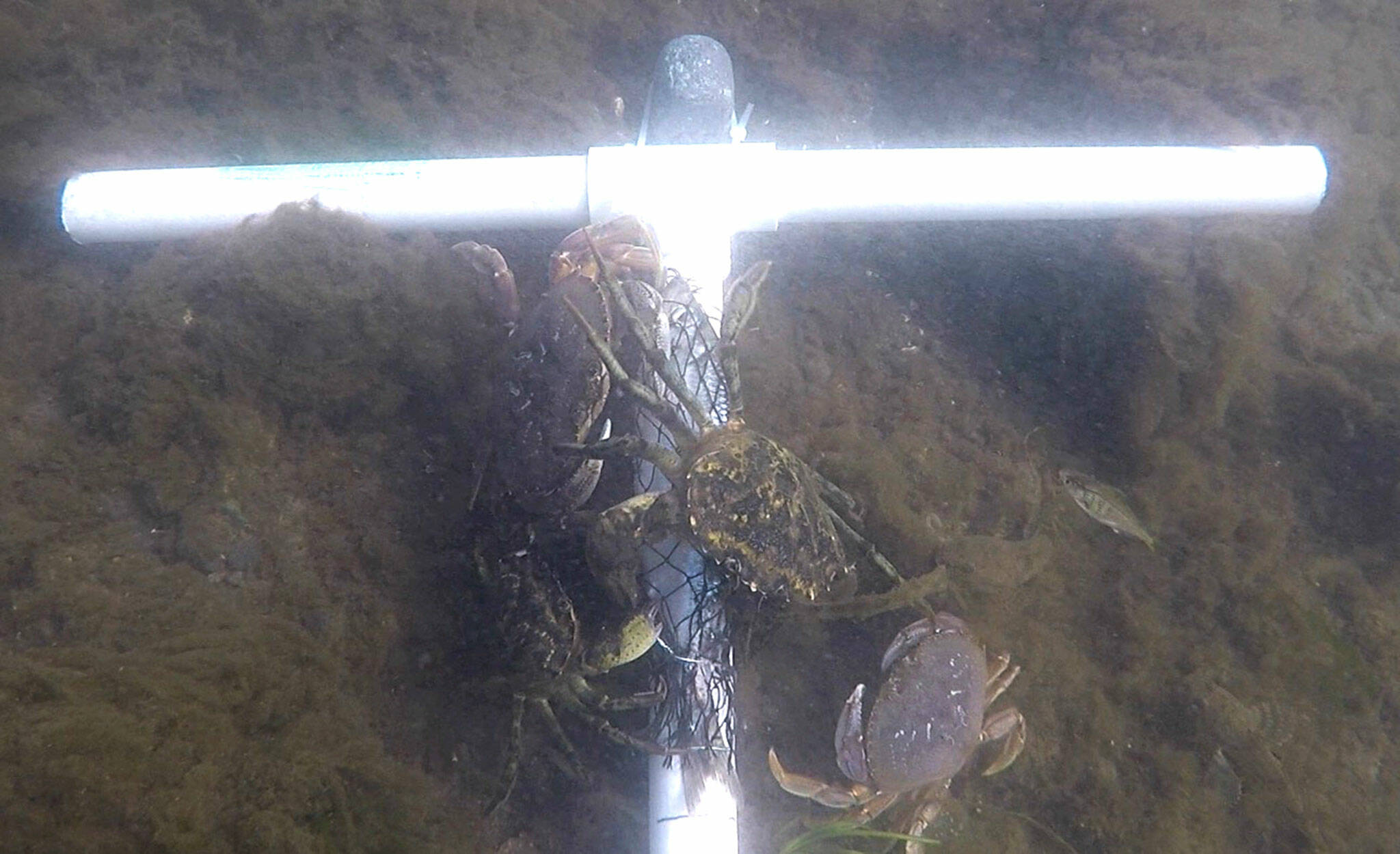
Continuing this year, staff with Makah Fisheries Management plan to continue underwater research of interaction between Dungeness crab and the invasive European green crab. (Photo courtesy Adrianne Akmajian/ Makah Fisheries Management)
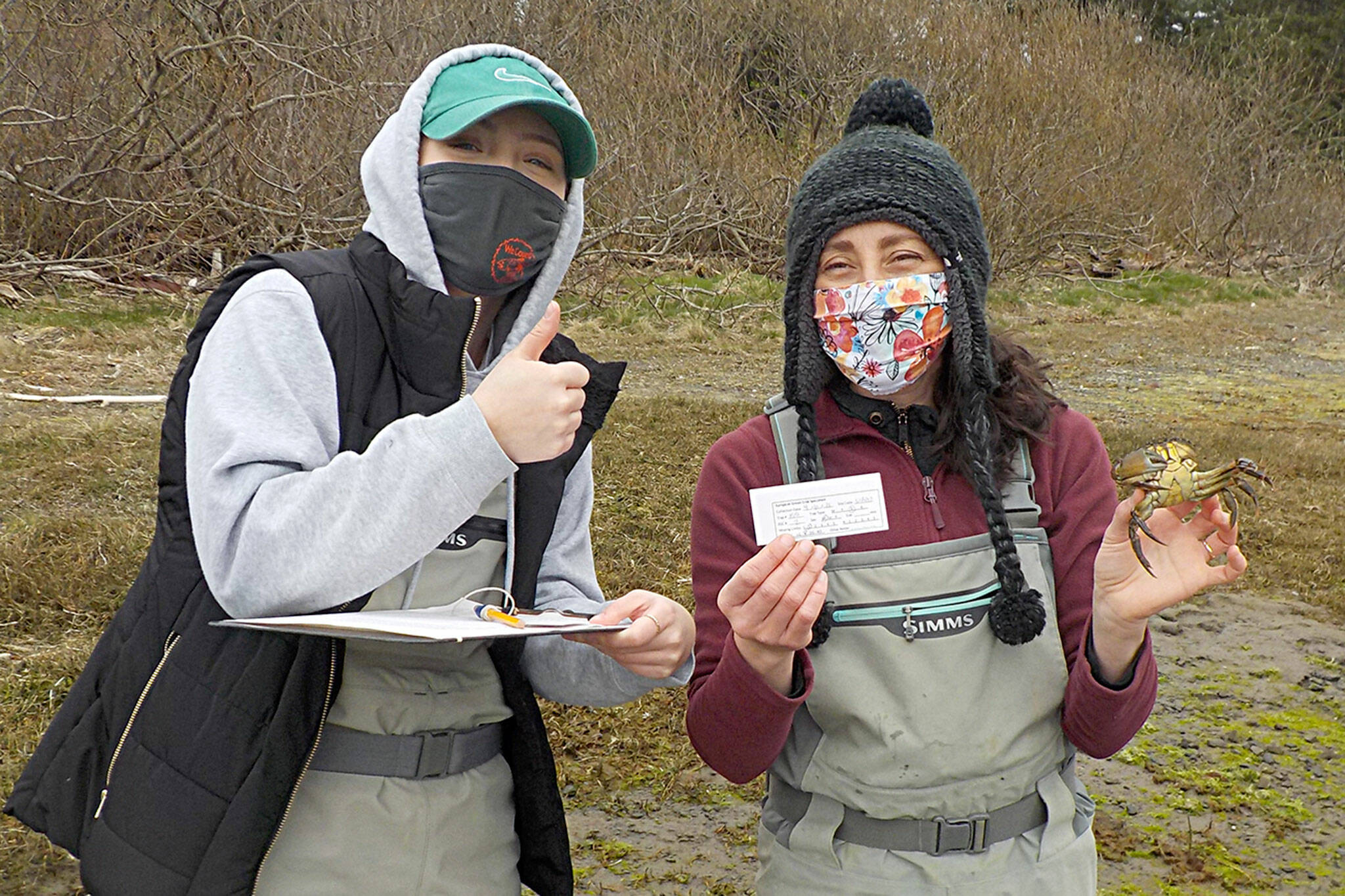
Representatives with the Makah Fisheries Management, Angelina Woods, left, and Adrianne Akmajian, hold up the first European green crab captured last year in April. The Makah Tribe would go on to catch more than 1,400 green crab, their most ever. (Photo courtesy Adrianne Akmajian/ Makah Fisheries Management)
