
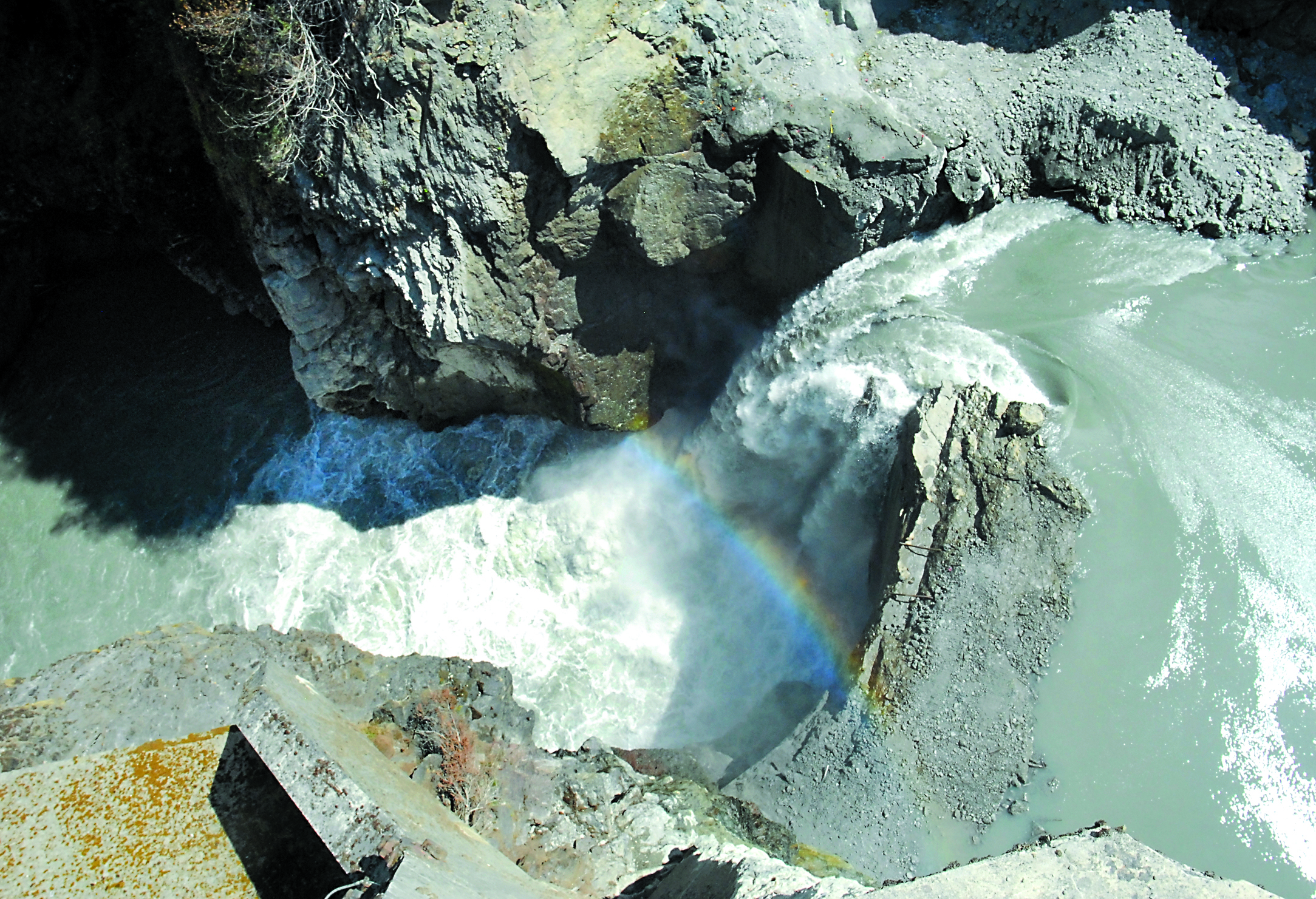
OLYMPIC NATIONAL PARK — Work continues at Glines Canyon Dam — which has been knocked down to less than half its original height — despite a six-week fish-protection window that halted the lowering of Lake Mills at the beginning of this month.
“We are preparing to demolish the intake tower at Glines,” Brian Krohmer, project manager for Barnard Construction, the National Park Service’s contractor for dam removal.
After knocking down the 115-foot intake tower, crews will drill holes in what’s left of the dam’s concrete edifice for the next blast on Sept. 15.
Crews also will complete other tasks during the fish window, which began Aug. 1 and will extend to Sept. 15.
“The next fish window [to protect migrating salmon and steelhead in the river] starts on Nov. 1, so for a month and a half, we’ll blast as much as we possibly can,” Krohmer said.
Two controlled blasts July 29 and
July 31 lowered Lake Mills — the rapidly-vanishing reservoir behind Glines Canyon Dam — from 496 feet to 492 feet above sea level.
A total of six blasts in July lowered the lake by about 24 feet, Olympic National Park officials said.
Notching of the top of the dam began last September.
About 90 feet of the 210-foot-high dam are left.
Crews are allowed to lower the reservoir 3 feet per blast every two days until the surface of the lake reaches the 470-foot mark.
From there, crews can draw down the reservoir 10 feet per blast once every five days.
Most of the material from the controlled blasts is landing in the underwater canyon immediately upstream from the dam.
“We’ll be removing rubble as we go,” Krohmer said.
Krohmer said there isn’t much of a reservoir pool left in Lake Mills as the delta gets closer and closer to the site.
The dam removal project — the largest of its kind in U.S. history — is well ahead of schedule.
The last remnants of the 108-foot Elwha Dam, nine miles downstream from Glines Canyon Dam, were removed in March.
Glines Canyon Dam will be gone by early next summer.
The work was originally scheduled to run through 2014.
Barnard Construction has about 10 people working on the removal of Glines Canyon Dam.
Krohmer said the intake tower will be blasted down and broken apart within the next two or three weeks.
Altair Campground, which was closed for visitor safety during the July blasting period, reopened Aug. 1.
The campground downstream from Glines Canyon Dam will remain open through Sept. 15 and close for the next series of blasts.
The National Park Service is overseeing the $325 million restoration project. The dam-removal contract with Barnard Construction is $26.9 million.
The Elwha Dam, constructiwon of which begain in 1910 and was completed in 1914, and 85-year-old Glines Canyon Dams blocked 70 miles of pristine salmon habitat when they were built without fish ladders.
________
Reporter Rob Ollikainen can be reached at 360-452-2345, ext. 5072, or at rob.ollikainen@peninsuladailynews.com.
