
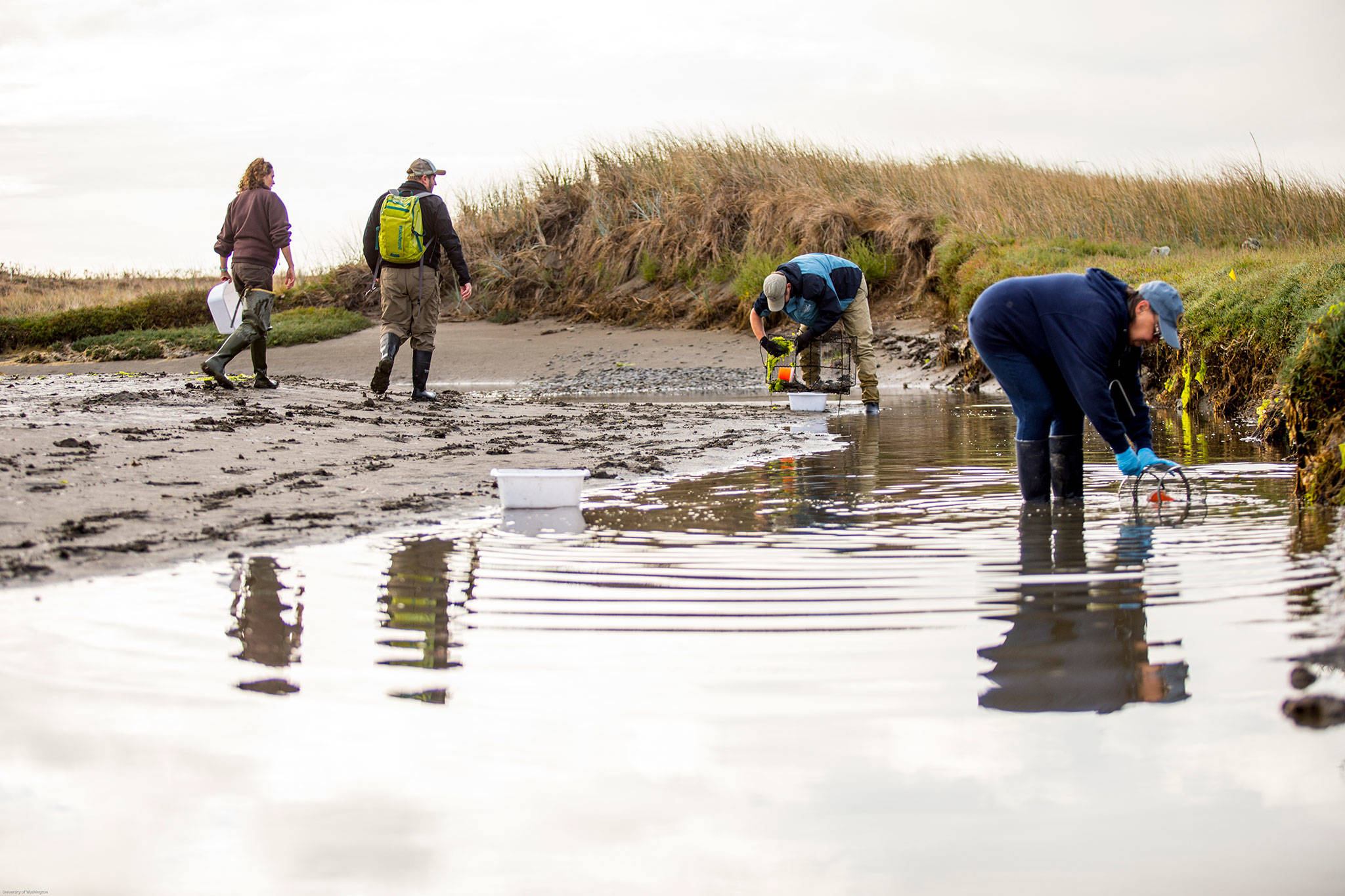
SEQUIM — Local resource managers are back on the hunt for European green crab.
Last year, the invasive species, considered one of the world’s worst, researchers say, was discovered on Graveyard Spit along the Dungeness Spit north of Sequim.
Through October last year, staff and volunteers at the Washington Maritime National Wildlife Refuge and with the Jamestown S’Klallam Tribe sought to trap as many of the green crabs as possible.
By season’s end, they had caught 96 green crabs on the Dungeness Spit and one in Sequim Bay.
Lorenz Sollmann, deputy project leader at the refuge, and a team of about 20 volunteers set out up to 127 traps at a time.
This year, Sollmann said the team tested the waters early in mid-March for three days and caught one green crab. On April 1, volunteers and staff began trapping for the season by placing 41 traps in the Graveyard Spit channel and four in the spit’s base lagoon near the mainland. So far, they’ve caught 22 green crabs in the channel as of Thursday with nine of them females ranging from 39-70 millimeters.
Sollmann said a majority of last year’s catches were in the channel west of Graveyard Spit, north of Dungeness Landing.
The tides have limited their trapping some, he said, with some weeks allowing for at least three days of trapping.
“Not that it was unexpected, but we’re more prepared for it this year and what it would take,” Sollmann said.
“We’re hoping for a lower number and ideally, we’ve caught the last one, but if not and there’s this trickle effect of finding them hopefully we’ll know more after this month,” he said.
Last year, Allen Pleus, Aquatic Invasive Species coordinator for the state Department of Fish and Wildlife, said trapping green crab is similar to fighting dangerous illnesses — “If you find small pockets, you try to get rid of it before it gets exponentially worse.”
Emily Grason, Crab Team project coordinator through Washington Sea Grant, reported that one female green crab can release up to 500,000 larvae at a time at least once a year.
In Dungeness, Sollmann feels they’ve made a dent in the numbers.
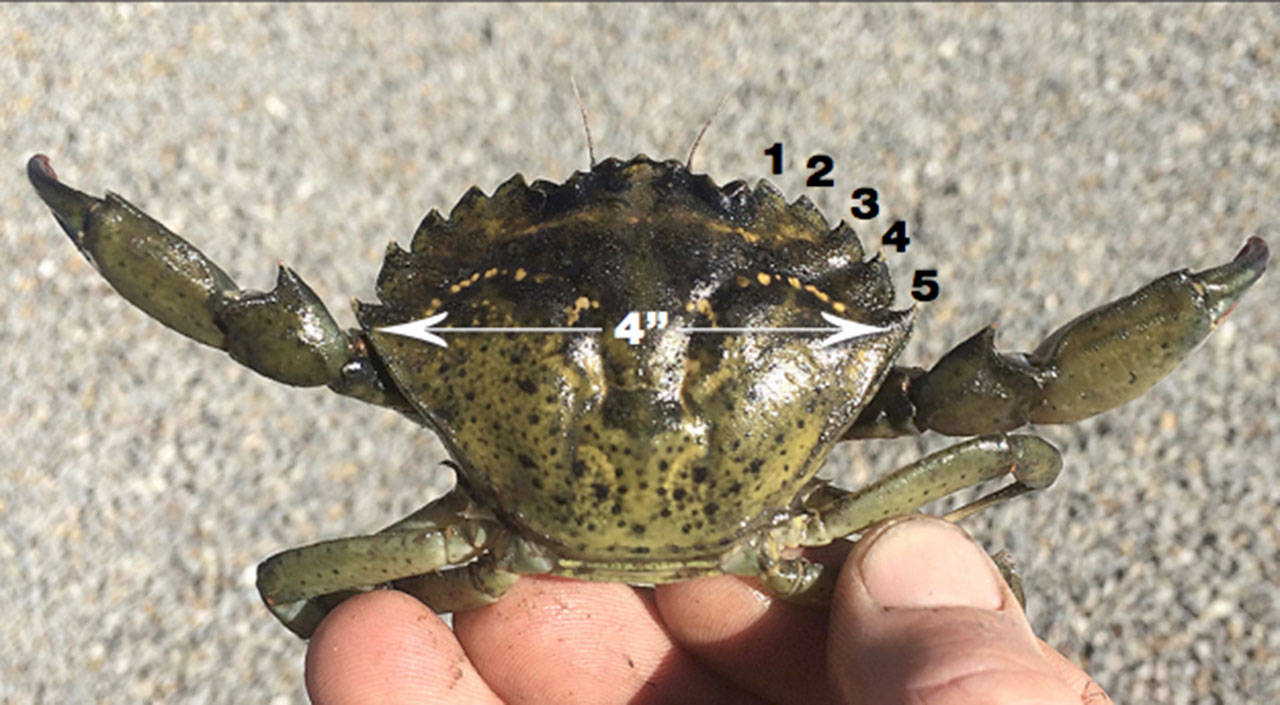
Sollmann previously said that their method of trapping the European green crab, known for its five spines on the sides of its eyes, is the most efficient and economically feasible with its staffing levels and funding.
Mysteries continue to circulate about the green crab in Dungeness as to how they got there and their origin.
Resource managers theorized that green crabs found in Dungeness and other areas like Westcott Bay and Padilla Bay floated over as larvae from Sooke Basin, B.C.
Grason reported on Crab Team’s blog that genomics testing, mapping of genomes, at Woods Hole Oceanographic Institution in Massachusetts revealed the crabs likely came from a coastal population in Canada, Washington, Oregon or even California but not Sooke because the genetics between the Sooke Basin crabs and coastal ones are distinctly different.
She also reports that oceanographic modeling shows that Sooke crab larvae often float towards the Pacific Ocean but it is possible for larvae to be pulled in along the Strait of Juan de Fuca’s southern side from coastal cities like Coos Bay, Ore.
“Because it is a somewhat rare, but predictable, even for larvae to get washed into the Salish Sea, we have an opportunity to keep ahead of the invasion through regular monitoring and a robust infrastructure for rapid assessment and response,” Grason wrote.
Sollmann said trapping will continue in Dungeness and there are monthly monitoring sites being established at Dungeness Landing and Port Williams while Jamestown S’Klallam Tribe staff will continue to monitor the Jimmycomelately Creek in Sequim Bay with help from Crab Team volunteers.
Adrianne Akmajian, marine ecologist with Makah Fisheries Management, said the tribe began trapping on April 24 near Neah Bay and plan to do it every two weeks through the end of September after a visitor reported seeing a green crab on the Makah Reservation to Washington Sea Grant.
With help from Sea Grant and the state Department of Fish and Wildlife, Akmajian said the team did a “rapid response” last October, setting 74 traps in the Wa’atch River and six traps in the mouth of the Tsoo-Yess River; they caught 34 green crabs – 22 in the Wa’atch and 12 in the Tsoo-Yess.
This year, the Makah’s crew plans to set traps in those waters again and try the nearshore of Neah Bay for a total of 88 traps over two days consecutively each week.
As of Thursday, the Makah had caught 42 crabs, with 25 of those coming from the Tsoo-Yess River on Wednesday.
To continue trapping, Akmajian said the Makah have received funding for their own equipment through the North Pacific Coast Marine Resources Committee to buy traps in the near future. For now they are borrowing equipment from Fish and Wildlife, she said.
If you come across a European green crab, you are encouraged to snap pictures of the crabs and send them to the Crab Team at crabteam@uw.edu for identification or bring it into the office of the Wildlife Refuge. Resource managers ask the crabs be left alone.
Staff and volunteers have been monitoring the Dungeness Spit since 2001 and it’s one of 50-plus early detection sites for green crabs.
For more resources on the green crab, visit https://wsg.washington.edu/crabteam.
________
mnash@sequimgazette.com.Matthew Nash is a reporter with the Olympic Peninsula News Group, which is composed of Sound Publishing newspapers Peninsula Daily News, Sequim Gazette and Forks Forum. Reach him at mnash@sequimgazette.com.
Trapping of green crabs on the North Olympic Peninsula has begun for the season.
