
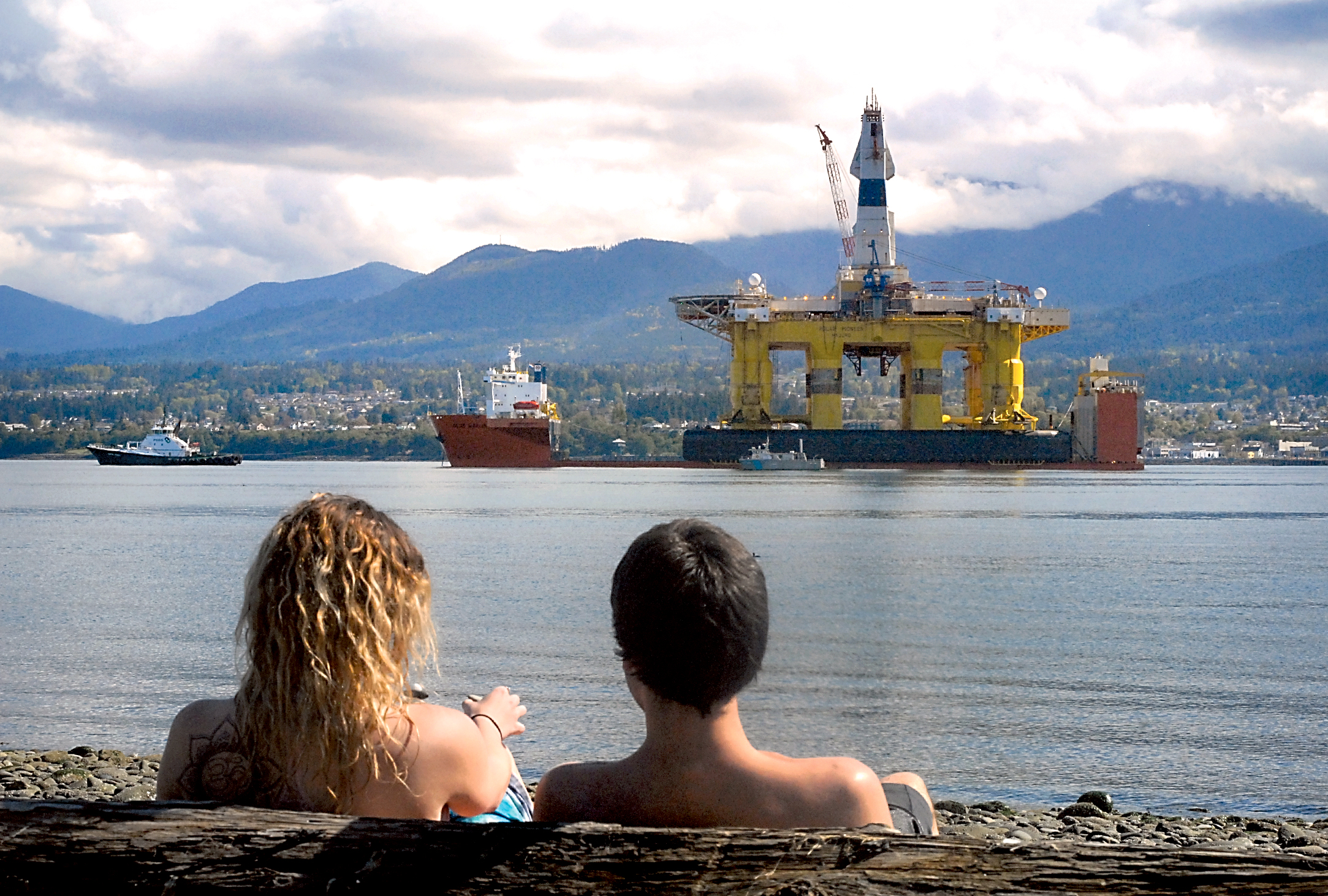
PORT ANGELES — Shell Oil Co. contractors are in the process of dismounting the Polar Pioneer from the semi-submersible heavy-lift ship MV Blue Marlin, something that could be completed sometime Sunday.
The Polar Pioneer — a 400-foot-long, 355-foot-tall rig owned by Transocean Ltd. — is being leased by Royal Dutch Shell plc, the parent company of Shell Oil Co., and is one of two drill rigs the company hopes to use for exploratory drilling in the Chukchi Sea, off Alaska’s northern shore.
The second rig, the drill ship Noble Discoverer, will pass through the Strait of Juan de Fuca on its way to Seattle sometime in May and will not stop in Port Angeles, according to Shell spokeswoman Megan Baldino.
The Blue Marlin, with the Polar Pioneer attached to its deck, left Malaysia in early March for Port Angeles Harbor, arriving here at about 7 a.m. April 17 with a contingent of protesters from Greenpeace and other groups greeting it and leaving after a few hours.
Protesters oppose Arctic offshore drilling and maintain that oil companies have not demonstrated they can clean up a major spill.
Shell initially had planned to dismount the massive oil rig early Saturday morning, but those plans were delayed.
Before it could be offloaded, crews had to remove the welded-on sea fastenings that secured the Polar Pioneer to the Blue Marlin deck for transit across the Pacific Ocean.
To unload the Polar Pioneer, the Blue Marlin — a mobile dry dock currently moored at Anchorage Site Two in the harbor — will submerge its large open deck below the water’s surface, allowing its cargo to float off into the harbor.
“This process is simply the refloating of the rig from the heavy-lift vessel that carried it,” Baldino said.
“This involves the heavy-lift vessel ballasting to a deep draft until the rig hull is in the water and the rig is floating on its own.”
The Polar Pioneer then will be towed to Anchorage Site One, located to the west of Site Two, where it will remain for about one more week while it is prepared to be towed to Seattle.
“Once the rig is offloaded from the heavy-lift vessel, which transported the rig from Malaysia to Port Angeles, the Polar Pioneer will then set her anchors and install her thrusters in Port Angeles before her move to Seattle,” Baldino said.
Information about how long the Blue Marlin will remain in the harbor here or where it will sail to next was not available Saturday.
On April 6, six Greenpeace activists boarded the Polar Pioneer about 750 miles northwest of Hawaii and remained there for about six days before leaving the vessel.
Protests are expected in Seattle over the use of the oil rig.
Shell, as a general policy, does not discuss financial information regarding its assets, Baldino said.
The managing director of Oilpro, a Houston-based professional network for the oil and gas industry built specifically for knowledge sharing, estimates the Polar Pioneer is worth about $275 million.
That estimate is based on current market trends and information from assets within the oil industry, said Joseph Triepke, speaking from Dallas.
“What we look at is fair market value. If this rig was to change hands today, it would probably go for between $250 million and $300 million,” Triepke said, noting a similar rig built today would cost about $550 million.
“The reason why those rigs are so expensive is there is a lot of extremely high-tech equipment on board — the drilling package, the pressure control system [and] the riser that reaches down to the seabed,” Triepke said.
The semi-submersible Polar Pioneer was built in 1985 by Hitachi Zosen Arctic of Japan and had extensive upgrades in 1994, 1999, 2004 and 2009.
“Semi-submersibles are floating vessels that can be submerged by means of a water ballast system such that the lower hulls are below the water surface during drilling operations,” Baldino said.
“These rigs are capable of maintaining their position over a well through the use of an anchoring system or a computer-controlled dynamic positioning thruster system.”
Although most semi-submersible rigs are relocated with the assistance of tugs, some including the Polar Pioneer are self-propelled and move between locations under their own power when afloat on pontoons.
Typically, semi-submersibles such as the Polar Pioneer are better suited than drill ships such as the Noble Discoverer for operations in rougher water conditions, Baldino said.
“Built for harsh environments, this rig has worked in the North Sea and the Barents Sea and can withstand significant weather events.”
The Polar Pioneer can accommodate up to 110 crew members who will have everything they need “to work, eat, sleep and stay healthy and safe during its time offshore,” Baldino said, noting that drilling rigs typically operate continually once on-site.
The Polar Pioneer is designed to drill to a maximum water depth of more than 1,600 feet and a total maximum drilling depth of 25,000 feet. Rigs built in recent years, in contrast, can drill in about 12,000 feet of water.
“This is what we would consider a low- to mid-grade floating rig,” Triepke said.
“It is because it is old and because of the equipment on board the rig, [which] is not going to be competitive with a rig that is coming out of the yard today.”
The Aiviq, named for the Inuit word for “walrus,” arrived in Port Angeles at about 3:22 a.m. Saturday.
It could not be confirmed Saturday if the Aiviq will tow the Polar Pioneer to Seattle.
Eventually, the $200 million, 360-foot-long steel ice-breaking tug’s job will be to move anchor lines that will attach the Polar Pioneer to the floor of the Chukchi Sea.
The ship was built to cut through ice over a yard thick and can operate in temperatures as low as minus 58 degrees.
The Aiviq also is equipped for oil spill response and is designed to recover about 10,000 barrels of spilled crude.
The ship was previously hired by Shell in 2012 to tow the Kulluk, another semi-submersible oil rig, to locations in the Chukchi and Beaufort seas to drill pilot holes and dig mudline cellars into the sea floor.
The company was not allowed to drill into oil-bearing deposits because the required response equipment was not on hand.
While being towed on New Year’s Eve in 2012 by the Aiviq across the Gulf of Alaska, the Kulluk ran aground off an island near Kodiak. No oil was spilled by the Kulluk during the incident, according to the Alaska Department of Environmental Conservation.
Shell hasn’t drilled in the U.S. Arctic since but hopes to resume exploratory drilling this summer.
________
Sequim-Dungeness Valley Editor Chris McDaniel can be reached at 360-681-2390, ext. 5052, or cmcdaniel@peninsuladailynews.com.
