
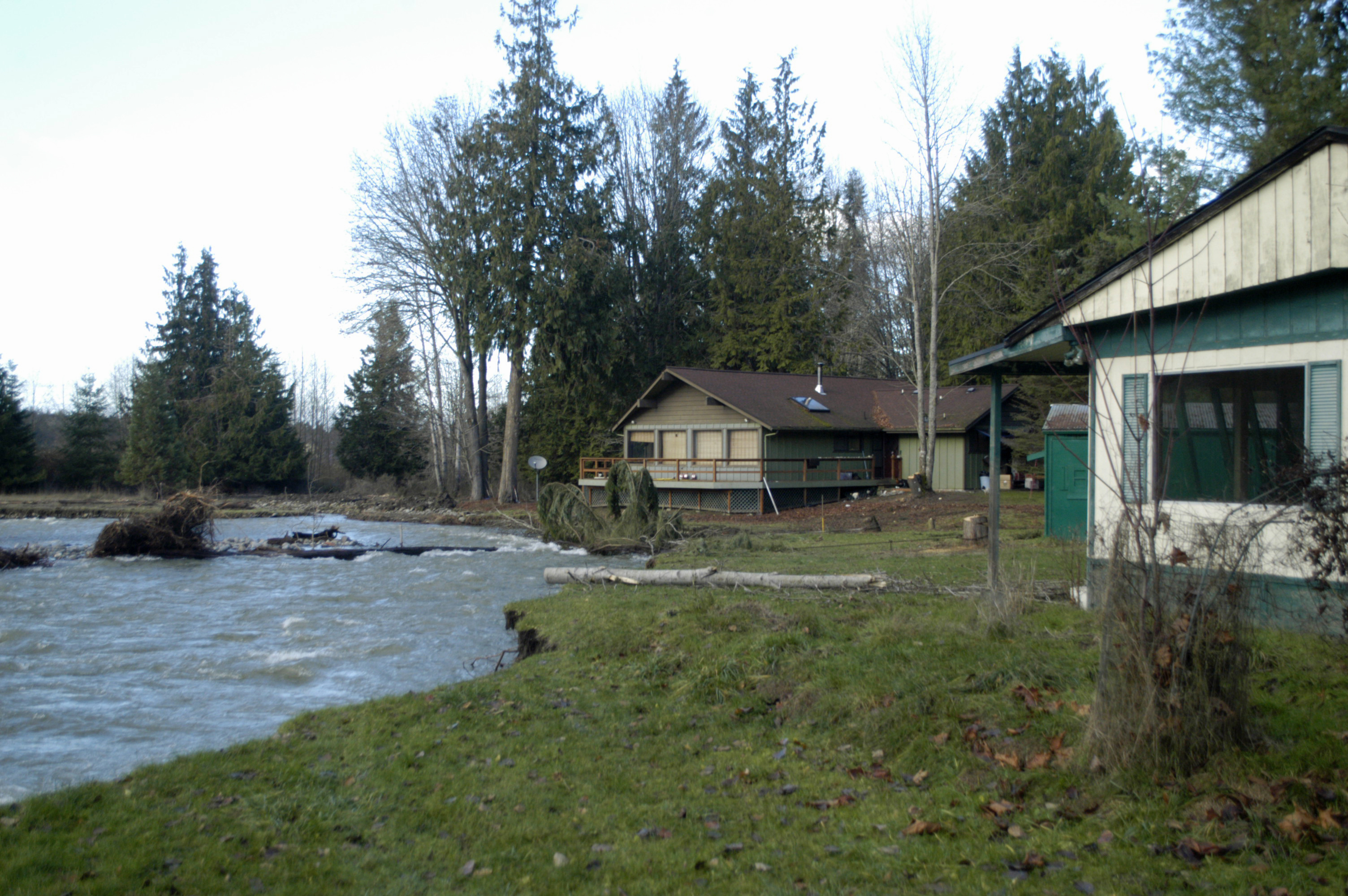
SEQUIM — Several homes threatened by the rain swollen Dungeness River last week are slated for purchase and demolition by the Jamestown S’Klallam tribe, which hopes to restore the floodplain for salmon habitat as part of its ongoing Dungeness Floodplain Restoration Project.
The Jamestown S’Klallam tribe is in final negotiations to purchase several lots of riverfront property from the Robinson family of Seattle, which owns the land.
About 20 acres in total is being sought for purchase by the tribe at a cost of $1,218,000, according to the state Recreation and Conservation Office.
The tribe also is interested in acquiring about nine acres adjoining the Robinson property owned by other private parties.
The tribe will use a $1,157,700 grant recently awarded by the state’s Salmon Recovery Funding Board to purchase the property.
The tribe is contributing an additional $204,300 in matching funds to complete the project.
The project will retire at least six development rights, move four residences from harm’s way, remove infrastructure from the floodplain, and permanently conserve floodplain habitat and salmon habitat forming processes, the tribe said.
Protecting home
Matt McWilliams, 59, worked throughout Wednesday, Thursday and Friday to shore up one of the homes, which he rents at 131 Serenity Lane next to the river.
For now, McWilliams’ home is still standing even though the river has permanently cut out a new channel located within about 10 feet of his home.
The river channel previously had been about 50 yards to the west.
The Dungeness River peaked at slightly above its flood stage of 7 feet early Wednesday, with a discharge of more than 4,000 cubic feet per second, according to the U.S. Geological Survey.
As of Monday afternoon, the river was at a height of slightly more than 4 feet, with a discharge of less than 1,000 cfs.
While McWilliams’ efforts have been successful to date, he will need to vacate the property 90 days after the land is purchased by the tribe, he has said.
“It is going to take 90 days to get packed up and gone,” he said last week.
“It is not a move that I wanted to make. I love it here.”
Possible changes
Randy Johnson, Jamestown S’Klallam habitat program manager, went to the property Friday afternoon to see if the 90-day timetable needed to be advanced due to the river encroaching on houses.
An employee with Clallam County also was at the property to survey the effects of the flooded river.
“As everyone knows, the tribe is in the process of purchasing the property, and the tenants have certain rights,” such as being granted relocation services, Johnson said Friday.
“We just want to track the safety of the situation because we don’t want a tenant to be in harm’s way. To me, it looks pretty scary.”
These ecosystem restoration and conservation actions will benefit Endangered Species Act-listed chinook salmon, bull trout, summer chum salmon and steelhead fish species along with coho, pink and fall chum salmon, the tribe said.
In addition, the project will increase public access and recreation opportunities for area residents and visitors, the tribe said.
During the past century, more than 800 acres of the Dungeness River’s floodplain was disconnected from the river through the construction of levees, roads and other infrastructure, the tribe said.
Stakeholders have worked for decades to reconnect a fraction of the lost floodplain, but opportunities for restoration are rare and usually expensive, the tribe said.
However, this project is expected to cost less than one-third of the costs of similar floodplain restoration projects and can be completed in less than two years, according to the tribe.
________
Sequim-Dungeness Valley Editor Chris McDaniel can be reached at 360-681-2390, ext. 5052, or cmcdaniel@peninsuladailynews.com.
