
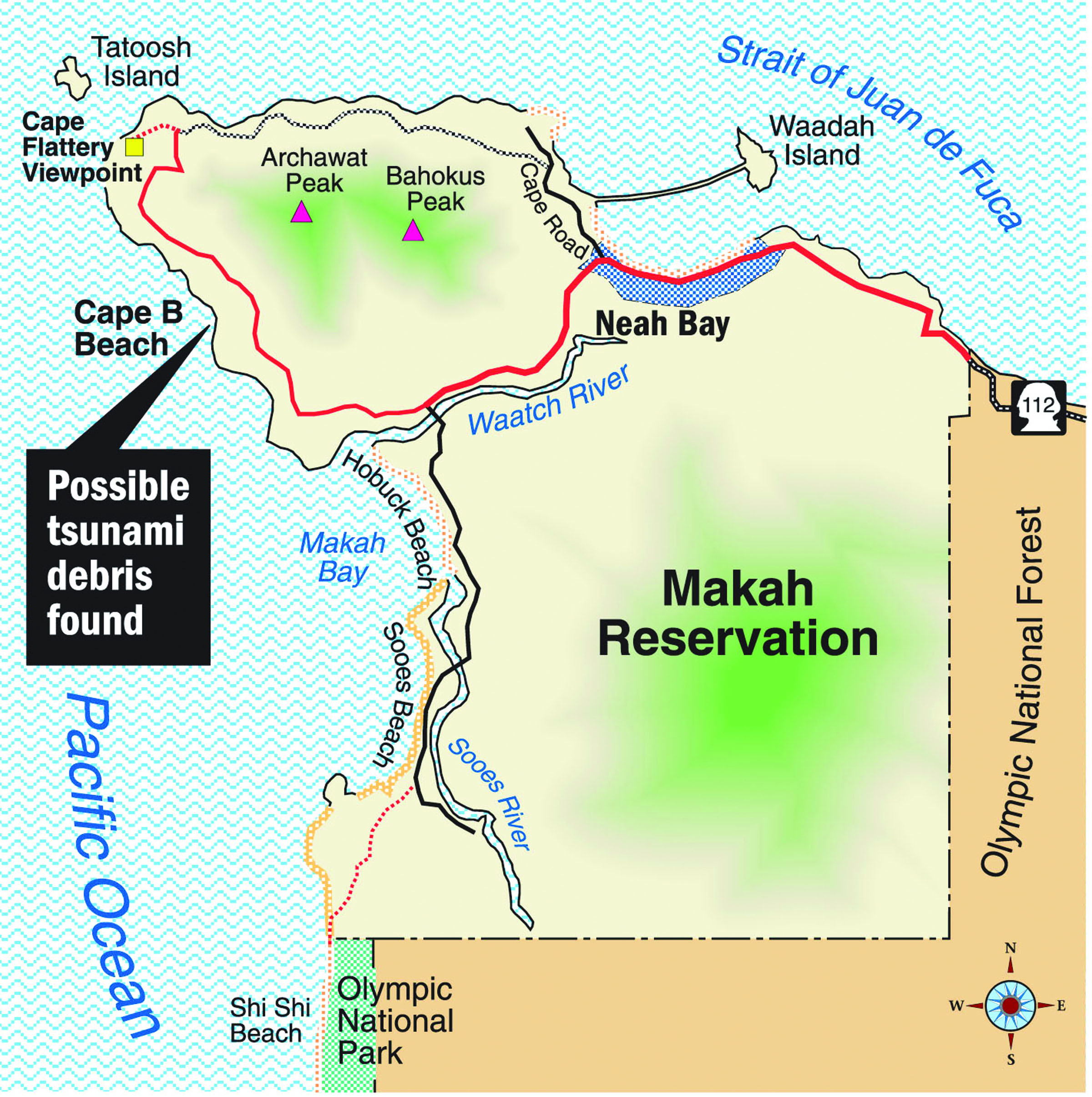
NEAH BAY — Part of a house found on a Cape Flattery beach may be the latest large piece of Japan tsunami debris to wash up on the West Coast.
So says a local beach cleanup group that encountered the debris.
Three kayakers, known as the Ikkatsu Expedition, have been surveying coastal beaches over the past few months.
On Sunday, they reported finding June 12 the remnants of a house — including a bathroom, complete with plumbing and some fixtures — on a private beach on the Makah Reservation.
According to the group’s report, the structure was partially intact when it first arrived but waves broke it up on the beach.
Items that were recovered from the resulting debris pile included a broken plastic laundry hamper, glass bottles containing residue of what smelled like cherry cough syrup, a plastic bottle that held what appeared to be iodine, a child’s potty seat, a pink plastic bowl and lumber.
Lumber from the wreckage was manufactured using metric dimension. Numbers stamped on the wood traced it to a mill in Osaka, the finders said.
Some of the pieces were nailed together, kayaker Ken Campbell told The Associated Press Tuesday.
It was exciting to find what appeared to be the remnants of a home, Campbell said.
But he added: “It was sobering, especially when you’re smelling somebody else’s cough syrup. Somebody lived here and it doesn’t look like a house anymore. I was not prepared to find something like that.”
“We also came across pieces of a washing machine (the front panel and the rusted hulk of the electric motor), and a red kerosene container, which were located near the pile,” their report said.
Curtis Ebbesmeyer, a Seattle oceanographer who is on the expedition’s advisory board, said it is too soon to confirm whether the debris was from a Japanese home.
“It’s like an archaeological dig,” he said Tuesday. “It’s a bunch of things that could be construed as a house.”
If so, it might be the first case of a Japanese home floating 5,000 miles across the Pacific Ocean following the devastating earthquake and tsunami of March 11, 2011.
In the past few months, Japanese tsunami debris found on the West Coast include a derelict fishing boat, a shipping container holding a Harley Davidson motorcycle, sports balls with their owners’ names still legible, and a large dock that washed up on an Oregon beach.
Ebbesmeyer said that this is just the beginning.
“It’s just dribs and drabs right now. You can expect the main mass to arrive in October. It could be 100 times this,” Ebbesmeyer said Tuesday.
Ebbesmeyer and Jim Ingraham are experts in “flotsametrics,” or the movement of ocean debris driven by ocean and wind currents, with more than 20 years of experience.
In 2011, their ocean model, Ocean Surface Current Simulator, or OSCURS, predicted that some items with low drag and areas exposed to the wind would arrive last fall.
So far, their predictions have been proven correct, including the fast arrival of the lightweight fishing floats, which took only seven months to cross the Pacific.
The house remnants were found at the same beach where a cleanup crew from the Olympic Peninsula chapter of the Surfrider Foundation and the U.S. Coast Guard discovered a large black fishing float in October 2011 that was later identified by Ebbesmeyer as the first piece of identifiable tsunami debris to arrive on U.S. beaches.
Since then, a large amount of debris has accumulated, much of it with Japanese markings.
“The beach was pristine when we left it [in the fall]. Now they said the beach is just a mess,” said Darryl Wood, member of the Surfrider organization.
The group also found a large number of fishing floats, most with Japanese writing on them, and large chunks of Styrofoam.
Surfers have been using and cleaning the private tribal beach with the permission of the Makah Tribe since the 1970s, Wood said.
Located an inaccessible area, the beach can be accessed only from the sea, by helicopter or by climbing down a steep, overgrown cliff.
In 2011, the Surfriders cleanup crew enlisted the aid of the Coast Guard to remove the trash that hd been collected during a pair of beach cleanup events and stored above the high tide line.
A group of Surfriders and Coast Guard crewmen rappelled down the steep hillside, packed the debris in nets and hooked it to a helicopter from Air Station/Sector Field Office Port Angeles.
Wood said Surfriders members will survey the wreckage later this week.
According to area residents, the amount of debris washing up on beaches has increased dramatically.
Meri Parker, general manager of the Makah tribe, said she walks Hobuck and Tsoo-yas beaches routinely.
She said that in the past few days, she was shocked by the amount of Styrofoam and other trash on the beaches.
“It made me sad,” she said.
________
Reporter Arwyn Rice can be reached at 360-452-2345, ext. 5070, or at arwyn.rice@peninsuladailynews.com.
