
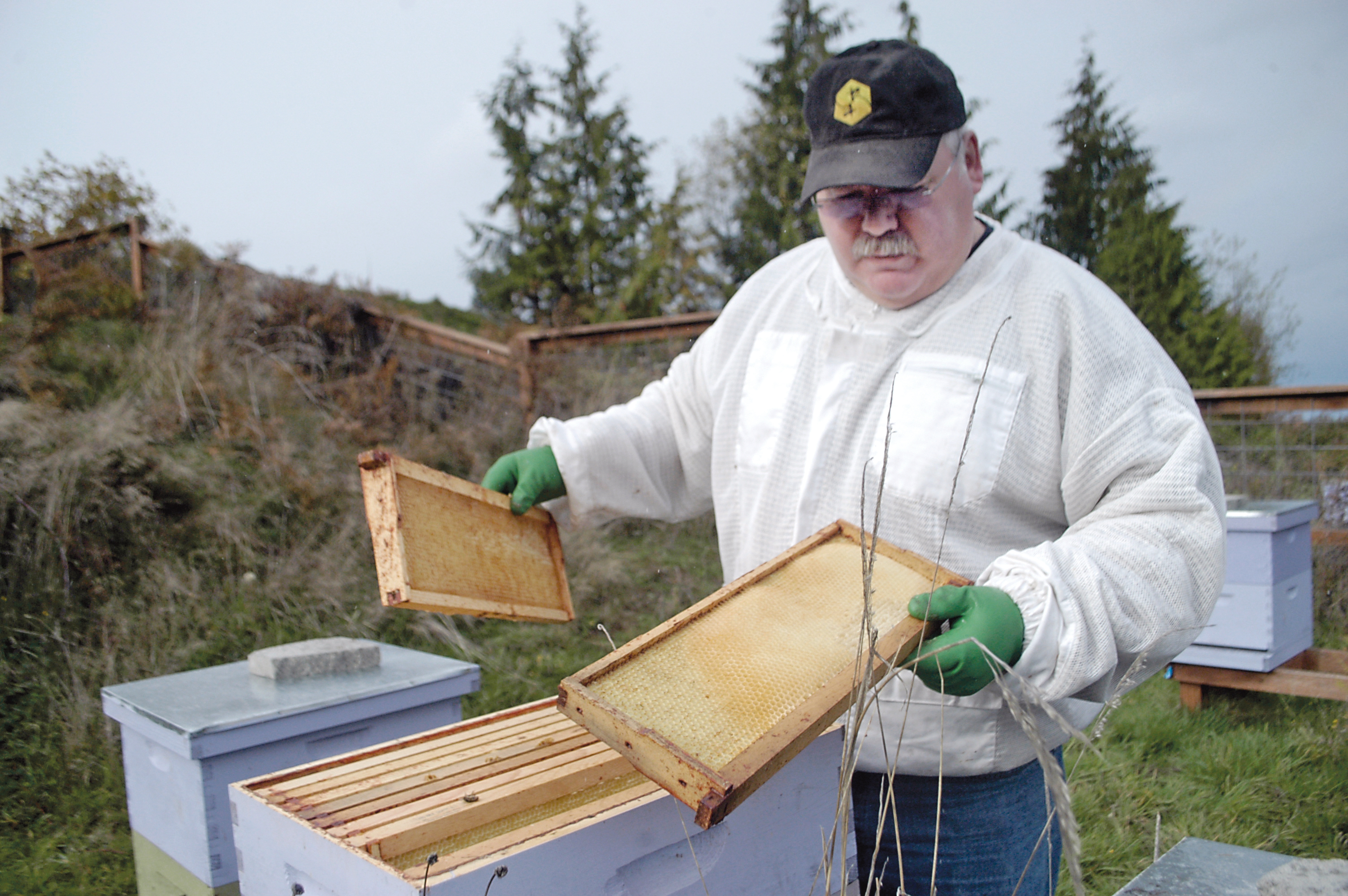
SEQUIM — The Sequim Bee Farm is the only honey-producer in Washington state that is among the 23 finalists in its category of the national 2016 Good Food Awards.
The winners of the national contest, which has 13 food or beverage categories, will be announced Jan. 15 at an awards ceremony at Fort Mason Center for Arts & Culture in San Francisco.
The Sequim Bee Farm, located at 193 Harbor Heights southwest of Sequim, is owned by husband and wife Buddy and Meg Depew.
The twosome, both 53, have produced honey from several hives at their home for a decade.
“We know we have great honey, and to just have that validation is something that we can tell our customers — somebody else thinks we are good, too,” Meg said.
In September, the business won a blue ribbon for its honey at the Washington State Fair in Puyallup.
But this “is the first time we have entered any competition” such as the Good Food Awards, Buddy said.
The couple, who have lived in Sequim for about 12 years, became interested in beekeeping after joining the North Olympic Peninsula Beekeepers’ Association and were mentored by Ed and Winona Giersch.
Buddy said he works in public service. His wife is a nurse practitioner. They have two daughters in their 20s who live in the area.
Started with four hives
The two started their bee farm with four hives, Buddy said.
“Most all of our bees come up from California” and are of the New World Carniolan honey breed, a subspecies of the western honeybee, known for being extremely gentle in its behavior toward beekeepers, he said.
Since then, they have added hives of Buckfast bees, a crossbreed of several European species developed in England in a climate similar to that of the North Olympic Peninsula.
“They have done so well out here, I have been replacing the bees, and once you replace the queen, in about six weeks, all the offspring there is hers,” Buddy said.
“During the summer, [bees] only live to be about six weeks, and that is it. During the winter, they will actually live a lot longer. They will live sometimes up to eight [or] nine months,” he said
The Depews now have about 26 active colonies.
With about 15,000 bees in a hive during the winter months, there are now a total of about 390,000 bees on the property.
In the summer, when the hives are at their strongest, there are about 50,000 bees per colony, or a total of about 1.3 million bees.
In past years, the bee farm has had as many as 30 hives with a peak of about 1.5 million bees.
But the numbers have dwindled somewhat of late.
Colony collapse
“We have colony collapse disorder, which is affecting bees worldwide,” Meg Depew said.
During colony collapse disorder, the majority of worker bees in a colony disappear, according to entomologists.
The cause hasn’t been determined.
Meg suspects it is a combination of exposure to pesticides and viruses introduced by mites that arrived in the area during the 1980s, she said.
“It is the perfect storm,” she said.
Drought
Also this year, the bee farmers contended with drought, which cut the amount of honey secreted by the bees, Buddy said.
“This year was probably the worst year we’ve had as far as honey production,” he said, estimating the bees produced only about 75 gallons of honey.
He plans to add another 15 hives next year.
A new starter colony, including a queen, costs about $125, with another $350 for the bees’ wooden apiary.
Buddy said the farm has come “not even close” to recouping the money spent over the years on beekeeping.
“It is a labor of love,” Meg said.
Said Buddy: “We really enjoy it. I would actually like to retire in a couple of years and do this full time.”
Bee stings
While the bees are generally docile, they do sting from time to time, Buddy said.
“Most of the time when it is warm out and the honey flows good, you open the hive and you don’t” necessarily have to worry about getting stung, he said.
However, “there are a couple of hives out there that are little more ornery than other hives,” he said.
“I probably average . . . about 12 [stings] a year, and it is usually because I am getting a little quick or jostling the bees.”
Meg said she has been stung about eight times since she started beekeeping.
For more information about the farm, see www.sequimbeefarm.com.
The Good Food Awards, now in its sixth year, “celebrates the kind of food we all want to eat: tasty, authentic and responsibility produced,” the organization said on its website at www.goodfoodawards.org.
The awards are organized by Seedling Projects, a nonprofit that supports the sustainable food movement.
________
Sequim-Dungeness Valley Editor Chris McDaniel can be reached at 360-681-2390, ext. 5052, or cmcdaniel@peninsuladailynews.com.
