
By Debbie Ross-Preston Northwest Indian Fisheries Commission
NEAH BAY — A fish hook has tied history, culture and the Makah community together in unexpected ways.
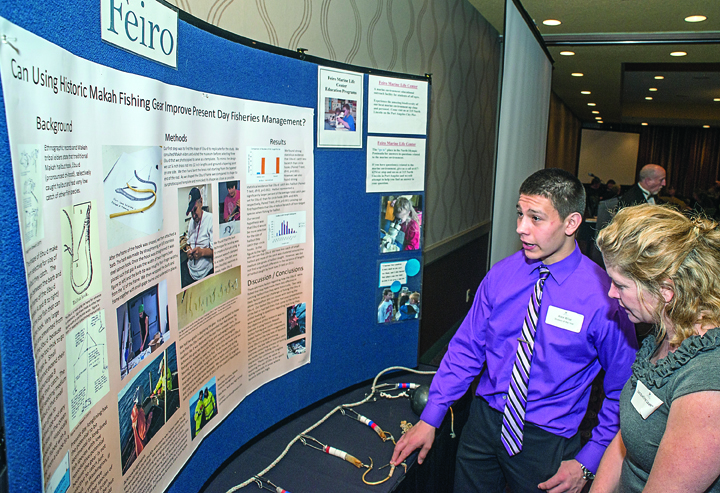
The cibu·d (pronounced “cha bood”), or halibut hook, became the subject of a student project during an internship with Makah Fisheries Management.
“I had a student, Larry Buzzell, come to me wanting to do a project that related to historical fishing methods,” said Jonathan Scordino, marine mammal biologist for the Makah tribe.
Historically, the hooks were made of both wood and bone. As the tribe gained access to new materials, they also made hooks from metal.
“The goal of the project was to test if the cibu·d was more selective for catching halibut than contemporary circle hooks when fished on a longline,” Scordino said.
Setting up the experiment was challenging because the study required 200 cibu·d to be made by hand.
“We decided to put it out to the community to see if they would come in and help us make them,” Scordino said.
The Makah Cultural and Research Center opened its exhibit preparation space for several weeks to allow community members to come in and help make the hooks.
“The response was terrific,” Scordino said. “Several volunteers put in more than 20 hours making cibu·d.”
Through trial and error, the group learned it was better to bend the metal hooks cold rather than heat the metal.
The design of the hook more closely mimics Polynesian fishing gear than historical North American fishing gear.
From past to present
Elder Jesse Ides (Hushta) watched as young people learned to make the hook he used in his youth.
“It’s terrific seeing them show the determination to make it and use it,” Ides said.
He recalled his father hauling canoes out to the halibut grounds to fish.
“You’d catch just halibut with that gear, nothing else,” he said.
Alex Wise is finishing the project by writing up how the catch of halibut and by-catch compared between cibu·d and circle hooks during the study.
“It was an interesting project. I have always been interested in fisheries, and it just seemed like the right choice for me,” said Wise, who won an Art Feiro Science Student of the Year award recently from the Feiro Marine Life Center in Port Angeles for his work on the hooks.
Wise also was recognized for the project at the Fish on the Fence Feiro fundraiser as one of two Science Students of the Year.
“The cibu·d was known to not only fish selectively for halibut but not catch too small or too big a halibut,” Scordino said.
“From a management perspective, that’s exactly the size you want to catch so the older spawners remain and the young grow to be a harvestable size.”
Tribal member Polly McCarty, who helps prepare exhibits at the Makah museum, was thrilled to see the community participation.
“This museum and its contents belong to the village,” McCarty said.
“It was wonderful to have them come in and interact with the history.”
A parallel project is to film the creation of wooden cibu·ds. Additionally, an exhibit was created in the Makah Fisheries Management building with the kelp line and hooks, and descriptions of the history.
A Preserve America and a cooperative National Oceanic and Atmospheric Administration grant helped pay for the projects.
________
Debbie Ross-Preston is the coastal information officer for Northwest Indian Fisheries Commission.
