
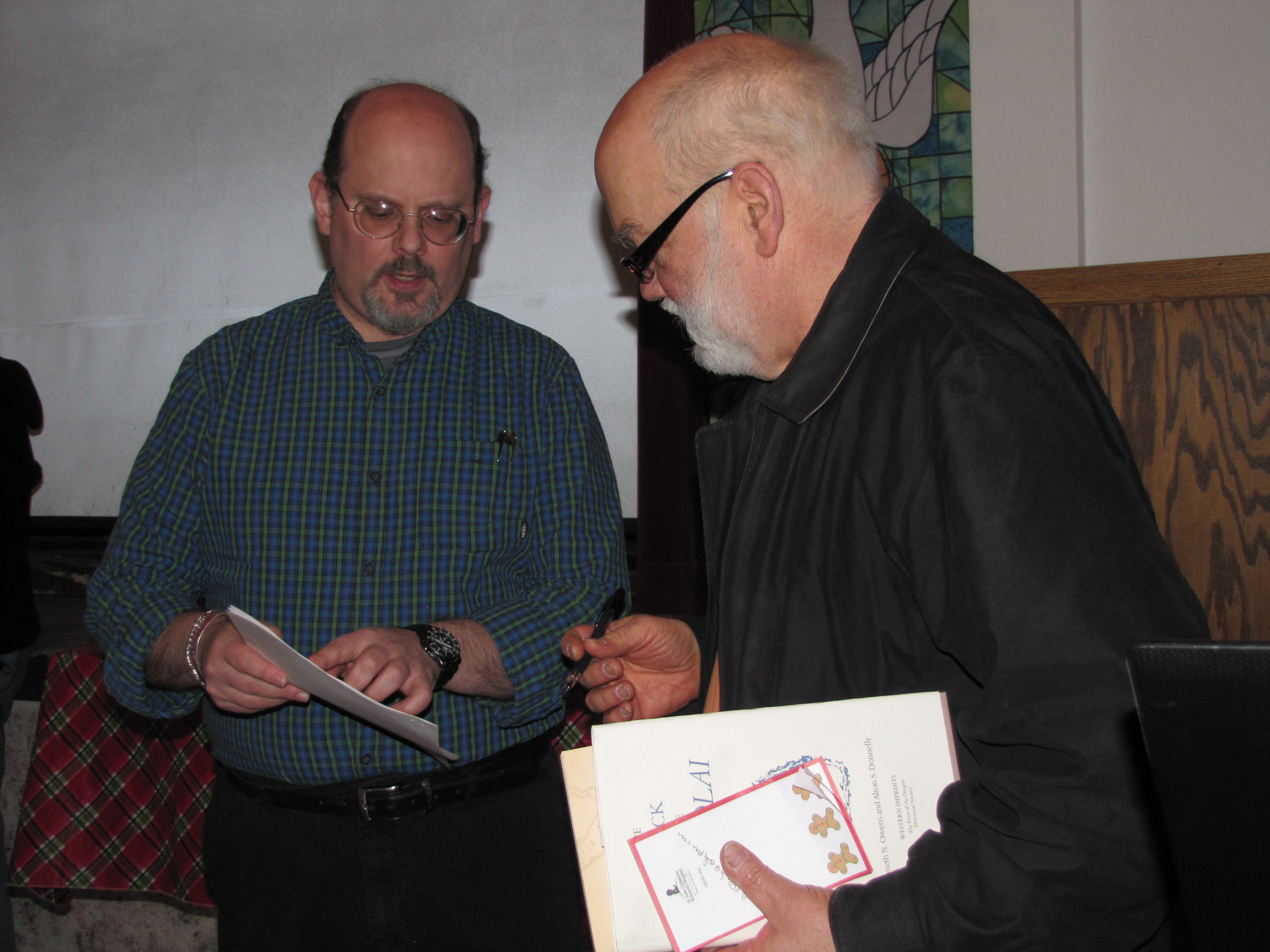
PORT ANGELES — A 19th century Russian serf who seemed to find himself in peril time and again was an unlikely West End hero, said Rod Fleck, historian and Forks planner-city attorney.
Timofei Tarakanov’s personal story of survival is wrapped around “three really bad days” that shaped the Pacific Northwest, Fleck told about 40 people at the Clallam County Historical Society’s “History Tales” presentation Sunday.
“This guy deserves his own movie, or at least an action figure,” he said.
The U.S., Russia and England wrestled over control of the American Northwest in the early 1800s.
Tarakanov was a serf, property of a wealthy Russian. He was well-educated and served his owner as supercargo on ships carrying tons of furs and other trade goods across the Pacific, Fleck said.
A “supercargo” was the clerk and representative of the owner of the ship’s cargo, whose authority was often second only to the ship’s captain.
Fleck said that in following his owner’s wishes, Tarakanov likely landed in a battle in Alaska, the shipwreck of the Sv. Nikolai and captivity in Washington, and a political disaster in Hawaii.
While Tarakanov’s published account of the Nikolai disaster do not include the earlier battle, Russian records show Tarakanov was probably present for the 1804 Battle of Sitka, then known as New Archangel, Fleck said.
“If he wasn’t at the battle, then he arrived immediately after,” he said.
Fleck noted that Tarakanov’s actions in dealing with a running conflict with tribes on the North Olympic Peninsula show he was no stranger to battle.
The Nikolai on Sept. 28, 1808 set out to establish an Oregon base for fur trading and to grow food to supply New Archangel.
The crew consisted of the captain, Nikolai Bulagin, his 18-year-old wife, Anna Petrovna Bulagina, 12 Russian men, an Englishman, three “Aleut” men, and four Aleut women, two who of whom were “handmaidens” for Bulagina.
On Oct. 29 of that year, Nikolai was becalmed off Destruction Island, she ship’s anchors broke and currents pushed the ship through the Quillayute Needles.
Unregistered navigation
“Bulagin should get a medal just for that effort,” Fleck said of the captain’s navigation through the Needles without wind or motor assistance.
On Nov. 1, gale winds from the southwest drove the ship aground near Ellen Creek, north of Rialto Beach.
The crew was able to salvage much of the supplies they needed for survival, but before the ship could be fully unloaded, the Quileute tribe arrived to negotiate use of their beach.
The Quileute were insistent that the trade include guns, and trade talks broke down.
Rocks were thrown, hitting Tarakanov in the head, and the crew members fired at the Quileute, killing several.
They further angered the Quileute by taking 18 salmon set to dry.
Crew members believed they had paid for the salmon by leaving a string of beads, but the Quileute saw it as theft, Fleck said.
“Bulagin decided, ‘We’ll just walk south.’” Fleck said. “On the West End. In November,” he said.
The map did not show the rivers they would have to cross to reach another ship at Gray’s Harbor, he said.
They reached the Hoh River and negotiated with Hoh tribe members for safe passage.
When the canoes entered the river, they pulled the drain plugs from the canoes, jumped from them and began swimming alongside the other canoe, Fleck said.
While Nikolai crew members used their hands to paddle back to shore, the Hoh tribe members, with Bulagina and the female Aleuts, continued across.
Bulagin broke down, and Tarakanov took command.
They worked their way up the Hoh River and set up camp.
A chieftain who then had custody of Bulagina offered a trade — Bulagina for four guns.
Bulagina refused and said she was treated better by her captor than by her husband.
Her defection caused Bulagin to have a complete mental breakdown, Fleck said.
Cabin constructed
The crew built a fortified cabin, and settled for the winter, trading supplies with a Hoh elder who lived nearby.
That spring, five members of the crew attempted to canoe to Gray’s Harbor and died; the remaining crew became enslaved, Fleck said.
Bulagina was traded to another chieftain and died of illness; Bulagin never recovered from “a broken heart,” and also died, he said.
Tarakanov survived by making kites and other items to entertain the chieftain who kept him captive.
In May 1810, an American ship traded for Tarakanov and other crew members, and he returned to New Amsterdam on June 9.
A journal kept by Tarakanov during the Nikolai venture was published worldwide.
Oral accounts by the Quileute, Hoh, and Makah tribes were recorded in the early 1930s.
Tarakanov was then assigned to a venture to build a fort in Hawaii.
However, the location chosen was adjacent to a sacred site associated with cannibalism, another ship was run aground and the mission failed.
Tarakanov was last recorded in Russia as a free citizen of Kirsk, at the age of 78.
A monument built in 2015 honors the crew of the Nikolai. The structure is 22 miles south of Forks on Upper Hoh Road near where historians believe the crew members set up their winter camp.
The monument was dedicated in a ceremony June 20, 2015.
