
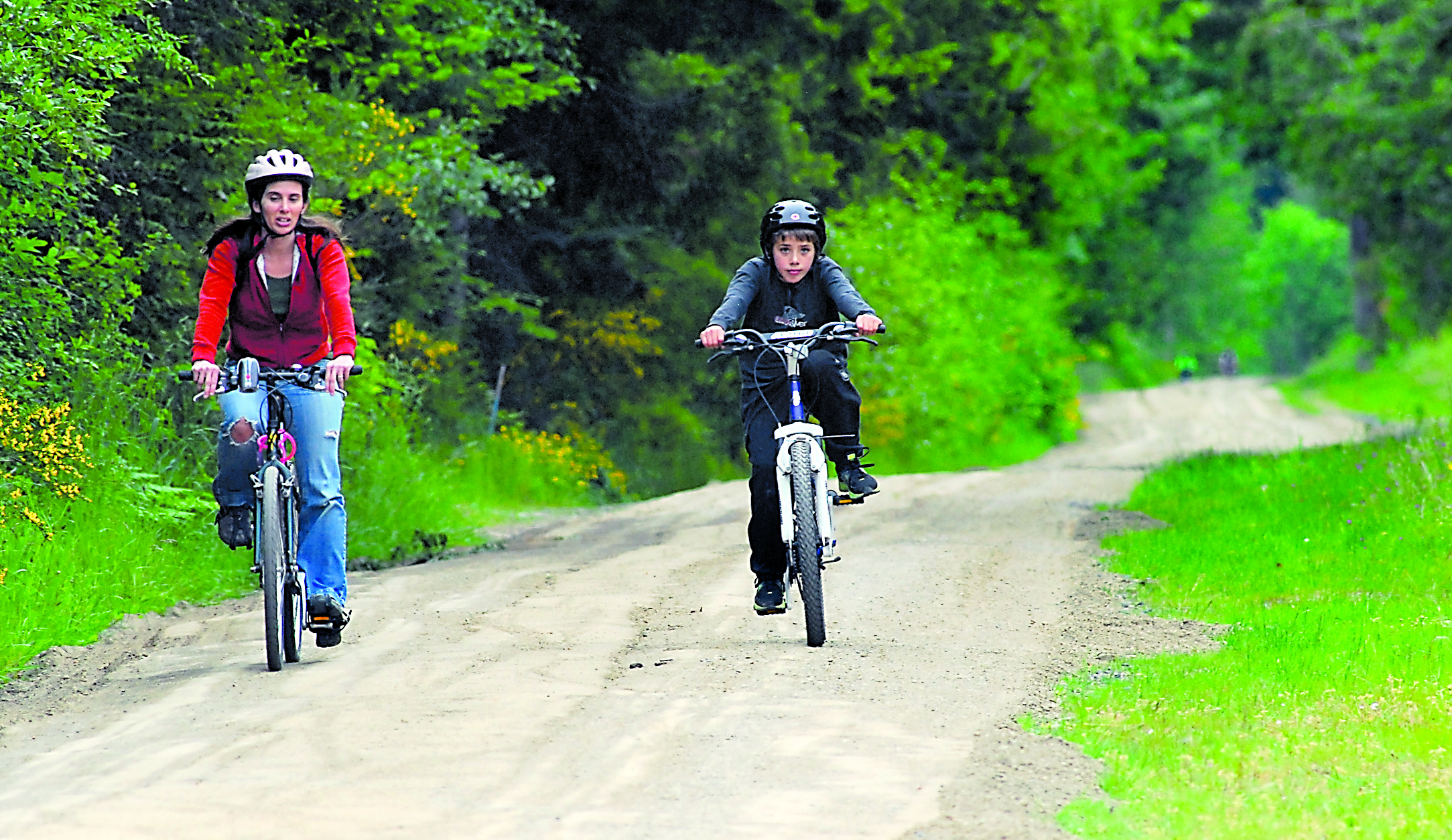
The path to the Pacific is taking shape one piece at a time.
Once completed, the 140-mile Olympic Discovery Trail will provide hikers, runners, bicyclists, horseback riders, roller bladers and wheelchair users a safe way to cross the entire North Olympic Peninsula on a dedicated route.
The paved trail will link Admiralty Inlet at Port Townsend to the Pacific Ocean at LaPush.
Seventy-two miles of the trail are completed within Clallam County, including a 25-mile off-road spur between the Elwha River Valley and Lake Crescent.
Most of the current planning on the Clallam County side is focused on the Lake Crescent area.
Lake Crescent is one of two “choke points” along the trail, the other being Discovery Bay in Jefferson County, Clallam County transportation program manager Rich James said.
“Once you get past those, everything is pretty easy,” James said.
James said he is hopeful that the entire trail will be completed in about 10 years.
In 2010, Clallam County completed a 6.4-mile segment from the west end of the existing Spruce Railroad Trail on the north shore of Lake Crescent to the top of Fairholme Hill.
A point of contention between the county and Olympic National Park, which owns the land surrounding the iconic lake, has emerged over the 3.5-mile Spruce Railroad Trail.
The park’s preferred alternative in its latest environmental assessment is to build a 10.5-foot-wide path with a crushed-rock surface.
The Spruce Railroad Trail will become part of the Olympic Discovery Trail, which is designed and built to Americans With Disabilities Act standards and American Association of State Highway and Transportation Officials guidelines.
Clallam County proposes an 8-foot-wide asphalt surface with 3 feet of natural tread to enable wheelchair users and road and hand-crank bicyclists to bypass U.S. Highway 101 through the narrow and windy Lake Crescent corridor while maintaining the Spruce Railroad Trail’s aesthetic appeal.
Most of the Olympic Discovery Trail is paved to a 10-foot width with a combined 4 feet of gravel on either side.
Clallam County in 2009 received a $999,000 grant from the state Recreation and Conservation Office to restore the two railroad tunnels on the 94-year-old Spruce Railroad grade and to rehabilitate the trail for additional user groups.
Park officials maintain that a crushed-rock surface would be “firm and stable,” suitable for wheelchair users and bicyclists.
The 231-page environmental assessment does not make a distinction between road bikes and mountain bikes.
Clallam County submitted feedback on the park’s environmental assessment Friday, the last day of a 30-day public comment period.
James, a critic of the proposed crushed-rock surface and the park’s removal of a 1.5-mile segment of unimproved railroad grade in the latest assessment, prepared the county’s remarks.
James has said a crushed-rock surface would not meet ADA requirements. He has said the surface would be “extremely difficult to maintain” considering the trail’s annual rainfall, tree leaf accumulation, equestrian use and 5 percent to 8 percent grade.
He declined to comment on the park’s preferred alternative in a Wednesday telephone interview.
Board Chairman Mike Doherty on Tuesday said he would sign the comments on behalf of the other commissioners.
“Many of our comments on the first EA [environmental assessment] on the same segment of the Spruce Railroad Trail hold true for this case,” said Doherty, who is on vacation but participated in the last two commissioners’ meetings by speakerphone.
“So if you go back and look at the first letter, it’s basically the same, with a few new items on the second EA.
“I don’t expect much to change, but I’ll make a commitment to read through it prior to Friday.”
Olympic National Park spokeswoman Barb Maynes said the park will analyze every comment it receives before preparing its findings on the environmental impacts.
No final decisions on trail surface have been made, Maynes said.
The Spruce Railroad grade was built in 1918 by soldiers in the Spruce Railroad Division. The Army built 36 miles of railroad grade, including the tunnels, in six months.
More information about the county’s vision for the Spruce Railroad Trail is available at www.clallam.net.
Meanwhile, Clallam County is working with the National Forest Service to build out the Olympic Discovery Trail along Forest Service Road 2918 west of Lake Crescent.
The segment eventually will link the trail to Cooper Ranch and Mary Clark roads, which parallel U.S. Highway 101 on the south side of the Sol Duc River all the way to Sappho.
About 10 percent of the completed trail will utilize low-traffic county roads, saving millions in right-of-way acquisition and construction costs.
State and federal grants are paying for the lion’s share of the Olympic Discovery Trail.
“It’s costing us roughly $200,000 a mile,” James said.
“That cost doesn’t apply when we use road segments.”
In the next several years, the county will negotiate with West End landowners to secure the route from Sappho to state Highway 110.
The Olympic Discovery Trial will be built along the side of the highway for its final approach to LaPush.
James said the Quileute tribe may be eligible for federal grants to sponsor the trail in the LaPush area.
The Jamestown S’Klallam tribe has done the same for the trail in Blyn.
Crews this year will pave the trail from west Port Angeles to the Elwha River, which the Olympic Discovery Trail crosses on a pedestrian deck that hangs below the 85-foot-high, 21/2-year-old Elwha River bridge.
Just past the bridge, the off-road Adventure Route breaks off from the main Olympic Discovery Trail.
Built by inmate work crews and teams of volunteers over several years, the wilderness route is designed for hikers and mountain bikers but is too steep and rugged for narrow-tired bicycles.
The county plans to build a paved segment on the north side of state Highway 112 to Joyce and reconnect it with the Adventure Route at the Lyre River headwaters.
James said it likely will take 10 years to complete that portion of the project.
Last Sunday, more than 2,000 runners and walkers used the Olympic Discovery Trail for the 10th annual North Olympic Discovery Marathon between Sequim and Port Angeles.
Once completed, the trail will become part of a statewide trail system that will connect the Pacific Ocean to Spokane.
________
Reporter Rob Ollikainen can be reached at 360-452-2345, ext. 5072, or at rob.ollikainen@peninsuladailynews.com.
