
By Felicia Fonseca
The Associated Press
FLAGSTAFF, Ariz. — Among the hundreds of firefighters, aircraft and engines dispatched to fight a recent wildfire in northern Arizona were two women — one from Washington state — whose focus wasn’t on flames. Their concern was smoke.
Because of the health hazards from wildfires spewing smoke into the atmosphere, Congress earlier this year said all top-tier federal teams battling wildland blazes should have at least one specialist assigned to monitor smoke.
The smoke itself can be more problematic than the flames that produce it. Smoke that poured into Seeley Lake, Mont., from a nearby wildfire in 2017 got so bad that health officials warned residents to leave or find somewhere else to sleep at night when smoke is at its worst.
Other places have opened respite centers or set up air filtration systems in buildings to give people a place to go when it’s too smoky. Fire crews time prescribed burns so that smoke disperses during the day or they ignite larger sections so smoke isn’t lingering for days.
The demand from agencies managing the wildfires is so great that not every request for air resource advisers can be filled.
“There’s a growing awareness of these positions and the importance of conveying that information,” said Pete Lahm, an air resource specialist with the U.S. Forest Service who trains and dispatches the advisers.
“I don’t think that importance was the focal point or the knowledge was the same three or four years ago. It’s grown leaps and bounds.”
The advisers come from various agencies. Carolyn Kelly, a smoke management field coordinator for the Washington state Department of Natural Resources, and Anita Thompson, a trainee from the Apache-Sitgreaves National Forest in eastern Arizona, spent a few days in Flagstaff on a wildfire that burned more than three square miles.
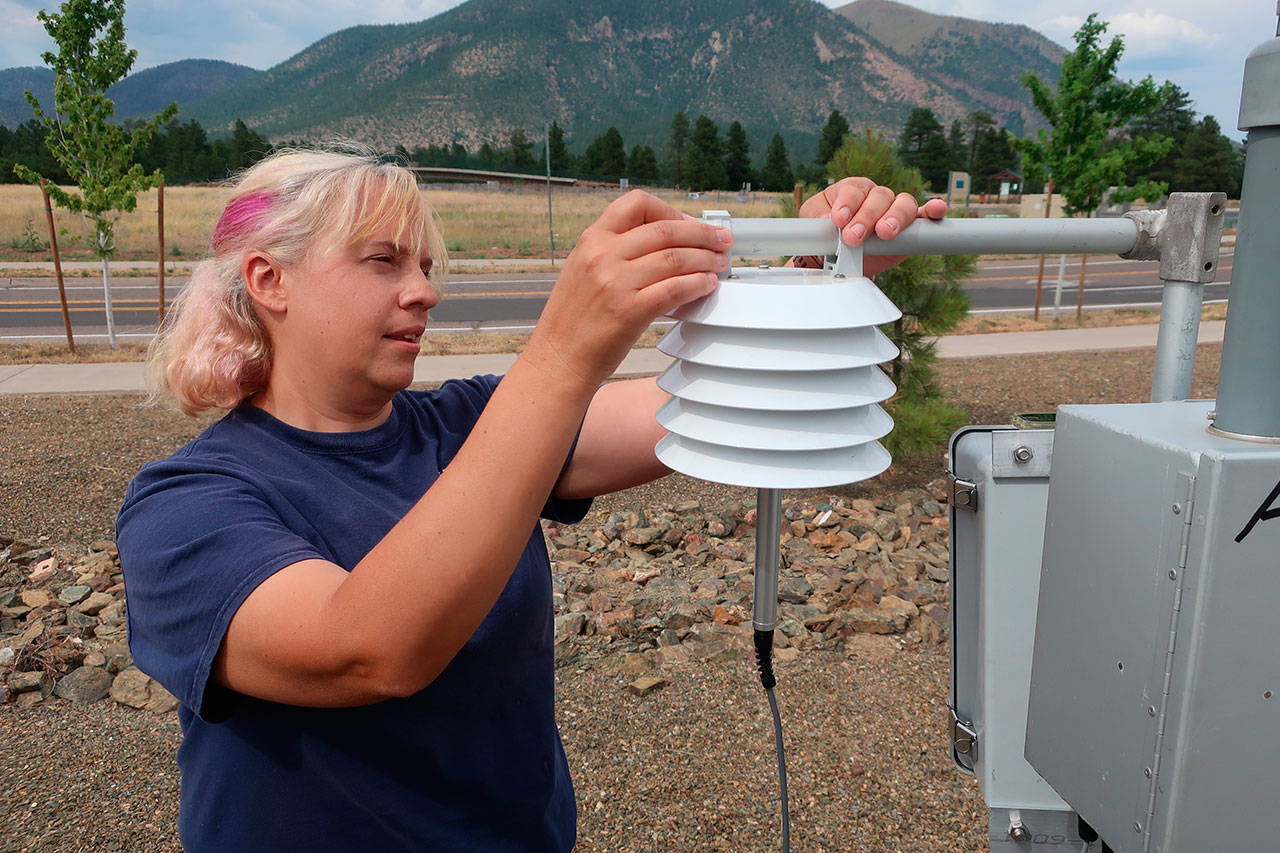
The two looked at smoke models, weather patterns, fire behavior, humidity and particulates to gauge the air quality. They checked permanent monitors and set up others around town where smoke would be expected to funnel through drainages or settle in low-lying areas.
The data is transmitted via satellite, allowing them to check the readings on their phones or computers. Each morning, they produced a color-coded smoke forecast that covered three days and was sent out to the public.
“The more information we can get out, the better choices that people can make to avoid the smoke, to get work done when the smoke is at the least impactful portion of the day,” Kelly said.
Lahm has about 95 air resource advisers he can send out across the country for two weeks at a time on fires. He’s training about two dozen others to help fill the demand. Most of the requests come from states in the U.S. West, with California and Oregon topping the list. Requests grew from 55 in 2016 to 105 in 2017 and 110 last year.
Patricia Grantham, supervisor on the Klamath National Forest in northern California and Oregon, said the communities there have come to expect a smoke forecast.
“They are very much in tune,” she said. “I work with very fire-savvy communities; they have been through it a lot.”
When Lahm is short on advisers, he tries extending assignments by a week or using one adviser for multiple fires in the same area. Still, he said he occasionally cannot fill all the requests when wildfires are raging across the country. The cost for the specialists falls to whatever agency is managing the fire.
While Kelly and Thompson never found the smoke to be detrimental to anyone’s health in Flagstaff, residents found it bothersome. Microscopic particles in the smoke can trigger breathing problems, headaches, chest pain and heart attacks.
Children, the elderly and people with lung disease or heart trouble are most at risk.
Kim Meehl said her home east of Flagstaff reeked of smoke but it was more tolerable than some fires the U.S. Forest Service purposefully sets.
Linda Romero and her husband were among those on alert to evacuate as the wildfire in a mountain pass was burning most intensely. Her solution for dealing with the smoke: “Be sensible and take precautions, stay inside.”
Coconino County in northern Arizona is planning to buy a dumpster-like container that incinerates tree trunks and branches left from projects to thin dense stands instead of burning them in piles to cut down on smoke.
But the reality is living in the forest comes with the risk of fire and smoke.
“We try to tell that story but I also empathize with people who move to this area for clean air and experience health problems because of some of the smoke generated through fires,” said Coconino National Forest Supervisor Laura Jo West. “It’s hard knowing that.”
