
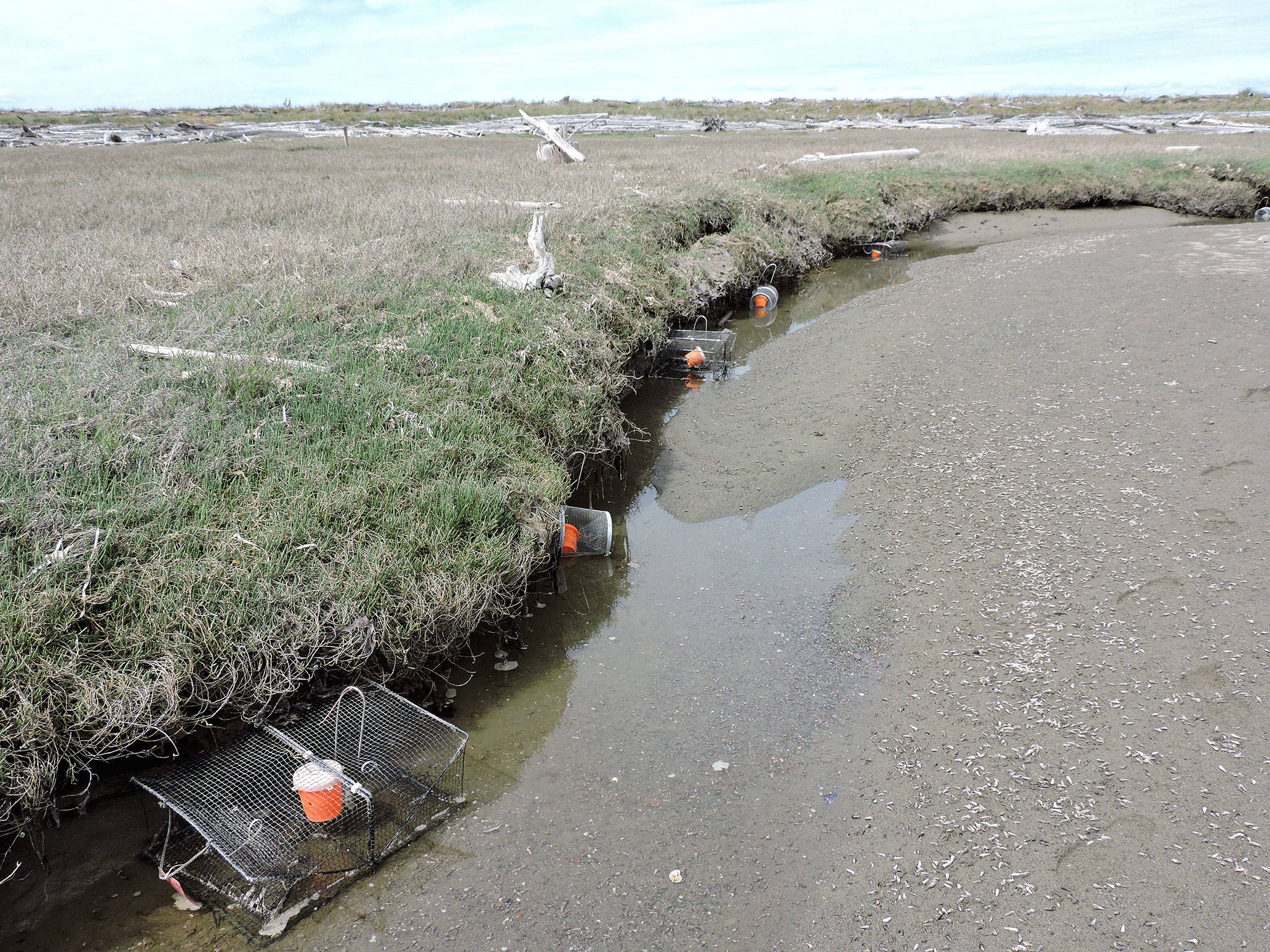
SEQUIM — Trapping efforts continue at Graveyard Spit on the Dungeness Spit as federal and state resource managers continue to find the invasive European green crab.
Lorenz Sollmann, deputy project leader at the Washington Maritime National Wildlife Refuge, said that crews have caught 72 European green crabs — 45 male and 27 female — as of Friday. Previous counts were 69 crabs as of last Wednesday and 64 crabs as of May 23.
Last week, crews captured five crabs, three males and two females, using 70 traps in the Graveyard Spit area. Two of the five days of trapping resulted in zero catches, Sollmann said.
“We continued to place a few traps in areas we haven’t had a trap in for a few weeks as well as new pools and side channels just to continue prospecting,” he said.
Scientists across the globe regard the European green crab, which is identifiable by its five spines on each side of its eyes, as one of the worst invasive species on Earth. It’s been blamed by industry officials in the northeastern U.S. for severely damaging shellfish harvests and seagrass beds.
Crews at the Dungeness National Wildlife Refuge first found a few green crabs April 13. The population there is now the largest reported in Washington state so far.
In early May, local resource managers placed 100-plus traps along the Dungeness Spit. The crabs continue to be found in a lagoon in Graveyard Spit across from Dungeness Landing near Sequim.
Containing the European green crab falls under the state’s Department of Fish and Wildlife’s Aquatic Invasive Species team led by program coordinator Allen Pleus.
He said they plan to keep intensively trapping.
“We are trying different trapping techniques to see if we’re missing ones that are not attracted to the bait,” Pleus said.
“If the numbers continue to decline [in catches each week], we will assess whether to reduce the trapping schedule for June and the rest of summer.”
Pleus said his team and staff continue to share equipment and personnel for trapping with volunteers at the Dungeness National Wildlife Refuge through the U.S. Fish & Wildlife Service.
Of the 100-plus traps, more than 80 came from the Department of Fish and Wildlife, Pleus said, and his staff visit regularly to help set, check and retrieve the traps.
He said the collaboration has been great and they “could not ask for better partners and support by the local stakeholders.”
Sollmann said volunteers and staff at the refuge have been “critical in providing assistance to make this project happen. They have helped cut bait and repair traps prior to the trapping season and in the field carrying, baiting, setting up and checking traps,” he said.
Pleus said Fish and Wildlife staff continue to partner with Washington Sea Grant’s Crab Team for trapping strategies and working with stakeholders about filling early detection monitoring gaps and conducting exploratory trappings in other high risk locations.
While Fish and Wildlife staff have performed monthly early detection monitoring since 2001, Pleus said, Crab Team staff members’ advice to move traps to a new location led them to find the first green crab in April.
The Crab Team maintains an early detection monitoring network of 41 sites with more than 170 volunteers.
Their staff identified some sites they hope to work with property owners to explore early detection monitoring options for green crab including the Hoko River, Clallam River, Pysht River and Port Angeles lagoon.
Where the crabs are coming from is unknown at this point, but Crab Team staff said in early May that the crabs might be coming from several points including Vancouver Island, Oregon, other parts of Washington or Sooke Basin because of their distance and/or the temperatures of those areas. Some green crabs were sent to scientists in May to determine where the crabs might have come from.
Sollmann said they’ve found four moltings so far, which Crab Team staff said indicates a crab could be ready to mate.
Female green crab can release up to 500,000 larvae per brood at least once a year, Crab Team staff said, and some larvae can travel upward of 100 kilometers or about 62 miles.
For more resources on identifying the green crab, places to look or to volunteer, see http://tinyurl.com/PDN-seagrantcrabteam.
Those who have found green crabs can send photographs and location to the Crab Team at crabteam@uw.edu.
________
Matthew Nash is a reporter with the Olympic Peninsula News Group, which is composed of Sound Publishing newspapers Peninsula Daily News, Sequim Gazette and Forks Forum. Reach him at mnash@sequimgazette.com.
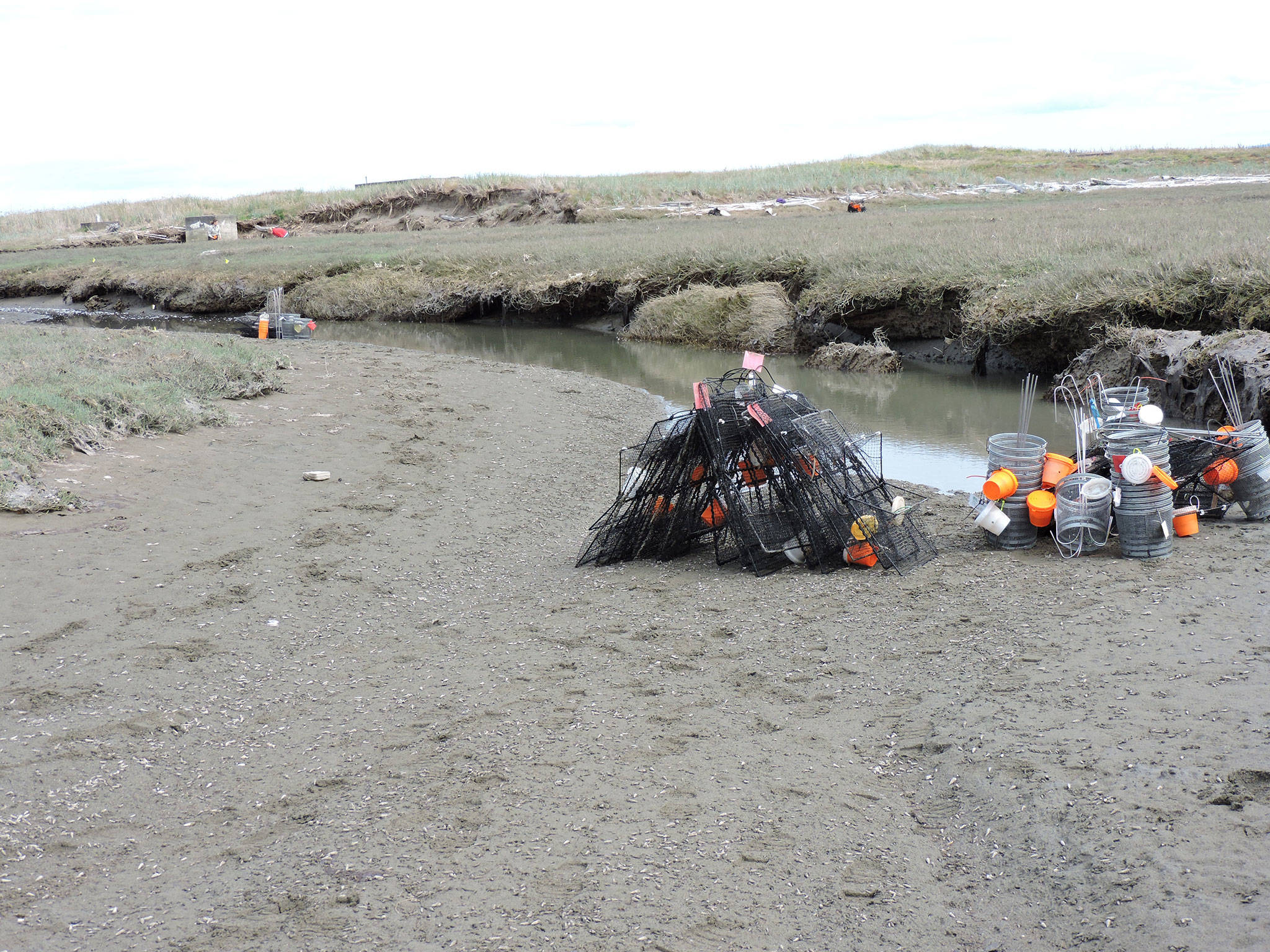
More than 100 traps have been placed on Dungeness Spit to capture European green crabs, considered one of the worst invasive species on the planet by scientists. (Lorenz Sollmann/Washington Maritime National Wildlife Refuge)
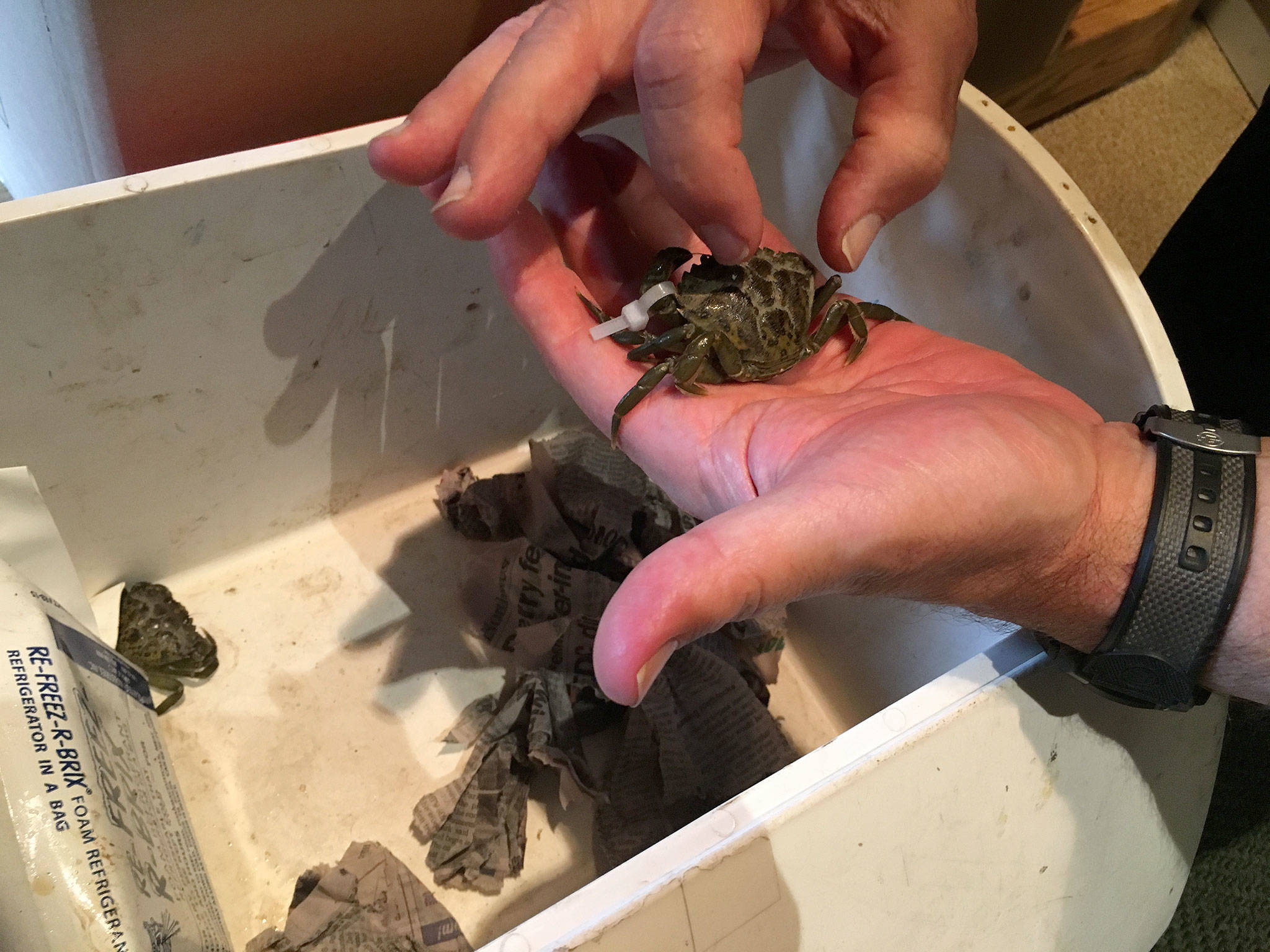
Resource managers say there are more than 100 traps out on Dungeness Spit for the European green crab, an invasive species. So far the crabs have only been caught at Graveyard Spit. (Matthew Nash/Olympic Peninsula News Group)
