
By Coral Davenport
The New York Times News Service
OLYMPIA — Billions of baby oysters in the Pacific inlets here are dying, and Gov. Jay Inslee of Washington is busy spreading the bad news.
“It used to be the canary in the coal mine,” Inslee said in a recent interview.
“Now it’s the oyster in the half shell. You can’t overstate what this means to Washington.”
Or to Inslee’s ambitions.
The Democratic governor, aided by what is expected to be millions of dollars from his billionaire friend Tom Steyer, is using the story of Washington’s oysters — scientists say a rise in carbon levels has spiked the acidity of the Pacific and is killing off shellfish — to make the case for passing the most far-reaching climate change policies in the nation.
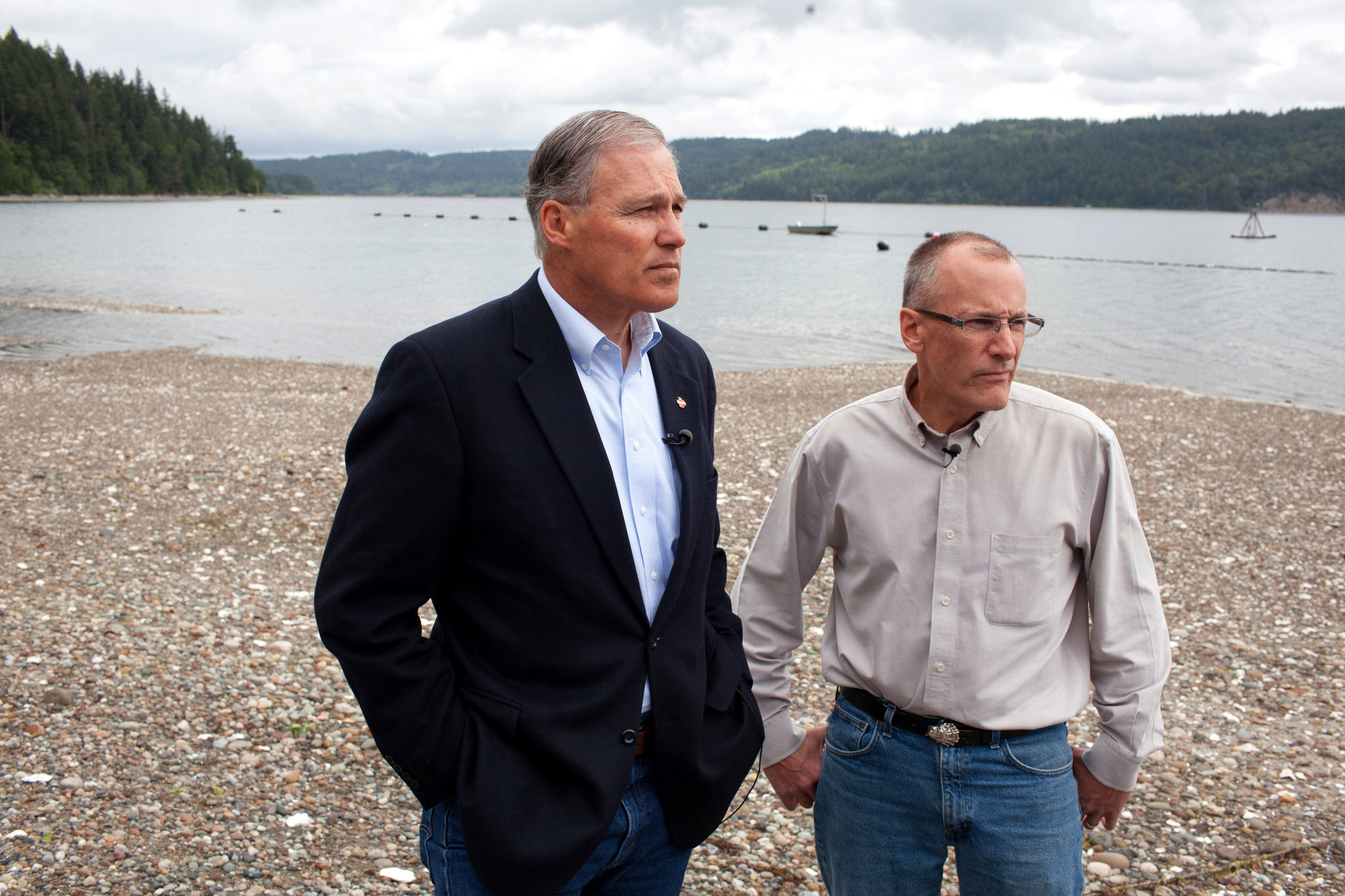
Inslee, who is campaigning for his agenda across the state this summer with oyster farmers in tow, is trying to position himself as America’s leading governor in the climate change fight.
But Inslee does not have the support of the majority of the state Senate — particularly those conservative lawmakers from the rural inland — so Steyer’s advocacy group, NextGen Climate, is working with the Washington League of Conservation Voters to handpick Democratic, pro-climate policy candidates across the state.
Steyer’s strategy is to spend heavily this fall to help defeat sitting lawmakers who oppose Inslee’s agenda and pave the way for the governor to move his policies through next year — an example, his critics say, of the insidious influence of big money from outsiders that makes local elections less local.
“We’re working to give Jay the Legislature that he needs,” said Gene Karpinski, president of the national League of Conservation Voters.
“The state senators are the obstacles.”
Inslee discussed the strategy over lunch at the governor’s mansion in May with Steyer, a retired California hedge-fund manager who has pledged to spend $100 million on climate issues in elections across the country this year.
Inslee makes no apologies for Steyer’s efforts on his behalf.
“Having a change in the state Senate would be a quantum shift in our ability to move forward,” Inslee said.
His plans, embraced by his liberal base in Seattle, include setting some of the toughest limits on carbon emissions in the country, joining with other states to cap carbon emissions.
Steyer has not yet named the candidates or the state Senate districts he plans to target in Washington, but his strategists are eyeing about half a dozen key seats that could tip the majority of the Senate in favor of Inslee’s agenda.
Right now, the Senate has 24 Republicans, two Democrats who caucus with the Republicans and 23 other Democrats.
Steyer has not said what he will spend in the districts, but his previous pattern indicates it will be hundreds of thousands of dollars for each candidate — a huge amount for a Washington state race.
Steyer’s money has not always bought results.
In 2013, his group spent $250,000 in a special election to try to oust Jan Angel, a Republican House member who opposes Inslee’s climate plans and was running for a state Senate seat last fall.
But Angel raised money throughout the state and won the election.
“Thank God that the people of my district were smart enough not to be purchased,” Angel said.
“When you have people with deep pockets like Tom Steyer coming in and trying to trash candidates, spending this kind of money, it’s a sad day for our democracy.”
Others are equally outraged.
“It’s ridiculous that money coming from outside the state is trying to influence our votes,” said Rick Tjoelker, an auto mechanic in Lynden who bristled at Inslee’s climate campaign.
“I’m not a fan,” Tjoelker said. “What do you mean by climate change? I don’t recognize that as a serious problem.”
Inslee said that views like Tjoelker’s have convinced him that he has to use the dying oysters — and the threat to a $270 million Pacific Northwest shellfish industry — to sound alarms about climate change for people who ordinarily might not listen.
Ocean acidification, he said, “has the same cause as climate change, but it has been unsullied with the political controversy of climate change.”
Inslee, the author of a book on renewable energy, Apollo’s Fire: Igniting America’s Clean Energy Economy, has pushed for legislation to fight global warming since he served in the U.S. House of Representatives, where he introduced a climate change bill in the House in 2005 that went nowhere.
In 2009, he pushed for a measure to create a national cap-and-trade program that would have cut carbon emissions from cars and power plants and forced companies to buy government-issued permits to pollute.
That bill passed the House but failed in the Senate.
Inslee argues that in the state of Microsoft and Boeing and where science and technology drive much of the economy, denying the science of climate change is a losing political stance.
“This is a scientifically literate state,” Inslee said.
Washington, he said, is positioned in a low-carbon economy to design and build new kinds of energy technology, like solar panels and software for the electric grid.
“It can be a jobs generator, and my state wants to get in the game,” he said.
In his recent efforts, he cites scientists who say that a global increase in carbon emissions from burning coal and oil has raised carbon dioxide levels in the oceans to unprecedented levels, translating to heavily acidic waters that are deadly to shellfish and other marine life.
A major scientific report released in May, the National Climate Assessment, found that the United States’ northwestern waters are among the world’s most acidic.
“We can attribute the problems in the oyster hatcheries to the increased carbon in the ocean,” said Terrie Klinger, a professor of marine affairs at the University of Washington.
Here in Washington’s Pacific inlets, oyster farmers are trying to adapt to the acidic waters by pumping their oyster hatcheries full of alkaline chemicals.
But scientists say the acidity levels are only going to keep rising.
“We have a nursery where we’ve set oysters continuously, but now they can’t develop a healthy shell,” said Paul Taylor, whose family has farmed oysters for five generations in Dabob Bay, a pine-fringed inlet of Hood Canal.
“Right now, it’s just hurting the babies, and in a controlled environment, we can manipulate the chemicals to get those through.
“But I don’t know at what levels of acidification the adults won’t grow. That unknown is very scary.”
Taylor, who said his 500-employee company is the largest shellfish supplier in the Pacific Northwest, said he knows the climate policies Inslee is pushing could increase his energy costs.
“I’m a businessman,” he said. “I know this could raise the cost of fuel for my boats and electricity for my buildings.
“But if this problem gets worse and our oysters can’t grow, then we just go away as a business.”
