
By Rachel La Corte
The Associated Press
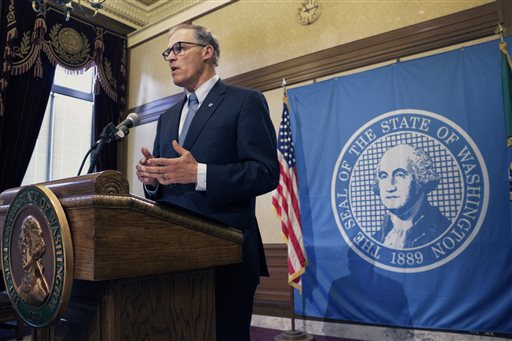
OLYMPIA — Gov. Jay Inslee on Tuesday directed the state Department of Ecology to develop a plan to cap carbon emissions in the state and to increase enforcement of existing pollution laws, saying that the state can’t wait for legislative action to address climate change.
“Carbon pollution and the climate change it causes pose a very real and existential threat to our state,” Inslee said in a written statement.
The plan to cap emissions would ensure the state met limits set by the Legislature in 2008, Inlsee’s office said. Under a law signed by then-Gov. Chris Gregoire, the state must cut greenhouse gas emissions to 1990 levels by 2020; to 25 percent below 1990 levels by 2035; and to 50 percent below 1990 levels by 2050.
Inslee has asked Ecology Director Maia Bellon to develop the reduction plan, and his office said that the rulemaking process is expected to take about a year.
The proposal differs from the cap-and-trade proposal the governor sought earlier this year because the regulatory cap would not charge emitters for carbon pollution. That proposal was strongly opposed in the Republican-controlled Senate, but it also never came up for a floor vote in the Democratic-controlled House.
Inslee wrote that the rulemaking process on the regulatory cap doesn’t prevent future legislative action for a more comprehensive program.
Also Tuesday, Inslee said he would not pursue a low-carbon fuel standard, which requires cleaner fuels over time. Under a requirement added by the Senate, a $16 billion transportation revenue package that was recently signed by the governor would have moved all fee-based funding for transit and bike paths into the main transportation account if the standard was adopted. Inslee was opposed to what he called a “poison pill,” but ultimately decided to sign the bill.
“Moving forward on a regulatory limit on pollution will ensure that Washington addresses carbon pollution and maintains a robust investment in transit, bicycle and pedestrian improvements, ferries and other important transportation choices,” the governor’s office wrote in a news release.
