
PORT ANGELES — A new forest is taking root in the former Lake Aldwell, and an increasingly worn hiking path leads the curious on a journey to explore the changing vistas.
More than a year ago, the water of the Elwha River drained from the reservoir behind the former Elwha Dam, which was completed in 1913 and removed by March 2012 as part of the $325 million Elwha River Restoration project.
Lake moonscape
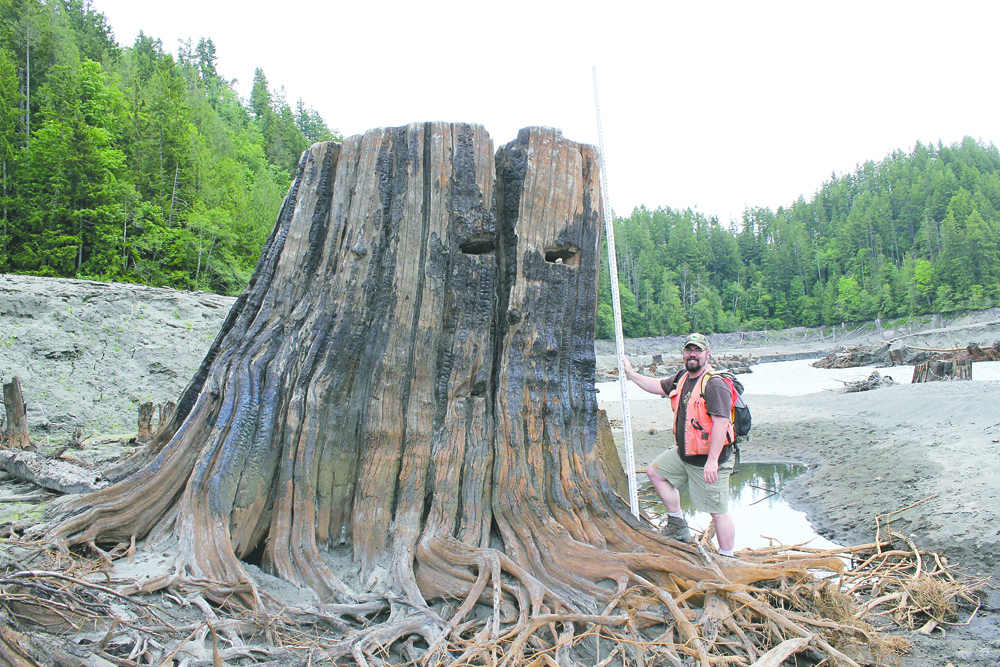
The receding water left the former lake a moonscape of bare silt, dead trees and stumps.
Now, much of it is bursting with green life.
“I’d say it’s wonderful,” said Joshua Chenoweth, revegetation manager for the Elwha River restoration effort.
Despite two of the driest summers in recorded history, millions of seedlings are thriving — both natural and those planted by crews tasked to revegetate the former Lake Aldwell, Chenoweth said last week.
A new milelong trail follows the river south into the newly green lower Lake Aldwell, north of the gooseneck curve, from the dam overlook parking lot on Lower Dam Road just off state Highway 112.
It begins at the former Lower Dam Road past the dam site, narrows to a footpath through older forested areas and snakes across the former lakebed, ending near the gooseneck.
The trail was established by restoration crews as they walked to areas to be planted.
Vegetation recovery in that area is beyond expectations but is not a surprise, Chenoweth said.
Thousands of alder, cedar, willow and maples have seeded themselves from the overhanging forest, rushes grow from the fine silt, and grasses and other native plants arrived on their own or were helped by planting crews who simply spread seed over the area, he said.
“There is a lot of diversity,” Chenoweth said.
Darwinistic survival
Out of the variety of plants present, those most adapted to emerging conditions will survive, while others will die off, he added.
The trail is easy and gently sloped, snaking between 100-year-old stumps, with side trails, small waterfalls and scenic views along the way.
An old wooden cabinet near the entrance to the trail conceals a natural spring and a cistern full of cold water, even near the end of a dry summer.
There is no plan for the future of the path, which Chenoweth said could be covered by the rapidly growing, numerous saplings unless hikers keep it clear.
The Elwha River floodplain, clearly visible from the trail, is still bare, with an active river braiding through it.
Cottonwoods are sprouting in some of the higher spots in the floodplain, which eventually will provide shelter for young fish, Chenoweth said.
“Cottonwoods are very sturdy. They are tough and fast-growing. A 2-inch seedling can have a 12-inch root system,” he said.
There has been little loss of vegetation to deer and elk browsing in the former Lake Aldwell basin, which has been somewhat of a surprise, Chenoweth said.
Dam history
Elwha Dam, which once rose 108 feet above the river canyon about 5 miles from the mouth of the Elwha River, was removed in March 2012, leaving the Elwha River to tumble freely through the narrow stone canyon.
The dam’s location is marked only by pale, blasted rock where crews removed the last bits of cement from the dam, which was built in 1912 and repaired in 1913 after the base of the dam failed.
Little remains of the 1927-built Glines Canyon Dam, which is in Olympic National Park about 8 miles upriver from Elwha Dam.
Glines Canyon Dam has been reduced from 210 feet to 60 feet, and Lake Mills is gone.
Removal of that dam is on hold while repairs are made to park water facilities that have been clogged by sediment.
Park Public Information Officer Barb Maynes said the amount of sediment released by dam removal is about what was expected but that the facilities didn’t work as they were designed to.
The Elwha River Restoration project includes the removal of the Elwha and Glines Canyon dams and restoration of habitat for the seven species of salmon native to the river and tributaries.
Replanting the barren valleys to stabilize steep slopes shades the river and provides for the protection of young fish, Chenoweth said.
Problem areas
The plants that have established themselves at the northern end of the lake are doing very well, but those south of the gooseneck and at the dam site itself are less successful, he said.
The former dam site is the most surprising for its lack of regrowth, Chenoweth said.
Despite being reseeded and replanted, very little is growing on the hill where the power station once stood.
“We don’t really know why. Maybe it is too dry,” he said.
This fall, crews will concentrate on replanting the former dam site, cutting holes for young trees in a layer of matting that was meant to protect new growth but may have smothered it instead, Chenoweth said.
Once that is done, crews will leave the lower lakebed’s new vegetation to take care of itself, then monitor its progress, he said.
Upper Lake Aldwell, including the delta and former lakebed south of the gooseneck curve, has produced mixed results in regrowth and still has large areas without growth.
“Texture is everything,” Chenoweth said.
Fine sediment slopes near the treeline show good growth and survival of both plantings and natural seedlings, but much of the lower area is sandy or rocky sediment that doesn’t hold water, he explained.
Planting in fall
Chenoweth said larger, more substantial native plants will be added this fall, hopefully before invasive weeds get into those more difficult areas.
There are stands of willow and cottonwood that are already between 8 feet and 10 feet tall, and are choking out weeds underneath them, he said.
Once complete, crews will shift efforts to the former Lake Mills, which has not had as much time to recover.
Of the 150 species classified as exotic species known to be in the area, the team has classified 33 as invasive and harmful in the revegetation zones.
The worst of those are Canada thistle and reed canary grass, which form thick mats of grass and roots that can choke out other growth, Chenoweth said.
There have been several outcroppings of canary grass, the largest of which have been treated and removed or reduced, but small patches continue to show up, he said.
Upper Lake Aldwell and the delta can be accessed from the former boat ramp area on Lake Aldwell Road off Highway 101. (See accompanying story.)
For more information about Elwha River restoration, including links to the project webcams, dam-removal blog and Elwha River Restoration Facebook page, visit the Olympic National Park website at http://tinyurl.com/Elwha-Restoration.
________
Reporter Arwyn Rice can be reached at 360-452-2345, ext. 5070, or at arwyn.rice@peninsuladailynews.com.
